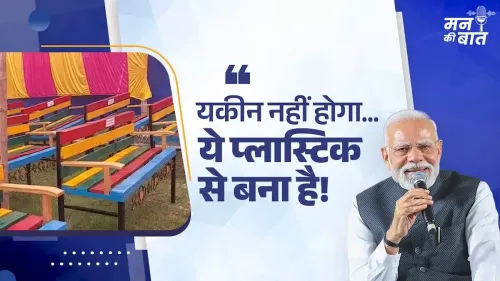
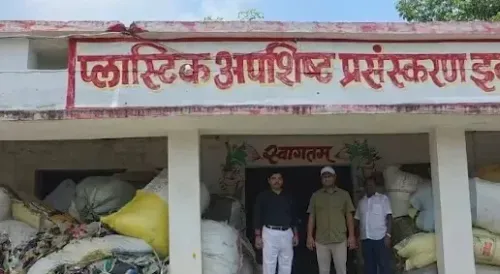
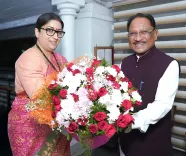
Giriraj Singh hails PM Modi's Mann ki Baat praise for Sitamarhi recycling model
Synopsis
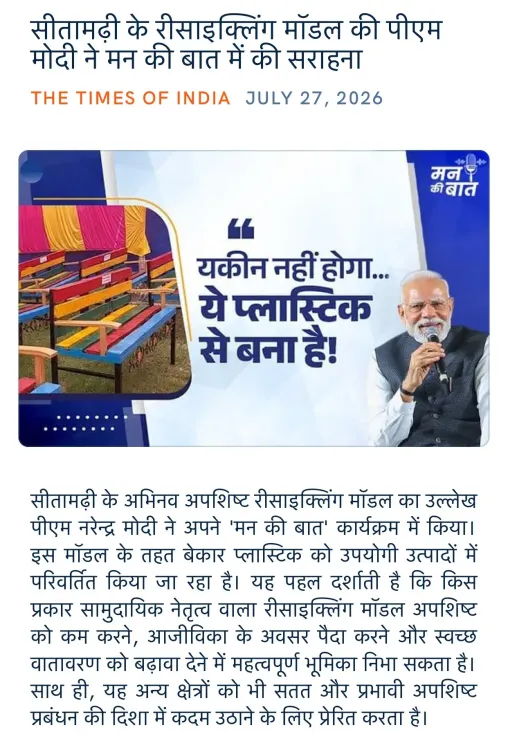
Prime Minister Modi praised Sitamarhi district's recycling model in his Mann ki Baat address, a development Union Textiles Minister Giriraj Singh amplified on 27 July 2026. The recognition spotlights Bihar's grassroots circular economy effort under the Swachh Bharat Mission framework.
Key Takeaways
Union Textiles Minister Giriraj Singh shared on 27 July 2026 that PM Modi praised Sitamarhi's recycling model in Mann ki Baat .
Mann ki Baat is a monthly radio address used by PM Modi to spotlight replicable citizen-led initiatives across India.
The recognition places Sitamarhi's grassroots recycling effort within the broader Swachh Bharat Mission framework, launched in 2014 .
Plastic Waste Management Rules (2016) provided the regulatory foundation that encouraged district-level recycling pipelines like Sitamarhi's.
Bihar districts have periodically featured in central government sustainability spotlights, and this mention could prompt replication in other districts.
Future policy steps may include formal documentation of the model and possible allocations in upcoming budgetary or state environmental plans.
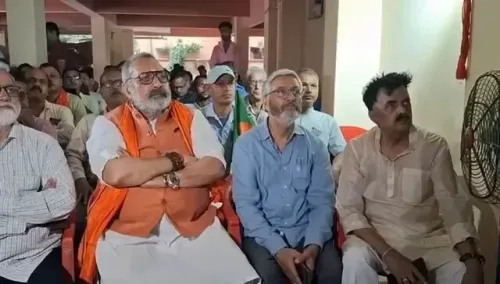
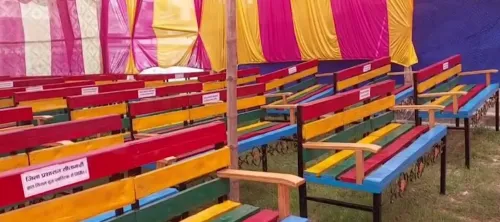
Union Textiles Minister Giriraj Singh on Monday, 27 July 2026, drew national attention to Sitamarhi district's recycling initiative after Prime Minister Narendra Modi highlighted it in his monthly radio address, Mann ki Baat. The minister shared the development on X, amplifying the recognition extended to the Bihar district's grassroots waste-management model.
Context
Mann ki Baat is a monthly radio broadcast in which Prime Minister Modi spotlights citizen-led and locally driven initiatives from across the country. The programme has over the years become a platform for the central government to elevate replicable community models in areas ranging from sanitation to rural enterprise. Sitamarhi's recycling effort receiving a mention in the broadcast signals that the district's approach has been deemed noteworthy enough for national-level visibility.
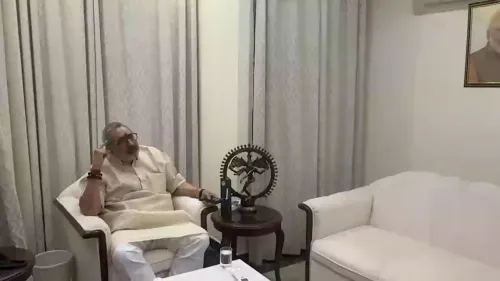
Minister Giriraj Singh, who represents Begusarai constituency in Bihar in the Lok Sabha, shared the development with evident pride, underlining the state's contribution to the country's sustainability agenda. His post on X read: 'सीतामढ़ी के रीसाइक्लिंग मॉडल की पीएम मोदी ने मन की बात में की सराहना' — translated: 'PM Modi praised Sitamarhi's recycling model in Mann ki Baat.'
Policy Backdrop
The recognition fits squarely within the framework of the Swachh Bharat Mission, launched in 2014, which has sought to institutionalise waste segregation, recycling, and sanitation practices across urban and rural India. The mission provided the policy scaffolding under which district-level recycling initiatives have taken root in states like Bihar.
Complementing this, the Plastic Waste Management Rules notified in 2016 placed further regulatory impetus on local bodies to develop structured recycling pipelines. Sitamarhi's model, by attracting Mann ki Baat mention, suggests it has advanced beyond token compliance into a demonstrable, community-embedded practice worth emulating.
Stakeholders and Impact
The immediate beneficiaries of this recognition are Sitamarhi's local administration and the community members who built and sustained the recycling model. A mention in Mann ki Baat typically generates downstream interest from other district administrations looking to replicate successful templates, potentially widening the model's footprint across Bihar and beyond.
The waste management sector also stands to benefit: national-level endorsement of a district recycling model reinforces demand for collection, processing, and circular-economy infrastructure. For Bihar, a state that has periodically featured in central government sustainability spotlights, the recognition adds to a growing portfolio of community-level implementation success stories.
What's Next
Attention will now turn to whether Sitamarhi's recycling approach is formally documented and circulated by the Ministry of Housing and Urban Affairs or state environmental agencies as a replicable blueprint. Past Mann ki Baat mentions of local models have sometimes preceded targeted allocations or technical support in subsequent budgetary cycles.
If the model gains traction, it could inform waste-management guidelines for other districts in the Gangetic plain, where recycling infrastructure remains uneven. The broader implication is that community-driven circular economy practices, when amplified through platforms like Mann ki Baat, can accelerate policy adoption at scale across India's vast rural hinterland.
Point of View
Amplifying this moment serves a dual purpose: it reinforces Bihar's developmental credentials ahead of a politically sensitive period, and it ties the state's local administration to the Prime Minister's flagship cleanliness agenda. The broader pattern of using Mann ki Baat to elevate replicable models has historically preceded policy formalization, making this mention worth tracking for downstream resource allocation. If the Sitamarhi model is formally codified, it could become a template for circular economy adoption across the Gangetic plain's underserved districts.
NationPress
25 Oct 2026
Frequently Asked Questions
What is the Sitamarhi recycling model praised in Mann ki Baat?
The Sitamarhi recycling model is a district-level waste management initiative from Sitamarhi, Bihar, that Prime Minister Modi highlighted in his Mann ki Baat radio address for its community-driven recycling practices. Specific operational details of the model have not been officially documented in the public domain as yet.
What is Mann ki Baat and why does a mention matter?
Mann ki Baat is Prime Minister Narendra Modi's monthly radio address in which he highlights citizen-led and locally driven success stories from across India. A mention in the programme typically brings national visibility to local initiatives and has historically preceded policy support or replication efforts in other districts.
Why did Giriraj Singh share this news on X?
Giriraj Singh, as a senior BJP leader and Lok Sabha MP from Bihar, shared the Mann ki Baat mention to highlight Sitamarhi district's contribution to India's sustainability agenda and to draw attention to Bihar's grassroots environmental governance efforts.
How does the Sitamarhi recycling model connect to Swachh Bharat Mission?
The Swachh Bharat Mission, launched in 2014, provided the policy and institutional framework encouraging districts to develop waste segregation and recycling practices. Sitamarhi's model is seen as an outcome of this broader national programme, supplemented by the Plastic Waste Management Rules of 2016.
Will the Sitamarhi recycling model be replicated in other Bihar districts?
A Mann ki Baat mention often generates interest from other district administrations looking to replicate successful models, and there is a possibility that Bihar's state government or the Centre may formally document and promote the Sitamarhi approach for wider adoption, though no official announcement has been made yet.