Yadav Highlights Sitamarhi's Waste-to-Wealth Model on Mann Ki Baat
Synopsis
Union Environment Minister Bhupender Yadav has praised a waste-to-wealth project in Bihar's Sitamarhi district, linking it to PM Modi's Mann Ki Baat programme and India's broader circular economy push under Swachh Bharat Mission 2.0.
Key Takeaways
Union Environment Minister Bhupender Yadav highlighted a waste-to-wealth initiative in Sitamarhi, Bihar on 27 July 2026 .
The post was tagged to #MannKiBaat , PM Modi's monthly radio address that regularly features grassroots environmental successes.
Swachh Bharat Mission (Urban) 2.0 (approved 2021 ) provides the primary policy and funding framework for such district-level waste processing projects.
Plastic Waste Management (Amendment) Rules, 2021 introduced Extended Producer Responsibility norms that incentivise waste valorisation enterprises.
Local communities, self-help groups, and waste processing enterprises in Sitamarhi are the immediate stakeholders and potential beneficiaries.
Quarterly progress reports under Swachh Bharat Mission 2.0 and Bihar's state budget allocations will determine the scalability of this model.
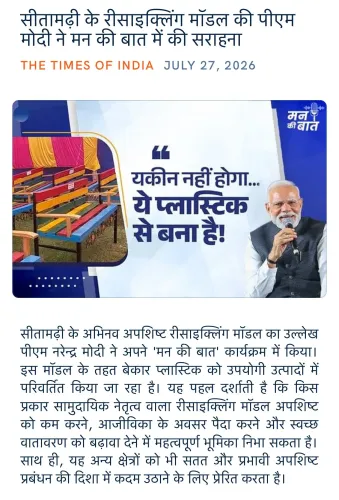
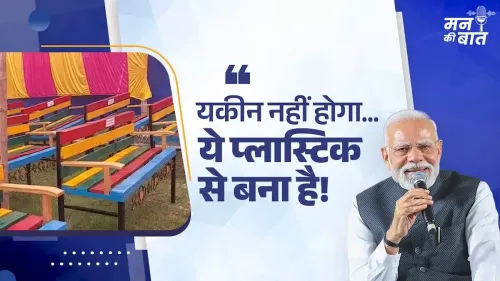
Union Environment Minister Bhupender Yadav on Sunday, 27 July 2026 spotlighted a waste-to-wealth initiative from Sitamarhi, Bihar, calling it a 'shining example' of circular economy principles in action, amplifying the story in the context of Prime Minister Narendra Modi's monthly radio programme Mann Ki Baat.
Context
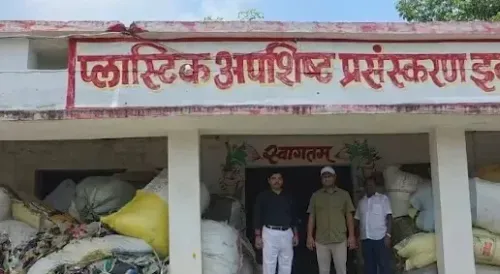
In his post on X, the Minister described the Sitamarhi project as a 'शानदार उदाहरण' ('splendid example') of the Waste to Wealth concept, tagging it to the #MannKiBaat conversation. The post accompanied a video, suggesting the initiative involves a tangible, on-the-ground operation converting waste into usable products or energy, though the precise nature of the Sitamarhi facility has not been officially detailed in public disclosures.
The reference to Mann Ki Baat is significant: the Prime Minister's radio address regularly features citizen-led or government-backed environmental successes from districts across India, and a ministerial amplification on social media typically signals that the story was either featured in or is being promoted ahead of the programme's broadcast cycle.
Policy Backdrop
The Waste to Wealth push sits within a broader policy architecture. Swachh Bharat Mission (Urban) 2.0, approved in 2021, placed scientific waste processing and material recovery at its core, allocating resources for cities and districts to build infrastructure that moves beyond landfilling. The Plastic Waste Management (Amendment) Rules, 2021 complemented this by introducing Extended Producer Responsibility frameworks, creating financial incentives for enterprises that convert waste streams into secondary raw materials.
India's commitments under the Paris Agreement and the Sustainable Development Goals also provide an international scaffolding for these domestic programmes, framing waste valorisation as both an environmental and economic imperative. Bihar, as one of India's most populous and rapidly urbanising states, represents a high-stakes testing ground for scalable waste management models.
Stakeholders and Impact
Local communities in Sitamarhi stand as the most immediate beneficiaries, with waste-to-wealth models typically generating livelihoods for waste pickers, self-help groups, and small processing enterprises. When such projects succeed, they reduce the burden on municipal landfills, lower greenhouse gas emissions from decomposing organic matter, and create a supply of recycled inputs for local industry.
Waste processing enterprises operating under the Extended Producer Responsibility framework also gain a structured market for recovered materials. Broader replication across Bihar's 38 districts could significantly alter the state's waste management footprint, provided adequate infrastructure investment and community participation are sustained.
What's Next
The next quarterly progress reports under Swachh Bharat Mission 2.0 will be a key indicator of whether district-level projects like Sitamarhi's are being tracked and scaled. Bihar's upcoming state budget allocations for waste infrastructure will also signal how seriously the state government intends to replicate such models. If the Sitamarhi initiative receives formal recognition through Mann Ki Baat, it could catalyse similar projects in other low-income districts, accelerating India's circular economy ambitions at the grassroots level.
Point of View
Elevating both the project's visibility and the BJP's environmental governance narrative ahead of state-level electoral cycles. Bihar, as a politically consequential state, makes this choice particularly pointed. The move also reflects a broader pattern of using social media to build a repository of replicable 'model' projects, effectively crowdsourcing proof-of-concept for national schemes like Swachh Bharat Mission 2.0. Whether the Sitamarhi initiative translates into a funded, scalable template or remains a one-off showcase will be the real test of policy intent.
NationPress
25 Oct 2026
Frequently Asked Questions
What is the waste-to-wealth initiative in Sitamarhi, Bihar?
It is a local project in Sitamarhi district that converts waste into usable products or energy, aligned with India's circular economy goals under Swachh Bharat Mission 2.0. The exact nature of the facility has not been officially detailed in public disclosures.
What is Mann Ki Baat and why was it mentioned?
Mann Ki Baat is Prime Minister Narendra Modi's monthly radio address that regularly spotlights citizen-led environmental and social successes from across India. Yadav's post tagged the Sitamarhi initiative to the #MannKiBaat conversation, indicating it may have been featured or is being promoted in that context.
What is India's Waste to Wealth policy?
Waste to Wealth is a government-backed concept promoting circular economy approaches to convert municipal and agricultural waste into usable products, energy, or raw materials. It is supported by Swachh Bharat Mission (Urban) 2.0 and Plastic Waste Management (Amendment) Rules, 2021.
What is Swachh Bharat Mission 2.0?
Swachh Bharat Mission (Urban) 2.0 was approved in 2021 with a focus on scientific waste processing, material recovery, and reducing landfill dependence across Indian cities and districts.
Who is Bhupender Yadav?
Bhupender Yadav is India's Union Minister of Environment, Forest and Climate Change and a senior BJP leader who frequently highlights state-level environmental projects and government schemes on social media.