PM Modi salutes India's youth as the nation's greatest present-day strength
Synopsis
Prime Minister Narendra Modi on 12 August 2026 honoured India's youth as the country's greatest present-day strength, pairing a Hindi tribute with a Sanskrit verse on serving the world through sight, mind, word, and deed — invoking both cultural continuity and modern national ambition.
Key Takeaways
Prime Minister Narendra Modi posted on 12 August 2026 calling India's youth 'the greatest strength of the present', not just the future.
He cited their 'sensitivity, spirit of service, and capability' as the force behind India's distinct global identity.
The post included a Sanskrit shloka emphasising service to the world through four means: sight, mind, word, and deed.
India has a median age of around 28 , with over 65 percent of its population under 35 — one of the world's largest youth cohorts.
The National Youth Policy (2014) and Skill India Mission (2015) form the policy backbone behind the government's youth-empowerment narrative.
The post included a video whose specific occasion could not be independently verified.
They are not just the future — they are the force shaping India right now. On Wednesday, 12 August 2026, Prime Minister Narendra Modi turned to Sanskrit scripture and a stirring call to service to honour India's youth, framing them as a generation that has already carved a distinct identity for the country on the world stage.
In a post in Hindi, the Prime Minister wrote: 'हमारे युवा साथी देश का भविष्य ही नहीं, वर्तमान की सबसे बड़ी शक्ति भी हैं।' — 'Our young companions are not just the future of the nation; they are also its greatest strength in the present.' He added that through their sensitivity, spirit of service, and capability, India's youth have built a distinct identity across the world.
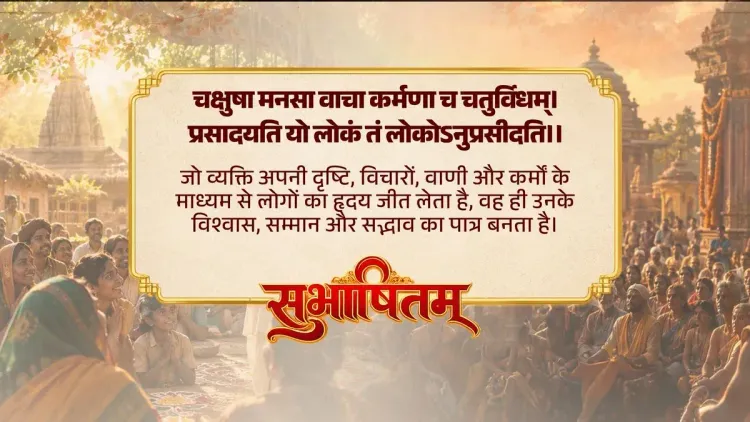
Modi then anchored the tribute in a Sanskrit shloka: 'चक्षुषा मनसा वाचा कर्मणा च चतुर्विधम् / प्रसादयति यो लोकं तं लोकोऽनुप्रसीदति।।' — 'One who pleases the world through sight, mind, word, and deed in these four ways — the world, in turn, is pleased with that person.' The verse, drawn from classical Indian thought, frames youth not merely as beneficiaries of national policy but as active, all-encompassing contributors to a harmonious society.
A demographic dividend turned into a national identity
India is home to one of the world's largest youth populations — with a median age of around 28 and over 65 percent of citizens under the age of 35. That arithmetic has long been described by economists and policymakers as a 'demographic dividend', a window of opportunity that, if harnessed, could drive decades of growth. Modi's messaging consistently transforms that statistical fact into a moral and cultural argument: India's young people are not a resource waiting to be activated — they are already delivering.
This framing has been a consistent thread across the Prime Minister's public communications. Official messaging frequently pairs contemporary themes of youth contribution with references to classical Sanskrit texts, signalling cultural continuity alongside modern ambition. The combination is deliberate: it speaks simultaneously to a generation proud of India's global rise and to a broader audience that values rootedness in tradition.
Policy scaffolding behind the tribute
The tribute does not exist in a vacuum. The National Youth Policy, revised in 2014, placed empowerment, participation, and leadership development at its centre. The Skill India Mission, launched in 2015, extended that intent into vocational training and employability — an attempt to translate the demographic dividend into measurable economic outcomes. Together, these frameworks form the policy scaffolding behind what Modi's post articulates as a lived reality: a generation of young Indians already making their mark.
The post included a video — the contents of which could not be independently verified — suggesting the message may be tied to a specific occasion, programme, or address to young volunteers or students. The broader pattern of such communications points toward upcoming youth forums, skill initiative anniversaries, or domestic policy launches as likely contexts.
A nation of 1.4 billion that has staked its century on the energy of its young: Modi's message today was less a policy announcement than a statement of faith — and a reminder that the world is watching how that faith is repaid.
Point of View
Moving the conversation from potential to demonstrated achievement. Pairing that claim with a Sanskrit shloka is a signature technique: it roots a forward-looking, globally-framed argument in classical Indian civilisational thought, broadening the emotional register of the message. Against the backdrop of the Skill India Mission and the revised National Youth Policy, the post reads as a periodic reaffirmation of the demographic-dividend thesis that has underpinned BJP governance since 2014. Watch for whether this messaging precedes a concrete policy announcement or a high-profile youth engagement event in the coming weeks.
NationPress
12 Aug 2026
Frequently Asked Questions
What did PM Modi say about India's youth on 12 August 2026?
Prime Minister Modi said India's youth are not just the nation's future but its greatest present-day strength, praising their sensitivity, spirit of service, and capability for building India's global identity.
What is the Sanskrit shloka PM Modi quoted in his youth post?
Modi quoted: 'Chakshushaa manasaa vaachaa karmanaa cha chaturvidham / Prasaadayati yo lokam tam loko'nupraseedati' — meaning one who pleases the world through sight, mind, word, and deed is, in turn, embraced by the world.
What is India's youth population percentage?
Over 65 percent of India's population is under the age of 35 , with a median age of around 28 , making it one of the largest youth populations in the world.
What is the Skill India Mission?
The Skill India Mission was launched in 2015 to provide vocational training and improve the employability of India's youth, forming a key part of the government's demographic-dividend strategy.
Why does PM Modi often quote Sanskrit in his speeches and posts?
Modi's use of Sanskrit verses is a deliberate communication strategy that pairs contemporary policy themes with classical Indian thought, signalling cultural continuity and appealing to audiences who value both modern ambition and traditional roots.