PM Modi Shares Sanskrit Shloka on Sun and Radiance
Synopsis
Prime Minister Narendra Modi shared a Sanskrit verse on 14 July 2026 describing the inseparable bond between the sun and its radiance. The post continues his consistent practice of amplifying India's classical heritage on social media, complementing the National Education Policy 2020's emphasis on Sanskrit in curricula.
Key Takeaways
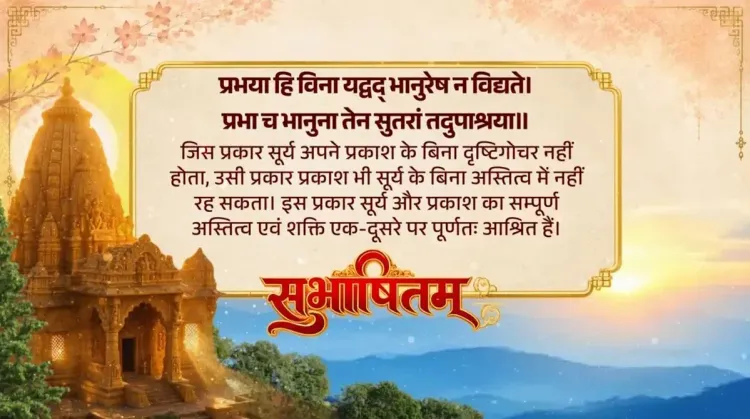
Prime Minister Narendra Modi posted a Sanskrit shloka on X on 14 July 2026 , accompanied by a video.
The verse describes the mutual dependence of the sun ( bhanu ) and its radiance ( prabha ), drawn from classical Indian textual traditions.
The post is part of a consistent pattern of cultural messaging by the Prime Minister, independent of any specific policy announcement.
The National Education Policy 2020 provides the institutional backdrop, mandating promotion of Sanskrit in school and higher education.
With one of the largest social media followings among world leaders, PM Modi's Sanskrit posts reach a wide audience and amplify classical language visibility.
Prime Minister Narendra Modi on Tuesday, 14 July 2026, shared a classical Sanskrit verse on X, invoking the imagery of the sun and its radiance to illustrate the principle of mutual dependence — continuing his periodic practice of amplifying India's civilisational heritage through social media.
The Verse
The shloka posted by Prime Minister Modi reads: 'प्रभया हि विना यद्वद् भानुरेष न विद्यते। प्रभा च भानुना तेन सुतरां तदुपाश्रया॥' Translated, it conveys: 'Just as the sun cannot exist without its radiance, so too does the radiance depend entirely upon the sun — each is the refuge of the other.' The verse draws from classical Indian textual traditions and encapsulates the philosophical concept of inseparable, co-constitutive relationships.
The post was accompanied by a video, though the specific occasion or visual content tied to the upload could not be independently verified at the time of publication.
Context
Prime Minister Modi has made the sharing of Sanskrit shlokas a recognisable feature of his social media presence, using such posts to foreground India's ancient knowledge systems independent of any immediate policy announcement. These posts serve as standalone cultural messaging, distinct from governance updates or scheme launches. The choice of a verse on the sun — bhanu — and its radiance — prabha — carries layered resonance in classical Indian philosophy, where the relationship between a source and its expression is a recurring theme in texts ranging from the Upanishads to later Sanskrit poetry.
Policy Backdrop
The promotion of Sanskrit and classical Indian knowledge systems has an institutional anchor in the National Education Policy 2020, which explicitly included provisions to integrate Sanskrit into school and higher education curricula. The policy positioned classical languages not as archaic relics but as living repositories of scientific, philosophical, and literary thought. Prime Minister Modi's cultural posts on social media complement this institutional push by keeping classical language visible in everyday public discourse.
India's Ministry of Education and bodies such as the Rashtriya Sanskrit Sansthan have in parallel expanded outreach programmes aimed at making Sanskrit more accessible to younger generations, aligning with the broader civilisational emphasis the current administration has maintained since 2014.
Stakeholders and Impact
The post reaches a vast audience: Prime Minister Modi's X account commands one of the largest followings of any world leader, meaning even a single shloka post achieves wide cultural circulation. Scholars, students of Sanskrit, and cultural organisations frequently engage with such content, amplifying its reach beyond the Prime Minister's direct follower base. For the classical-language community in India, such high-profile endorsements carry symbolic weight, lending visibility to a language that institutional surveys have found is studied by a small but growing number of learners.
What's Next
Observers of the government's cultural communication strategy will watch whether verses or themes of a similar nature surface at national cultural events or during any forthcoming review of education policy implementation later in 2026. The consistent pattern of Sanskrit posts suggests this is a deliberate, long-term cultural signalling effort rather than a response to any single event — one likely to continue as a thread woven through the Prime Minister's broader public communication.
Point of View
Making it broadly shareable across ideological lines. Seen alongside the National Education Policy 2020, these posts suggest a deliberate two-track strategy: institutional reform through policy and cultural reclamation through everyday public communication. The consistency of this pattern over several years indicates it is a considered long-term communication posture, not incidental.
NationPress
14 Jul 2026
Frequently Asked Questions
What Sanskrit shloka did PM Modi post on 14 July 2026?
PM Modi posted the verse 'प्रभया हि विना यद्वद् भानुरेष न विद्यते। प्रभा च भानुना तेन सुतरां तदुपाश्रया॥', which translates to: 'Just as the sun cannot exist without its radiance, so too does the radiance depend entirely upon the sun — each is the refuge of the other.'
Why does PM Modi share Sanskrit shlokas on social media?
PM Modi shares Sanskrit verses as part of a consistent cultural messaging strategy that underscores India's civilisational heritage. These posts complement formal policy initiatives such as the National Education Policy 2020, which promotes Sanskrit in schools and universities.
What does the Sanskrit word 'bhanu' mean?
'Bhanu' (भानु) is a classical Sanskrit word for the sun. In the verse posted by PM Modi, it is paired with 'prabha' (प्रभा), meaning radiance or light, to illustrate their inseparable, co-dependent relationship.
How does the National Education Policy 2020 relate to Sanskrit promotion?
The National Education Policy 2020 explicitly included provisions to integrate Sanskrit and other classical languages into school and higher education curricula, positioning them as living repositories of scientific and philosophical knowledge rather than archaic subjects.
Has PM Modi shared Sanskrit verses before?
Yes, Prime Minister Modi has periodically shared Sanskrit shlokas on X and other platforms over several years, making it a recognisable feature of his social media presence and part of a broader emphasis on India's classical knowledge systems.