India port container traffic to hit 40 million TEUs by FY30
Synopsis
India's ports expect container volumes to grow from 25.7 million to about 40 million TEUs by FY30, a faster pace than the past six years. A new 2-million-TEU terminal at Tamil Nadu's Kamarajar Port is part of the plan. The port's existing terminal is already running at 88% capacity.
Key Takeaways
Indian port container traffic grew at a 6.9% CAGR between FY2019–20 and FY2025–26 , reaching 25.7 million TEUs .
Container traffic is projected to reach about 40 million TEUs by FY 2030 .
Major port capacity rose from 873 MTPA in FY2014–15 to 1,728 MTPA in FY2025–26.
A second container terminal at Kamarajar Port will add 2 million TEUs of capacity and handle ships of up to 24,346 TEUs .
The port's first terminal ran at about 88% of its 0.8 million TEU capacity in FY2025–26.
KPL reported revenue of about ₹1,280 crore and profit before tax of ₹924 crore in FY2025–26.
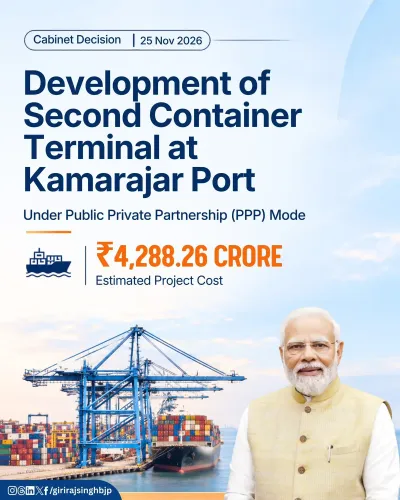
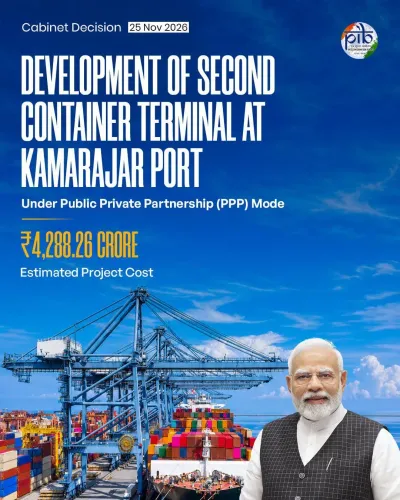
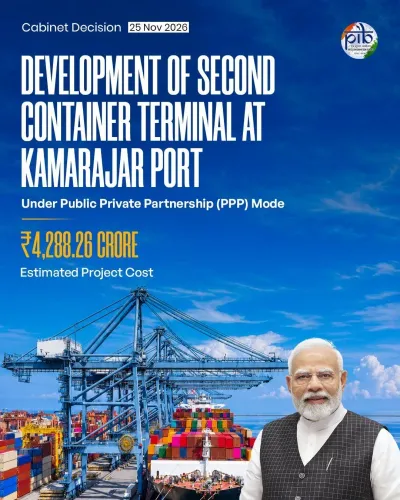
Container traffic at Indian ports is projected to reach about 40 million twenty-foot equivalent units (TEUs) by FY 2030, according to a government factsheet released in New Delhi on Saturday, 28 November 2026. Traffic grew at a compound annual growth rate (CAGR) of 6.9 per cent between FY2019–20 and FY2025–26, reaching 25.7 million TEUs. To meet the rising demand, the government has approved a second container terminal at Kamarajar Port Limited in Tamil Nadu.
A TEU is the standard unit for measuring container capacity. One TEU equals one 20-foot shipping container.
Port Capacity Has Nearly Doubled
The factsheet shows that cargo-handling capacity at India's major ports rose from 873 million tonnes per annum in FY2014–15 to 1,728 million tonnes per annum in FY2025–26. That is close to a twofold increase in just over a decade.
The projected rise from 25.7 million TEUs to 40 million TEUs within four years would need container growth well above the 6.9 per cent CAGR recorded over the previous six years. Notably, capacity additions such as the Kamarajar terminal are meant to keep infrastructure ahead of that demand curve.
Second Terminal at Kamarajar Port
The new terminal will add 2 million TEUs of annual handling capacity once it is complete. The 111-acre facility will have a terminal length of 900 metres and a berth width of 30 metres. It will also have a design draft of 18 metres and a water depth of 20 metres along the berth.
The terminal will be able to handle container vessels up to 400 metres long, with capacities of up to 24,346 TEUs. That puts it in the range of the largest ships in global container trade.
Industrial Hinterland Across Three States
The terminal is expected to serve industries in Tamil Nadu, Karnataka and Andhra Pradesh. Key industrial clusters in its catchment include Chennai–Sriperumbudur–Oragadam, Hosur, Bengaluru, Sri City and Tirupati.
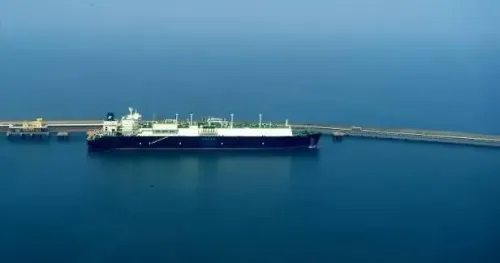
Kamarajar Port is one of India's 12 major ports and a key maritime gateway for Tamil Nadu's industrial belt. It handles a wide range of cargo, including:
- coal and petroleum products
- LNG and LPG
- containers and automobiles
- general cargo
Existing Terminal Nearing Saturation
The port's first container terminal began commercial operations in March 2018 with an annual capacity of 0.8 million TEUs. In FY 2025–26, it handled about 0.7 million TEUs, running at roughly 88 per cent of capacity. Container traffic at the port grew by around 9.9 per cent a year over five years.
The port is also financially strong, according to the official statement. “During FY 2025–26, Kamarajar Port Limited (KPL) reported revenue of around Rs 1,280 crore and profit before tax of Rs 924 crore. Over the past five years, its cargo traffic registered a CAGR of 13.64 per cent, indicating sustained growth in port activity,” the statement said.
With the existing terminal close to full use and national volumes projected to climb sharply, timely completion of the second terminal will be key to the region's export competitiveness.
Point of View
Well above the 6.9% CAGR India actually delivered over the past six years. Projections are the easy part; meeting them depends on hinterland rail and road links, customs efficiency and transshipment volumes that still largely go to Colombo and Singapore. Kamarajar's second terminal is a sensible bet, since the first is near saturation and the port is highly profitable. The real test is whether it is delivered on time and drawn into southern India's manufacturing corridors, or becomes another berth built ahead of the logistics that feed it.
NationPress
28 Nov 2026
Frequently Asked Questions
How much container traffic are Indian ports expected to handle by FY30?
Indian ports are projected to handle about 40 million TEUs of container traffic by FY 2030, according to a government factsheet. Traffic stood at 25.7 million TEUs in FY2025–26.
What is the new container terminal at Kamarajar Port?
It is a second container terminal at Kamarajar Port Limited in Tamil Nadu, approved by the government to add 2 million TEUs of annual capacity. The 111-acre facility will handle vessels up to 400 metres long, with capacities of up to 24,346 TEUs.
Which regions will the Kamarajar terminal serve?
The terminal is expected to serve industries across Tamil Nadu, Karnataka and Andhra Pradesh. This includes clusters such as Chennai–Sriperumbudur–Oragadam, Hosur, Bengaluru, Sri City and Tirupati.
How did Kamarajar Port perform in FY2025–26?
Kamarajar Port reported revenue of around ₹1,280 crore and profit before tax of ₹924 crore in FY2025–26. Its existing container terminal handled about 0.7 million TEUs, operating at roughly 88% of capacity.