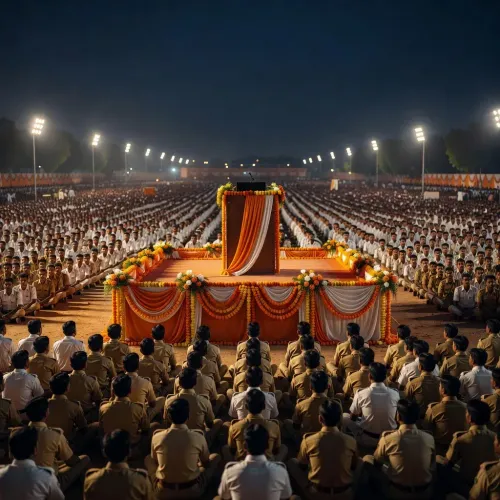
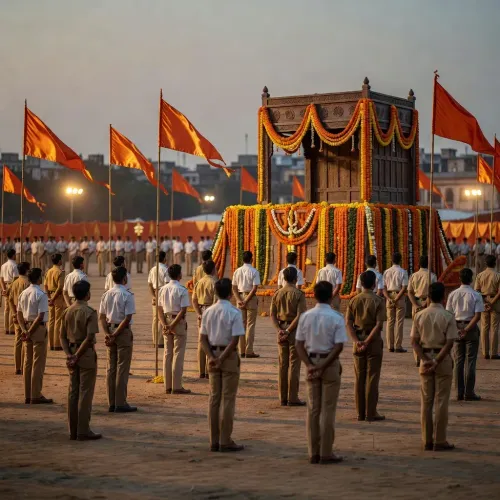
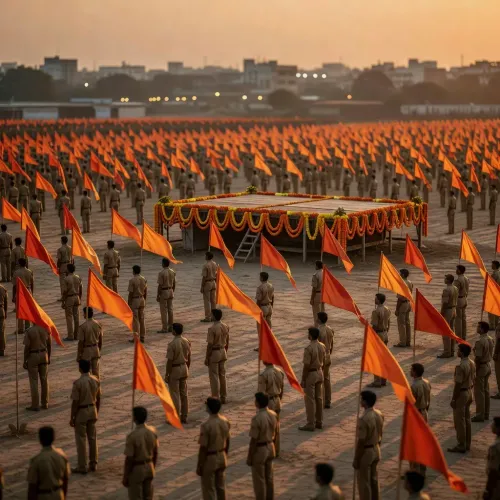
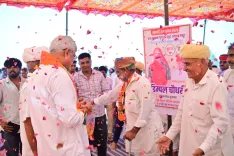
Pradhan hails Bhagwat's Vijayadashami address in Nagpur
Synopsis
Union Education Minister Dharmendra Pradhan publicly praised RSS Sarsanghchalak Dr. Mohan Bhagwat's annual Vijayadashami address in Nagpur, linking it to Atmanirbhar Bharat, social harmony, and India's civilisational role in the world.
Key Takeaways
Union Education Minister Dharmendra Pradhan endorsed RSS chief Dr.
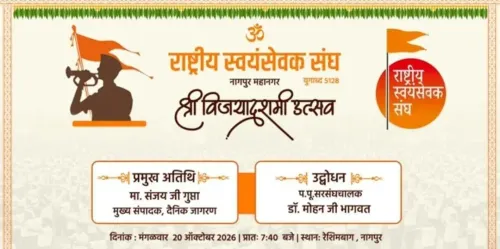
Mohan Bhagwat's Vijayadashami address delivered in Nagpur on 20 October 2026 .
The RSS was founded on Vijayadashami day in 1925 in Nagpur by K.B.
Hedgewar, making the annual address a founding-day tradition.
Pradhan explicitly connected the RSS address to Atmanirbhar Bharat , the government's self-reliance campaign launched in 2020 .
The minister highlighted RSS swayamsevaks' role in strengthening grassroots national participation ( janbhagidari ) and social cohesion.
Pradhan invoked 'Vande Mataram' as a symbol of dedication to the motherland and national unity.
India's Sanatan worldview was described as a guide toward global welfare, framing the address with civilisational soft-power significance.
Every year on Vijayadashami, the city of Nagpur becomes the ideological nerve centre of a century-old movement — and this year's address by RSS Sarsanghchalak Dr. Mohan Bhagwat has drawn an emphatic public endorsement from Union Education Minister Dharmendra Pradhan, who called the speech a fresh charge of energy for the causes of nation-building, social harmony, and a self-reliant India.
Posting on Tuesday, 20 October 2026, Pradhan wrote in Hindi that Bhagwat's 'Vijayadashami Utsav' address at Nagpur would serve as guidance for all in the direction of national service, adding that the speech touched on 'fundamental values of national life and various aspects linked to India's future.' He specifically invoked 'Vande Mataram' as an enduring inspiration for dedication to the motherland and national unity.
A tradition born on the same date in 1925
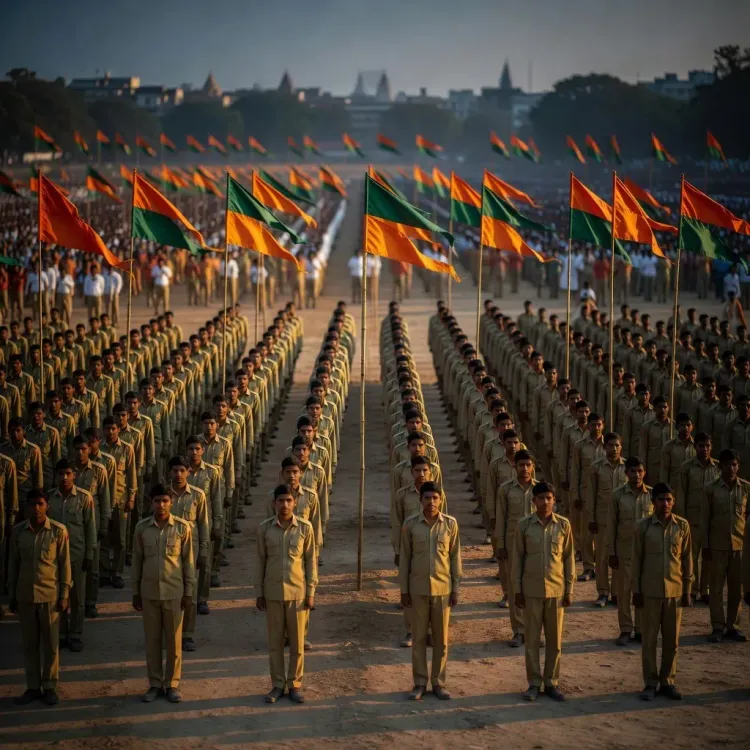
The Vijayadashami address is no ordinary speech. The Rashtriya Swayamsevak Sangh was founded on Vijayadashami day in 1925 in Nagpur by K.B. Hedgewar, making the festival both the organisation's birthday and its most symbolically loaded annual moment. Each year, the Sarsanghchalak's address from the RSS headquarters sets the tone on questions of cultural nationalism, social service, and public affairs — and is closely parsed across the political spectrum.
Dr. Mohan Bhagwat has led the organisation as Sarsanghchalak since 2009, delivering these flagship speeches through a period of sweeping political and social change in India. His addresses typically weave together themes of samajik samarasata (social harmony), volunteer service through the shakha network, and India's civilisational vision.
Atmanirbhar Bharat and the cultural-policy overlap
Pradhan's specific mention of Atmanirbhar Bharat — the self-reliance campaign launched by the Government of India in 2020 — alongside the RSS address is deliberate framing. It signals the ideological continuity the ruling BJP draws between the RSS's cultural mission and the government's economic and strategic programmes. Senior BJP ministers routinely amplify the Vijayadashami address, but Pradhan's post is notable for explicitly threading the RSS swayamsevaks' grassroots work into the larger narrative of national participation (janbhagidari).
The minister also described India's Sanatana jeevandrishti — the Sanatan worldview — as one of 'harmony and restraint' that 'shows the path of global welfare,' a phrase that broadens the address's resonance beyond domestic politics into India's growing aspiration for civilisational soft power on the world stage.
With the RSS marking another Vijayadashami at its centenary-plus headquarters and a senior Union Minister amplifying the message to a national audience, the annual Nagpur address once again lands at the intersection of culture, governance, and politics — where it has always mattered most.
Point of View
But the explicit invocation of Atmanirbhar Bharat alongside cultural themes signals an effort to fuse the organisation's civilisational mission with the government's economic-nationalist programme. Coming from the Education Minister — whose portfolio directly touches curriculum, values formation, and the National Education Policy — the framing of RSS volunteerism as a driver of 'national participation' carries particular resonance. Annually, such endorsements serve both to reinforce ideological solidarity and to present the RSS's social network as a complement to state-led development. The 'global welfare' phrasing is newer and reflects India's broader aspiration to project civilisational soft power as its geopolitical stature rises.
NationPress
20 Oct 2026
Frequently Asked Questions
What is the RSS Vijayadashami address?
The RSS Vijayadashami address is an annual speech delivered by the Sarsanghchalak at the organisation's headquarters in Nagpur on Vijayadashami day, which is also the RSS's founding anniversary. It is the organisation's most important public statement of the year, covering themes of national unity, culture, and social service.
Why does the RSS celebrate Vijayadashami as its founding day?
The Rashtriya Swayamsevak Sangh was founded on Vijayadashami day — 1925 — in Nagpur by K.B. Hedgewar , so the festival serves simultaneously as a Hindu cultural occasion and the organisation's birthday, giving the annual address special symbolic weight.
Who is Mohan Bhagwat?
Dr. Mohan Bhagwat is the Sarsanghchalak, or supreme chief, of the RSS. He has led the organisation since 2009 and delivers the flagship Vijayadashami address each year from Nagpur.
What is Atmanirbhar Bharat and why did Pradhan mention it with the RSS speech?
Atmanirbhar Bharat is a self-reliance campaign launched by the Government of India in 2020 to boost domestic production and reduce import dependence. Pradhan's mention ties the RSS's cultural-nationalist mission to the BJP government's economic-nationalist agenda, presenting them as complementary.
What did Dharmendra Pradhan say about the RSS Vijayadashami speech 2026?
Pradhan called Bhagwat's address 'energising for the resolve of nation-building, social harmony and Atmanirbhar Bharat,' praised RSS swayamsevaks for strengthening grassroots national participation, and described India's Sanatan worldview as a guide for global welfare.