Pradhan pays tribute to Shaheed Jayi Rajguru on his Jayanti
Synopsis
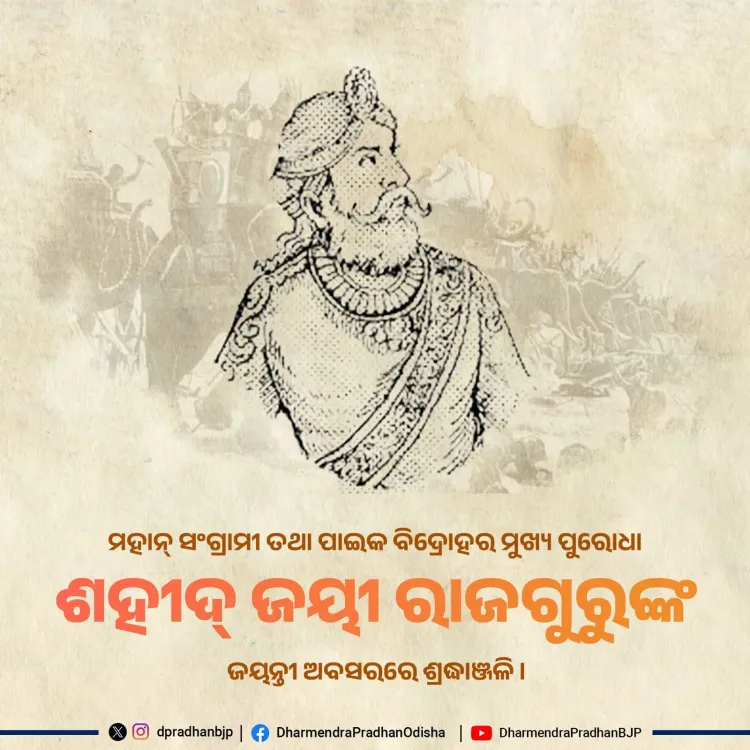
Union Education Minister Dharmendra Pradhan marked the Jayanti of Shaheed Jayi Rajguru — royal advisor to the King of Khurda and driving force behind the 1817 Paika Rebellion — calling him a great warrior and the foremost leader of one of India's earliest armed anti-colonial uprisings.
Key Takeaways
Dharmendra Pradhan paid tribute to Shaheed Jayi Rajguru on his Jayanti on November 18, 2026 .
Rajguru was the royal advisor to the King of Khurda and a key organiser of Paika resistance against the British East India Company; he was executed in 1806 .
The Paika Rebellion of 1817 , which he helped inspire, is regarded as one of India's earliest large-scale armed uprisings against colonial rule — predating the 1857 revolt by forty years.
The Government of India formally commemorated the rebellion's bicentenary in 2017 , acknowledging its significance in the national freedom struggle.
Pradhan, an Odisha MP , regularly marks birth and death anniversaries of regional freedom fighters as part of a broader effort to integrate state-specific histories into the national independence narrative.
Before the word 'rebellion' had entered the colonial lexicon in India, an Odia warrior-priest was already in chains — and would die defying British authority. On the birth anniversary of Shaheed Jayi Rajguru, Union Education Minister Dharmendra Pradhan paid tribute on Wednesday, November 18, 2026, honouring the man widely remembered as the principal architect of the Paika Rebellion.
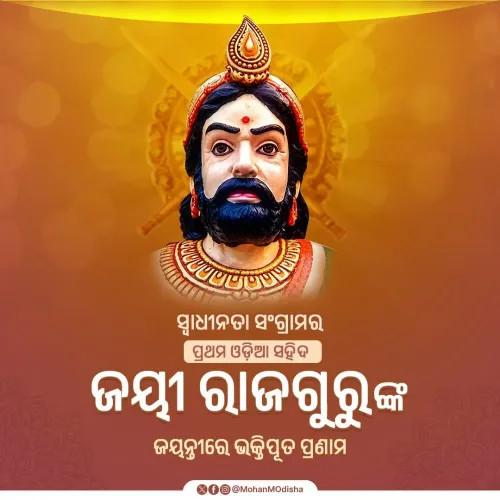
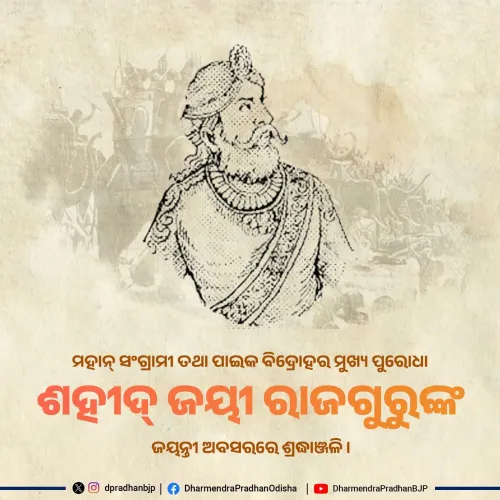
Posting in Odia on X, Pradhan wrote: 'Mahān saṅgrāmī tathā Pāika bidrohar mukhya purodha Shaheed Jayi Rajgurunkū śraddhāñjali' — offering respectful tribute to the great warrior and foremost leader of the Paika uprising on the occasion of his Jayanti.Who was Jayi Rajguru — and why Odisha remembers him
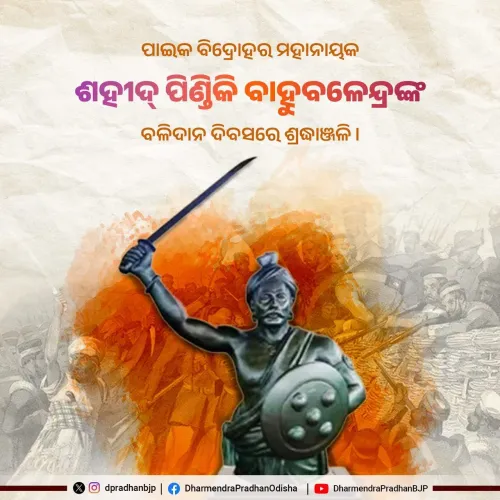
Jayi Rajguru was the royal advisor to the King of Khurda in present-day Odisha and one of the earliest armed resistors against British East India Company administration on the subcontinent. He organised the Paika warriors — a martial community that had long served Odia kings — into a force of resistance and was eventually captured and executed by colonial authorities in 1806, more than a decade before the rebellion he inspired would reach its peak. His execution did not extinguish the flame. The Paika Rebellion of 1817 — which Rajguru had helped seed — broke out as a full-scale armed uprising against British land revenue policies and their dismantling of traditional Odia power structures. It is now counted among the earliest large-scale insurrections against colonial rule in the Indian subcontinent, predating the better-known uprising of 1857 by forty years.A bicentenary, a government reckoning, and Odisha's place in the freedom story
In 2017, the Government of India marked the 200th anniversary of the Paika Rebellion with official commemorations, formally acknowledging its place in the national independence narrative — a recognition that activists and historians from Odisha had long sought. That centrepiece moment gave renewed legitimacy to the argument that India's anti-colonial struggle was never a monolithic, Delhi-centred affair. It stretched into Odia forests, coastal kingdoms, and village militias centuries before independence. Dharmendra Pradhan, an Odisha MP and senior BJP leader, has consistently used anniversaries of regional freedom fighters to anchor that argument on social media. The tribute follows a pattern among Indian ministers of regional origin — using the platform of a national portfolio to keep state-specific historical memory alive and politically relevant. Rajguru died in a colonial jail. His Jayanti is a reminder that the idea of a free India was paid for in instalments — long before anyone thought to call it a movement.Point of View
Reinforcing the BJP's connect with Odia identity ahead of any electoral cycle. The 2017 bicentenary commemoration of the Paika Rebellion gave this effort institutional backing, but social-media tributes sustain the narrative year-round. For a minister holding the education portfolio, such posts also carry an implicit policy signal — that curriculum and historical memory remain live battlegrounds for whose sacrifices get remembered and taught.
NationPress
18 Nov 2026
Frequently Asked Questions
Who was Jayi Rajguru?
Jayi Rajguru was an Odia warrior and royal advisor to the King of Khurda who organised early armed resistance against the British East India Company in Odisha. He was executed by colonial authorities in 1806 and is remembered as a key figure behind the Paika Rebellion of 1817.
What was the Paika Rebellion?
The Paika Rebellion of 1817 was an armed uprising in Odisha by Paika warriors against British East India Company rule, triggered by oppressive land revenue policies and the dismantling of traditional Odia power structures. It is considered one of the earliest large-scale anti-colonial insurrections in India.
When is Jayi Rajguru's Jayanti observed?
Jayi Rajguru's birth anniversary, known as his Jayanti, was observed on November 18, 2026, as marked by Union Education Minister Dharmendra Pradhan's tribute post. The exact standardised date of observance is a matter of regional tradition.
Why did the Government of India commemorate the Paika Rebellion in 2017?
In 2017, the Government of India held official commemorations marking the 200th anniversary of the Paika Rebellion, formally recognising it as an important chapter in India's freedom struggle and acknowledging Odisha's contribution to early anti-colonial resistance.
Why does Dharmendra Pradhan frequently post tributes to Odia freedom fighters?
Dharmendra Pradhan is an Odisha MP and senior BJP leader. As a minister with regional roots, he regularly uses his national platform to highlight Odia historical figures, keeping state-specific contributions to India's independence narrative visible in public discourse.