Pradhan joins Odisha MLAs for key rail meet in Bhubaneswar
Synopsis
Union Education Minister Dharmendra Pradhan chaired a railway infrastructure meeting in Bhubaneswar with MLAs from Angul, Pallahara, Chhendipada, and Parjang, reviewing Talcher coalfield corridors, the Talcher–Bimlagarh line, Barkot–Lapanga line, and the Talcher–Sukinda Road rail project across four Odisha districts.
Key Takeaways
Dharmendra Pradhan attended a railway-focused meeting in Bhubaneswar on 30 September 2026 with MLAs from Angul, Pallahara, Chhendipada, and Parjang constituencies.
Discussions covered rail infrastructure in Angul, Dhenkanal, Sambalpur, and Deogarh districts of Odisha.
The Inner and Outer Corridors of the Talcher Coalfields — critical for coal freight movement — were a focal point of review.
Three new rail line projects were on the agenda: Talcher–Bimlagarh , Barkot–Lapanga , and Talcher–Sukinda Road .
Talcher in Angul district is one of India's largest coalfield zones, making rail capacity there a national energy-supply concern.
The meeting reflects a consistent pattern of central BJP leaders from Odisha coordinating with state legislators on freight rail projects in mineral-rich districts.
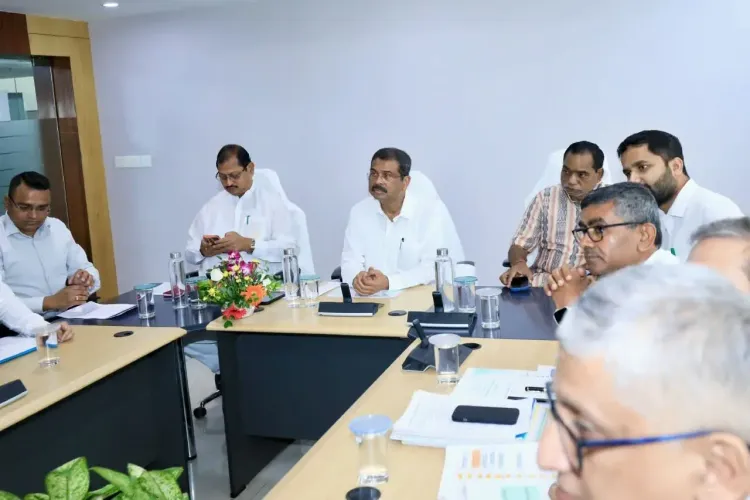
Coal corridors, new rail lines, and freight bottlenecks in Odisha's mineral heartland took centre stage on Wednesday, 30 September 2026, when Union Education Minister Dharmendra Pradhan joined legislators from Angul, Pallahara, Chhendipada, and Parjang at a railway-focused meeting in Bhubaneswar — signalling that the push to unlock eastern India's industrial logistics is very much alive at the political level.
Four districts, one freight ambition
The meeting brought together MLAs representing constituencies across Angul, Dhenkanal, Sambalpur, and Deogarh districts — a cluster that sits atop some of Odisha's densest mineral reserves. Discussions centred on strengthening existing rail infrastructure, laying new lines, and improving overall transport connectivity in the region, according to Pradhan's post on X.
The agenda was specific, not ceremonial. Participants took stock of the Inner and Outer Corridors of the Talcher Coalfields, the long-awaited Talcher–Bimlagarh new rail line, the Barkot–Lapanga new rail line, and the Talcher–Sukinda Road rail line — four projects whose progress directly determines how quickly coal and other minerals can move from pit-head to power plant or port.
Why Talcher sits at the centre of this conversation
Talcher, in Angul district, is one of India's largest coalfield zones and a critical node in the country's thermal power supply chain. Rail capacity constraints here have long been a chokepoint: when trains cannot move coal fast enough, power stations feel the strain hundreds of kilometres away. The Inner and Outer Corridor projects are designed precisely to decongest that node, separating freight flows and expanding throughput.
Central ministers from Odisha have a consistent track record of convening state legislators on rail connectivity in mineral-rich districts — these meetings feed into Ministry of Railways coordination and keep local political pressure on project timelines. Pradhan's participation, as a senior BJP leader with deep roots in Odisha, underscores the dual role such meetings play: advancing infrastructure and keeping regional stakeholders aligned.
The Barkot–Lapanga and Talcher–Sukinda lines
Beyond Talcher's coalfield corridors, the Barkot–Lapanga and Talcher–Sukinda Road alignments represent newer aspirations — rail links that would open up areas currently dependent on road transport for heavy freight. Their inclusion in the meeting's agenda suggests active follow-up on project execution rather than fresh proposal-stage discussion, though specific progress milestones from the meeting have not been independently confirmed.
The gathering reflects a broader national pattern: eastern India's freight infrastructure is being treated as a strategic priority, with new rail corridors seen as essential to feeding India's industrial and energy demands over the next decade.
If the Talcher corridors and the new lines discussed in Bhubaneswar reach completion on schedule, Odisha's mineral belt could shift from a logistics constraint to a genuine supply-chain advantage — and that outcome will be watched closely in the next round of Railways ministry reviews.
Point of View
Bridging state legislators and central ministries. The specific focus on Talcher's coalfield corridors fits squarely into the BJP-led government's broader eastern India freight push, where mineral logistics are treated as both an economic and an energy-security priority. With four districts and four named rail projects on the table, the meeting signals that political momentum behind these long-pending lines is being deliberately sustained ahead of likely Railways ministry reviews. Whether that momentum translates into accelerated project timelines will be the real test.
NationPress
30 Sept 2026
Frequently Asked Questions
What rail projects were discussed at Dharmendra Pradhan's Bhubaneswar meeting?
The meeting reviewed the Inner and Outer Corridors of the Talcher Coalfields, the Talcher–Bimlagarh new rail line, the Barkot–Lapanga new rail line, and the Talcher–Sukinda Road rail line, along with broader rail infrastructure in Angul, Dhenkanal, Sambalpur, and Deogarh districts.
Why is Talcher important for India's railway and coal infrastructure?
Talcher in Angul district, Odisha, hosts one of India's largest coalfield zones. Rail connectivity here is critical for moving coal to thermal power stations across the country, making capacity upgrades a national energy-supply priority.
Which MLAs joined Dharmendra Pradhan at the Bhubaneswar rail meeting?
Legislators from Angul, Pallahara, Chhendipada, and Parjang constituencies participated in the meeting, representing areas spanning Angul, Dhenkanal, Sambalpur, and Deogarh districts of Odisha.
What is the Barkot–Lapanga rail line project in Odisha?
The Barkot–Lapanga line is a proposed new railway link in Odisha aimed at improving freight and passenger connectivity in an area currently reliant on road transport, and it was among the projects reviewed at the 30 September 2026 meeting.
Why is Dharmendra Pradhan involved in railway matters if he is the Education Minister?
Senior central ministers who are elected from or politically rooted in a state often engage on a wide range of regional development issues — including rail and infrastructure — to coordinate between state legislators and central ministries, regardless of their specific portfolio.