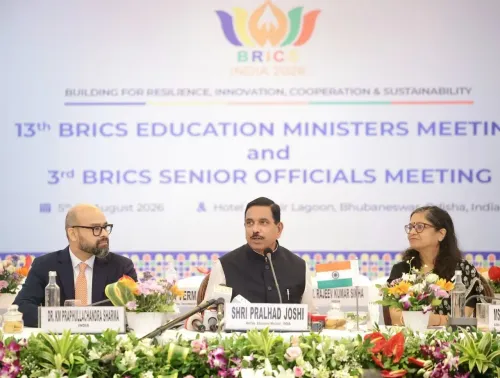
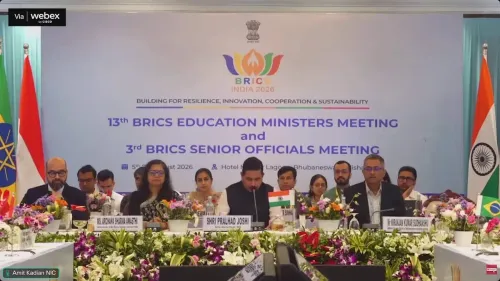
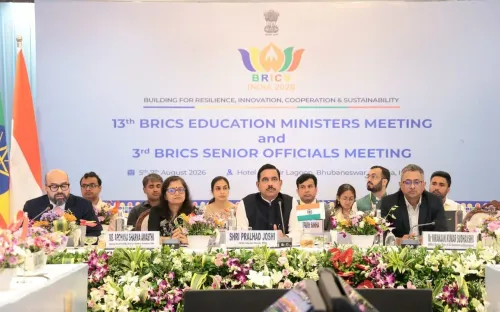
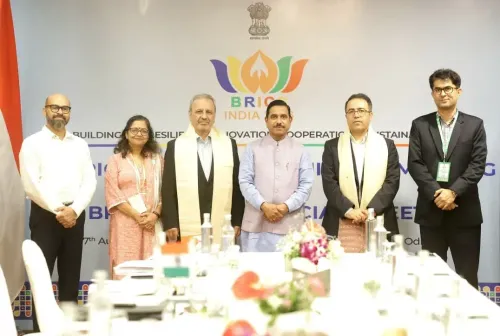
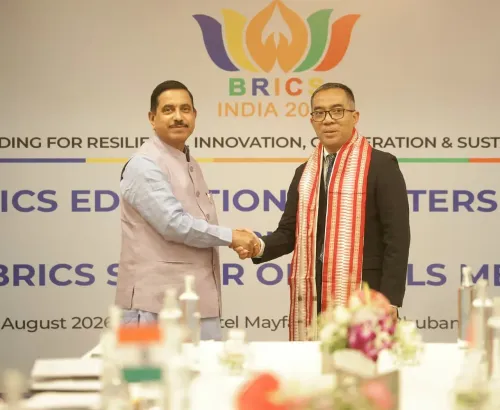
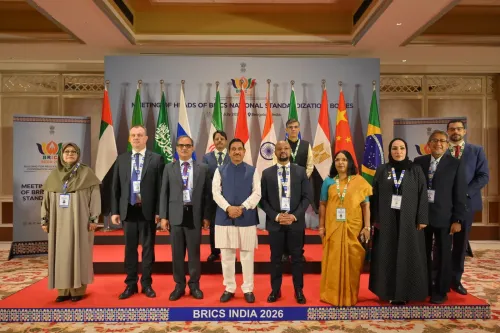
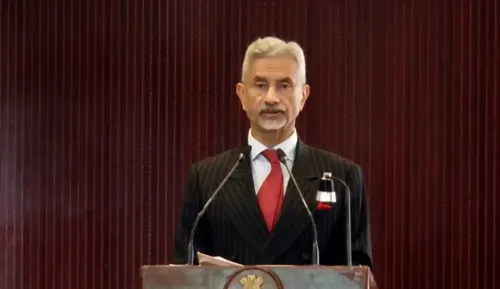
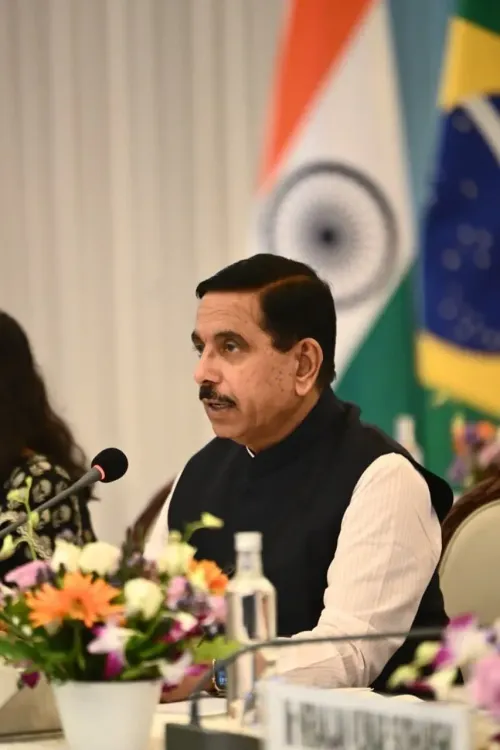
Pralhad Joshi at 13th BRICS Education Ministers' Meeting
Synopsis
Union Minister Pralhad Joshi concluded the 13th BRICS Education Ministers' Meeting on 7 August 2026, announcing the adoption of a joint declaration committing member nations to inclusive, equitable and future-ready education systems under India's 'Humanity First' philosophy.
Key Takeaways
The 13th BRICS Education Ministers' Meeting concluded on 7 August 2026 , chaired with participation from all BRICS member nations.
Member nations adopted the BRICS Education Ministers' Declaration , committing to inclusive, equitable and future-ready education systems.
India anchored its engagement in the philosophy of 'Humanity First' , framing education as a force for shared global progress.
Key pillars of the declaration include empowering learners, advancing research and innovation, and promoting academic collaboration.
The #BRICS2026 tag signals India's active role in the current BRICS cycle, building on its 2021 presidency legacy on education and skills.
Concrete follow-up mechanisms — joint research programmes, mobility schemes — will be the benchmark at the next BRICS Summit.
A joint declaration on inclusive, future-ready education systems — and India's 'Humanity First' philosophy stamped firmly at the centre of it. Union Consumer Affairs Minister Pralhad Joshi on Friday, 7 August 2026 announced the conclusion of the 13th BRICS Education Ministers' Meeting, hailing the adoption of the BRICS Education Ministers' Declaration as a landmark of collective resolve among the bloc's member nations.
What the Declaration commits BRICS nations to
The adopted declaration, as Joshi described it, reflects a shared commitment to building education systems that are 'inclusive, equitable and future-ready.' The minister credited all participating nations for their 'constructive engagement,' signalling that the document emerged from genuine multilateral consensus rather than a single nation's push. The declaration's pillars — empowering learners, advancing research and innovation, promoting academic collaboration — map directly onto the long-standing agenda of BRICS sectoral forums, which have steadily expanded beyond economic coordination into education, health and science since the bloc's early years. The idea: build institutional linkages that outlast any single summit cycle.India's 'Humanity First' framing takes centre stage
Joshi invoked India's guiding philosophy of Humanity First as the lens through which New Delhi approached the meeting — a framing that positions India not merely as a participant but as a values-anchor within the BRICS education track. It is a posture India has consistently adopted in South-South forums, using inclusive development narratives to distinguish its multilateral engagement from purely transactional diplomacy. The #BRICS2026 tag on the post points to an active Indian role in the bloc's current cycle, continuing a pattern that dates to India's 2021 BRICS Summit presidency, when education and skills development were first elevated as priority cooperation areas.What comes next for the declaration
A declaration is only as strong as its follow-through. The real test will be whether the 13th meeting's commitments translate into concrete joint research programmes, student and faculty mobility schemes, or shared credentialling frameworks — mechanisms that researchers and higher education institutions across BRICS nations are watching for. The next BRICS Summit will be the natural checkpoint for those follow-up announcements. For now, the minister's statement plants a clear flag: India intends education to be a durable pillar of BRICS cooperation, not a ceremonial agenda item.Point of View
Rather than a minister from the Education portfolio, underscores how seriously the government treats BRICS sectoral diplomacy as a whole-of-cabinet exercise. The declaration's emphasis on research, innovation and academic mobility also dovetails with India's domestic push under the National Education Policy to internationalise its higher education institutions. Whether the declaration produces binding follow-through or remains aspirational will define India's credibility as a BRICS agenda-setter in the 2026 cycle.
NationPress
7 Aug 2026
Frequently Asked Questions
What is the BRICS Education Ministers' Declaration?
The BRICS Education Ministers' Declaration is a joint document adopted by education ministers of BRICS member nations, outlining shared commitments to building inclusive, equitable and future-ready education systems, promoting academic collaboration and advancing research and innovation.
What happened at the 13th BRICS Education Ministers' Meeting?
The 13th BRICS Education Ministers' Meeting concluded on 7 August 2026 with the adoption of a joint declaration. Union Minister Pralhad Joshi represented India and reaffirmed the country's commitment to BRICS education cooperation under the 'Humanity First' philosophy.
Why was Pralhad Joshi at a BRICS education meeting?
Pralhad Joshi, Union Minister of Consumer Affairs and New and Renewable Energy, represented India at the 13th BRICS Education Ministers' Meeting, reflecting the government's whole-of-cabinet approach to multilateral sectoral diplomacy.
What is India's role in BRICS 2026?
The #BRICS2026 tag in Joshi's post signals India's active role in the current BRICS cycle. India previously held the BRICS presidency in 2021, when education and skills development were elevated as priority cooperation areas.
What does 'Humanity First' mean in India's BRICS policy?
'Humanity First' is the guiding philosophy India has invoked in multilateral forums to frame its development agenda around inclusive growth and shared global well-being, distinguishing its engagement from purely economic or transactional diplomacy.