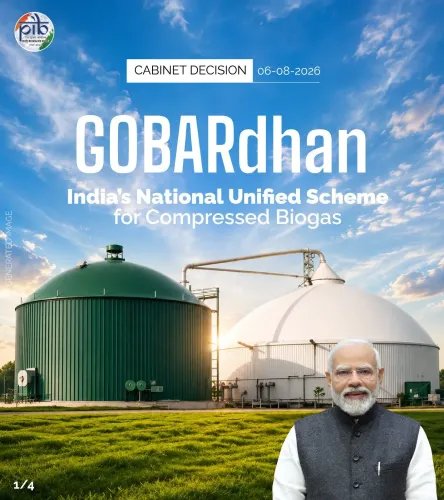
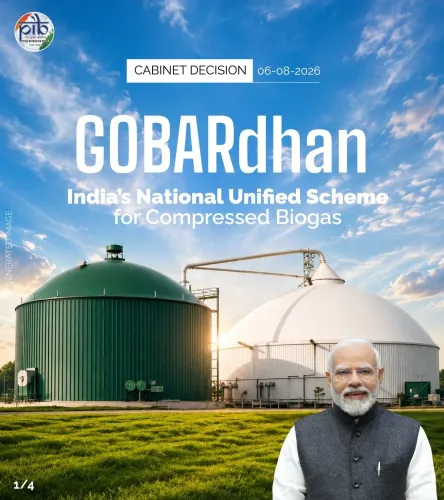
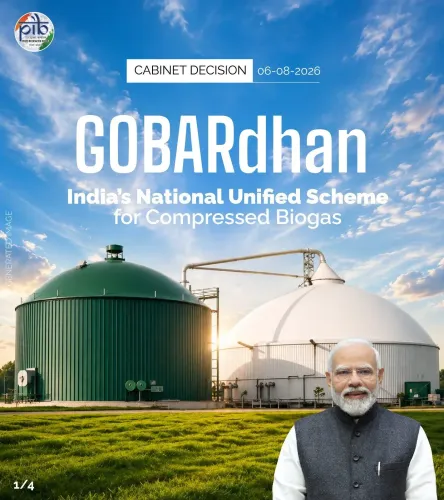
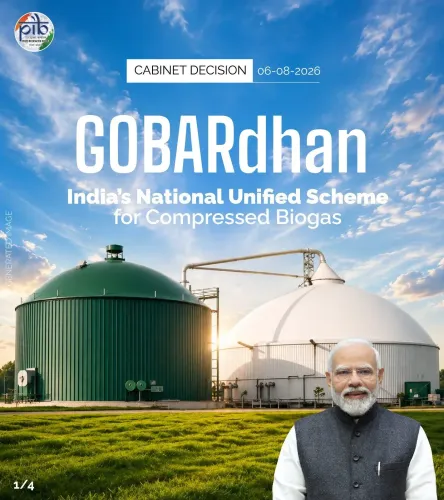
Pralhad Joshi: Cabinet clears ₹23,731 cr GOBARdhan CBG scheme
Synopsis
The Union Cabinet has approved the GOBARdhan National Unified Scheme for Compressed Biogas with a ₹23,731 crore outlay, consolidating India's fragmented biogas efforts into a single framework offering assured offtake, stable pricing, capital support, and pipeline connectivity to scale domestic clean fuel production from organic waste.
Key Takeaways
The Union Cabinet approved the GOBARdhan National Unified Scheme for CBG with an outlay of ₹23,731 crore .
The scheme provides assured offtake, stable pricing, capital support, pipeline connectivity, and access to finance for CBG developers.
It consolidates the earlier GOBAR-DHAN (2018) and SATAT (2018) initiatives into a single national framework.
Farmers and rural entrepreneurs are primary beneficiaries through new income streams from organic waste feedstock.
CBG can directly substitute Compressed Natural Gas (CNG) , advancing import substitution under Atmanirbhar Bharat .
Scheme success will depend on state implementation plans, oil marketing company offtake commitments, and private investment inflows.
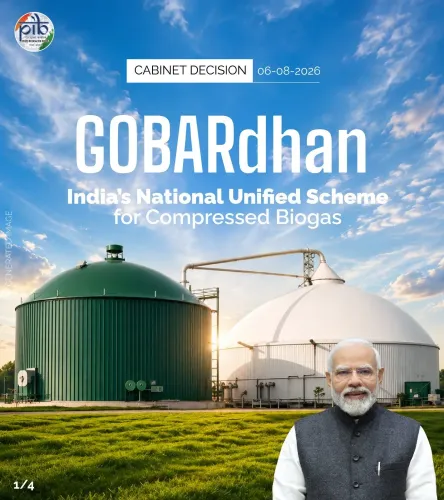
India's organic waste is about to become a national energy asset. Union Consumer Affairs Minister Pralhad Joshi announced on Thursday, 6 August 2026 that the Union Cabinet, under Prime Minister Narendra Modi, has approved the GOBARdhan National Unified Scheme for Compressed Biogas (CBG) with a total outlay of ₹23,731 crore — the most comprehensive push yet to turn cattle dung, farm residue, and municipal organic waste into clean fuel at scale.
What GOBARdhan promises farmers and rural India
The scheme is built around a five-pillar support structure: assured offtake, stable pricing, capital support, pipeline connectivity, and access to finance. Together, these address the exact bottlenecks that stalled earlier biogas efforts — developers couldn't secure buyers, banks wouldn't lend without revenue certainty, and plants sat idle without grid or pipeline links. GOBARdhan is designed to close all three gaps simultaneously.
For farmers and rural entrepreneurs, the upside is direct. Cattle dung and crop residue — historically burned or left to decompose — become feedstock with a market price. The scheme explicitly targets rural livelihood creation and farmer income augmentation, positioning CBG plants as agri-adjacent businesses that communities can own or supply.
From SATAT to a single national framework
India has tried versions of this before. The original GOBAR-DHAN scheme was launched in 2018 under the Swachh Bharat Mission (Gramin) to set up village-level biogas plants. The same year, the Ministry of Petroleum and Natural Gas launched the SATAT initiative, targeting 5,000 CBG plants with assured offtake by oil marketing companies. Both moved slowly — fragmented funding, unclear mandates, and limited private appetite kept scale elusive.
The new GOBARdhan scheme consolidates those earlier efforts into one unified national programme with a single financial architecture. The integration matters: private investors now see a single policy window rather than navigating overlapping central and state frameworks.
CBG's role in India's energy security calculus
Compressed Biogas is chemically similar to Compressed Natural Gas (CNG) and can substitute it directly in vehicles, industrial burners, and piped city gas networks. Every unit of CBG produced domestically is one less unit of imported natural gas — a direct import-substitution play under the Atmanirbhar Bharat framework. With global energy prices remaining volatile, locking in domestic renewable gas supply carries strategic weight beyond the environment ministry's brief.
Minister Joshi framed the scheme within the twin visions of 'Waste to Wealth' and Viksit Bharat — the government's overarching developed-India target for 2047. CBG sits at the intersection of rural economy, clean energy, and circular economy policy, which is precisely why the Cabinet-level approval carries cross-ministerial significance.
What the scheme's success will actually depend on
The ₹23,731 crore outlay signals intent. Execution will hinge on how quickly state governments release implementation guidelines, how aggressively oil marketing companies honour offtake commitments, and whether private CBG developers convert pipeline access into operating plants. Watch for the first round of state-level project sanctions and private investment announcements as the real test of GOBARdhan's unified architecture.
India has the organic waste. It has the rural infrastructure gap. And now it has a ₹23,731 crore national scheme to connect the two — the question is whether this time, the plants actually get built.
Point of View
731 crore on fixing execution rather than reinventing the wheel. By bundling financial, infrastructure, and market-access guarantees under one roof, the government is explicitly acknowledging that single-pillar support (offtake alone, or capital alone) failed to move private capital at scale. If the unified framework does attract serious private investment, it validates the 'policy aggregation' model that the government has also applied in solar and green hydrogen — making GOBARdhan a template to watch for future clean-energy pushes.
NationPress
6 Aug 2026
Frequently Asked Questions
What is the GOBARdhan scheme approved by the Cabinet?
GOBARdhan is India's National Unified Scheme for Compressed Biogas, approved by the Union Cabinet with a ₹23,731 crore outlay to convert organic waste — including cattle dung and farm residue — into clean compressed biogas fuel through assured offtake, stable pricing, capital support, and pipeline connectivity.
How much money has the government allocated for the GOBARdhan CBG scheme?
The Union Cabinet has approved an outlay of ₹23,731 crore for the GOBARdhan National Unified Scheme for Compressed Biogas.
What is the difference between GOBARdhan and the earlier SATAT initiative?
The original GOBAR-DHAN scheme (2018) focused on village biogas plants under Swachh Bharat Mission, while SATAT (2018) targeted 5,000 CBG plants with oil company offtake. The new GOBARdhan unified scheme consolidates both into a single national framework with integrated financial and infrastructure support.
How will the GOBARdhan scheme benefit farmers?
Farmers can sell cattle dung and crop residue as feedstock to CBG plants, creating a new income stream. The scheme also targets rural livelihood creation through biogas plant operations and supply chains in rural areas.
What is Compressed Biogas and how is it used?
Compressed Biogas (CBG) is a renewable fuel produced from organic waste that is chemically similar to Compressed Natural Gas (CNG). It can be used directly in vehicles, industrial burners, and piped city gas networks as a domestic, cleaner alternative to imported natural gas.