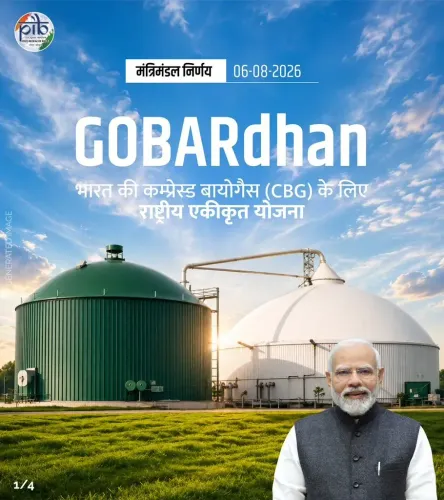
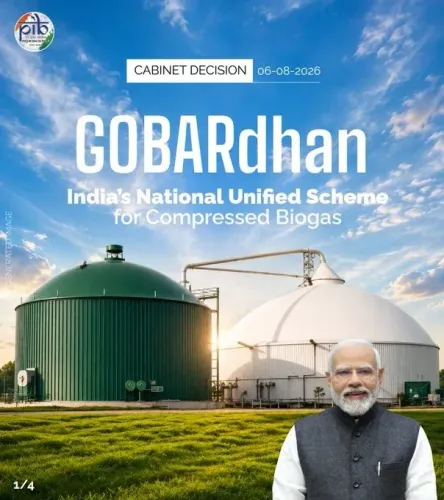
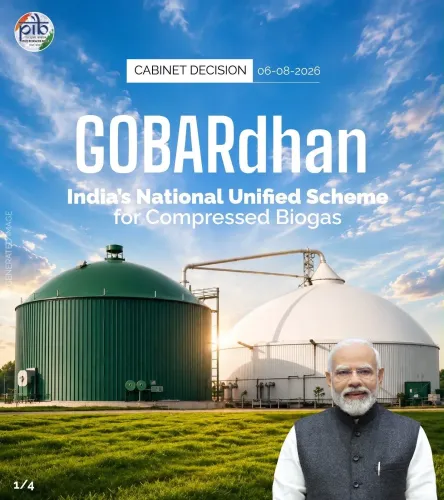
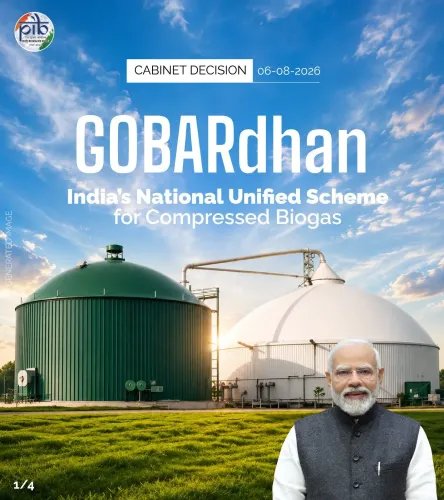
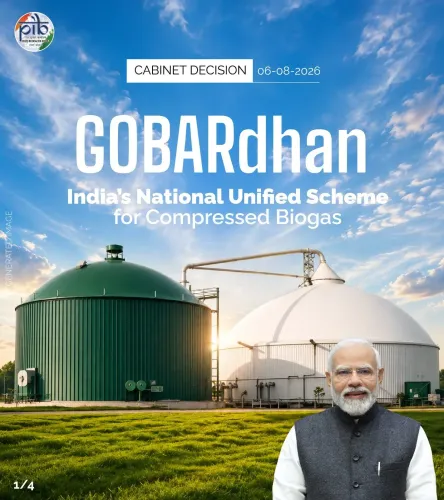
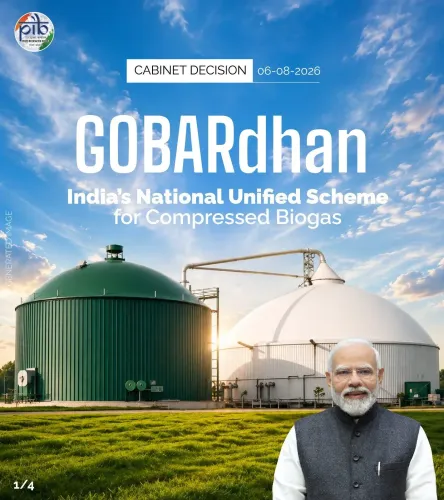
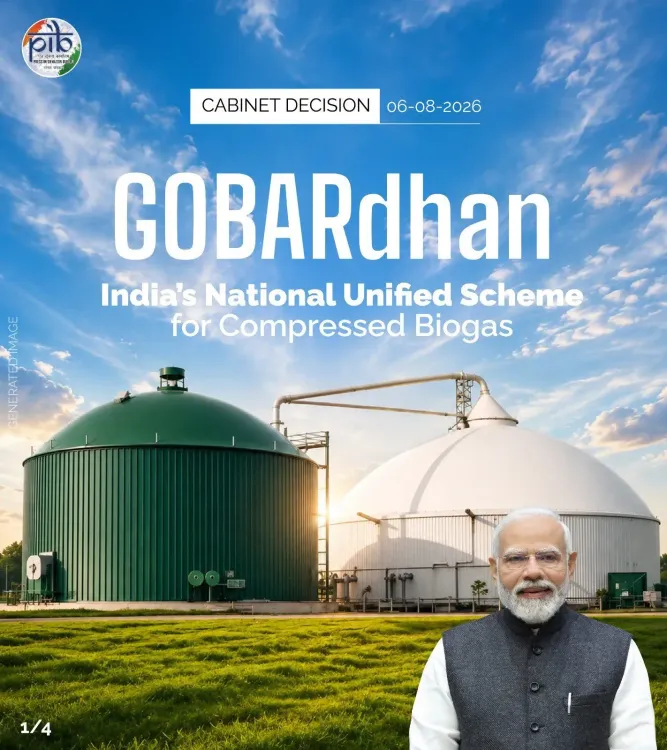
Puri hails Rs 23,731 cr GOBARdhan cabinet nod as historic CBG leap
Synopsis
The cabinet has approved a Rs 23,731 crore outlay for the GOBARdhan scheme, targeting a near-tenfold increase in Compressed Biogas production. Petroleum Minister Hardeep Singh Puri calls it a historic step linking clean energy, farmer income, and India's Atmanirbhar Bharat goals.
Key Takeaways
The cabinet has approved Rs 23,731 crore for the expanded GOBARdhan scheme , announced on 6 August 2026 .
The approval targets a nearly tenfold increase in Compressed Biogas (CBG) production across India.
GOBARdhan was originally launched in 2018 under the Swachh Bharat Mission (Gramin) to convert organic waste into biogas and bio-fertiliser.
The scheme is designed to simultaneously address farmer income, rural waste management, and fossil fuel import substitution .
The SATAT initiative (also 2018) laid the groundwork for private CBG plant investment that this expanded outlay is intended to accelerate.
State-level implementation and plant commissioning will be the key indicators of whether the sanctioned funds deliver on their targets.
India's cabinet has greenlit a Rs 23,731 crore expansion of the GOBARdhan scheme — a move Union Petroleum Minister Hardeep Singh Puri says will multiply the country's Compressed Biogas output nearly tenfold, turning cattle dung and crop waste into a pillar of national energy security.
Puri framed the approval as far more than a clean-energy headline. Writing on 6 August 2026, he described it as a 'transformative decision' that simultaneously empowers farmers, the rural economy, and energy security — and called it a concrete step toward making Prime Minister Narendra Modi's 'Waste to Wealth' vision a genuine mass movement (jan-andolan).
What the GOBARdhan scheme does — and why the scale matters
GOBARdhan — short for Galvanising Organic Bio-Agro Resources Dhan — was first launched in 2018 under the Swachh Bharat Mission (Gramin) to convert livestock dung and organic agricultural waste into biogas and bio-fertiliser for rural households. The same year, the government's SATAT initiative extended that logic to compressed biogas as an alternative transport fuel, inviting private players to set up CBG plants across the country.
The fresh cabinet sanction supercharges both tracks. A near-tenfold jump in CBG production — if delivered — would place India among the world's most ambitious biogas economies, dramatically reducing dependence on imported fossil fuels while giving farmers a new revenue stream from waste they currently burn or discard.
The rural income angle the minister is betting on
Puri was explicit that this is not a standalone energy play. The scheme's architecture routes payments to farmers and rural aggregators who supply organic feedstock to CBG plants, creating an income loop that the Ministry of Petroleum and Natural Gas has positioned as an Atmanirbhar Bharat cornerstone. For villages where stubble-burning remains a seasonal air-quality crisis, the financial incentive to channel that waste into biogas plants carries an environmental dividend as well.
Progress on actual plant commissioning and state-level uptake of the sanctioned outlay will be the real test of whether the cabinet's ambition translates into kilowatt-hours and farmer income on the ground.
India has staked its bioenergy credibility on exactly this kind of integrated model — waste management, rural income, and import substitution wrapped into one scheme. The Rs 23,731 crore bet is now live. The clock is running.
Point of View
Signalling that bioenergy has graduated from pilot-scheme status to mainstream energy policy. By tying CBG expansion explicitly to farmer income and rural waste management, the government is attempting to build a political constituency for clean energy beyond urban consumers. The Rs 23,731 crore outlay also reflects a deliberate import-substitution calculus — every unit of domestic CBG offsets LNG or CNG imports, strengthening the Petroleum Ministry's energy-security brief. Whether state governments can absorb and implement the sanctioned funds at pace will determine if this becomes a landmark or another ambitious scheme that under-delivers on rollout.
NationPress
20 Sept 2026
Frequently Asked Questions
What is the GOBARdhan scheme?
GOBARdhan (Galvanising Organic Bio-Agro Resources Dhan) is a central government scheme launched in 2018 under Swachh Bharat Mission (Gramin) that converts cattle dung and agricultural waste into biogas and bio-fertiliser, benefiting rural households and farmers.
How much money has been approved for GOBARdhan in 2026?
The cabinet has approved an outlay of Rs 23,731 crore for the expanded GOBARdhan scheme, as announced by Petroleum Minister Hardeep Singh Puri on 6 August 2026.
What is Compressed Biogas (CBG) and how is it different from regular biogas?
Compressed Biogas is biogas that has been purified and compressed to a pressure suitable for use as a transport fuel, similar to CNG. It is produced from organic waste including cattle dung and crop residue, making it a renewable alternative to fossil fuels.
How will GOBARdhan benefit farmers?
The scheme creates a payment mechanism for farmers who supply organic feedstock — including livestock waste and crop residue — to CBG plants, generating additional rural income while reducing the practice of stubble-burning.
What is India's SATAT initiative?
SATAT (Sustainable Alternative Towards Affordable Transportation) was launched in 2018 to encourage private investment in Compressed Biogas plants across India, positioning CBG as an affordable alternative transport fuel and complementing the GOBARdhan scheme.