Pralhad Joshi: Exam malpractice amendment clears Parliament

Synopsis
Parliament passed the Public Examinations (Prevention of Unfair Means) Amendment Bill 2026 in both Lok Sabha and Rajya Sabha on 30 July, strengthening the 2024 anti-paper-leak Act with stricter enforcement provisions. Union Minister Pralhad Joshi warned that anyone tampering with students' futures will face the harshest action.
Key Takeaways
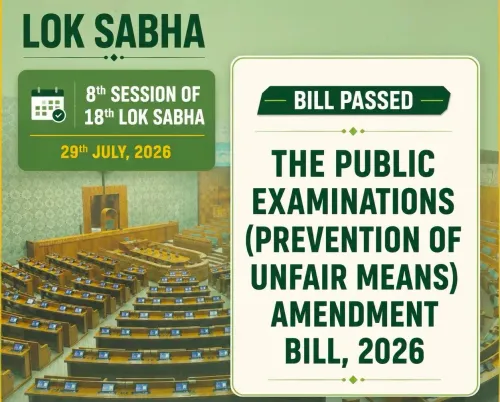
The Public Examinations (Prevention of Unfair Means) Amendment Bill 2026 was passed by both Lok Sabha and Rajya Sabha on 30 July 2026 .
The amendment strengthens the original Public Examinations (Prevention of Unfair Means) Act, 2024 , which was enacted in February 2024 following the NEET and UGC-NET paper leak controversies.
Union Minister Pralhad Joshi announced the passage and warned of the 'strictest possible action' against anyone engaging in exam malpractice.
The law covers major national examinations conducted by bodies including UPSC , SSC , and NTA .
Gazette notification and implementation rules will be the next critical steps before the amended provisions take effect.
Millions of students preparing for India's fiercely competitive public examinations got a significant legislative shield on Thursday, 30 July 2026, as both houses of Parliament passed the Public Examinations (Prevention of Unfair Means) Amendment Bill 2026 — tightening a law that was already born out of crisis.
Union Minister Pralhad Joshi announced the development on X, posting in Kannada that the bill had cleared both Lok Sabha and Rajya Sabha in a single day. 'Let one thing be clear,' he wrote: 'Anyone who attempts to play with the futures of students or engages in examination malpractice will face the strictest possible action — and will not be spared under any circumstances.'
A 2024 law forged in the heat of NEET and UGC-NET scandals
The amendment builds on the Public Examinations (Prevention of Unfair Means) Act, 2024, which Parliament passed in February 2024 in direct response to a string of paper leak controversies — most visibly the NEET-UG and UGC-NET debacles that erupted mid-2024 and triggered nationwide protests. That original law created new categories of offences and stiff penalties targeting paper leaks, impersonation, and organised cheating rings that exploit bodies such as UPSC, SSC, and the NTA.
The 2026 amendment, according to Joshi's post, goes further — introducing what the minister described as 'even stricter rules' to make enforcement more effective. The goal, he said, is to ensure public examinations are 'fair, transparent, and merit-based,' and to protect the dreams and futures of crores of aspirants.
Why Parliament moved again, two years on
The 2024 Act was a landmark, but implementation exposed gaps: enforcement mechanisms needed sharper teeth, and the scale of organised malpractice — involving coaching networks, middlemen, and digital cheating tools — kept evolving. Examination integrity has become a first-order governance issue in India, where a single recruitment exam can draw tens of millions of applicants and a leaked paper can derail careers and trigger political crises simultaneously.
The amendment's passage through both chambers in one session signals a rare legislative consensus on the issue. What follows now is equally important: the gazette notification of the amended Act and the framing of implementation rules by the designated agencies will determine how quickly the tougher provisions bite on the ground.
For the crores of students who sit for UPSC, SSC, and NTA-conducted exams each year, the message from Parliament on Thursday was unambiguous — the state is raising the cost of cheating, and it intends to make that cost felt.
Point of View
However, will be in implementation: whether the new enforcement mechanisms translate into actual prosecutions, or whether the law remains a deterrent on paper while organised cheating networks adapt. For the BJP, keeping examination integrity on the front burner also serves a broader narrative of governance accountability ahead of state electoral cycles.
NationPress
30 Jul 2026
Frequently Asked Questions
What is the Public Examinations (Prevention of Unfair Means) Amendment Bill 2026?
It is a parliamentary amendment to the 2024 Act of the same name, passed by both Lok Sabha and Rajya Sabha on 30 July 2026, introducing stricter enforcement provisions to prevent paper leaks and malpractice in national public examinations.
Which exams does the Public Examinations (Prevention of Unfair Means) Act cover?
The 2024 Act covers examinations conducted by central bodies including UPSC, SSC, and NTA — which run high-stakes tests such as UPSC Civil Services, SSC CGL, NEET-UG, and JEE.
Why was the 2024 law amended so soon?
The 2024 Act was passed after the NEET-UG and UGC-NET paper leak controversies. The 2026 amendment tightens enforcement mechanisms where gaps were identified in the original law's implementation.
What did Pralhad Joshi say about the amendment bill?
Joshi said the bill aims to make public examinations fair, transparent, and merit-based, and warned that anyone who engages in examination malpractice or tampers with students' futures will face the strictest possible action without exception.
What happens after Parliament passes the amendment bill?
The bill must receive Presidential assent and be notified in the Official Gazette before it becomes law. Implementation rules will then be framed by the Ministry of Education or the designated examination bodies.