Trump to Announce Plan Replacing Illegal Alien CDL Holders With Veterans
Synopsis
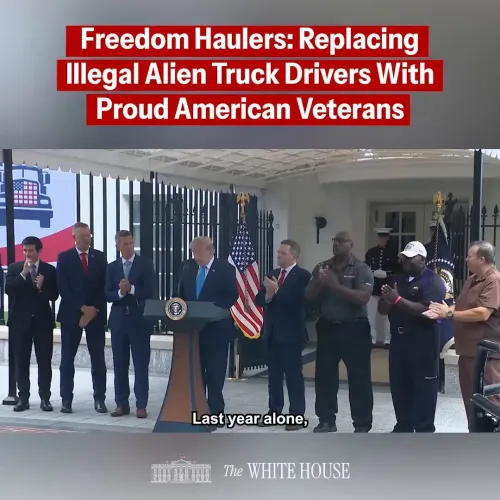
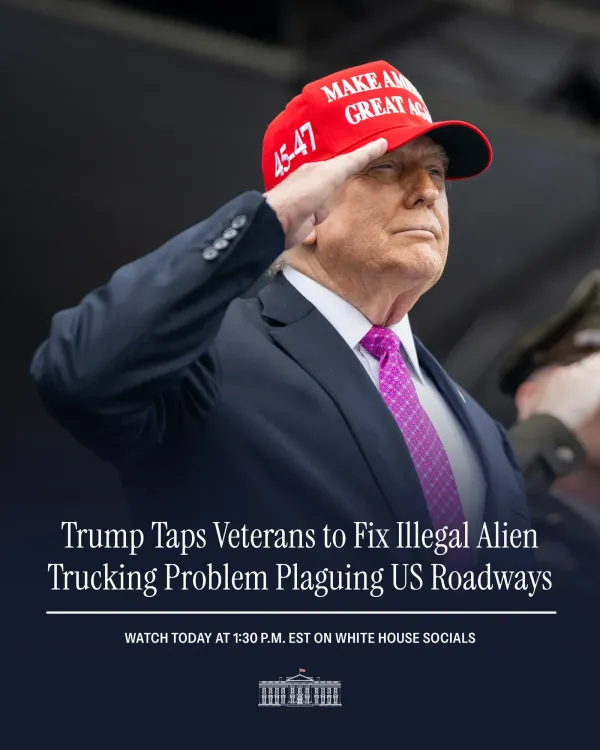
The White House announced President Trump will unveil a plan on July 31, 2026 to remove illegal aliens holding commercial driver's licences and replace them with American veterans, framing the move as both a public-safety and domestic-employment priority.
Key Takeaways
The White House posted that President Trump will make an announcement at 1:30 p.m.
EST on July 31, 2026 targeting illegal aliens holding commercial driver's licences (CDLs).
The administration framed the issue as a public-safety concern, stating illegal aliens with CDLs have 'endangered Americans on the road.' The stated policy goal is to replace illegal alien truck drivers with American veterans .
The move echoes Executive Order 13788 (April 2017) , Trump's 'Buy American and Hire American' directive from his first term.
Key details — including whether the action involves an executive order, regulatory change, or agency directive — were pending the scheduled announcement.
Trucking carries roughly 70 percent of U.S. domestic freight, making CDL workforce policy an economy-wide issue.
A direct challenge to unauthorized workers in one of America's most safety-critical industries landed on Thursday, July 31, 2026, as The White House signalled that President Donald Trump would use a 1:30 p.m. EST announcement to unveil a plan pushing illegal aliens out of commercial trucking and replacing them with American veterans.
The CDL Flashpoint: Why Commercial Trucking Is Ground Zero
Commercial driver's licences are federal-grade credentials — they authorise the operation of vehicles weighing tens of thousands of pounds on shared highways. The White House framed the issue squarely around public safety, stating that 'too many times, illegal aliens with commercial driver's licences have endangered Americans on the road.' That framing is deliberate: it ties immigration enforcement not to abstract policy but to something tangible — an 18-wheeler on the interstate.
Trucking is also the circulatory system of the American economy, moving roughly 70 percent of all domestic freight. Any shift in who holds CDLs — and how those licences are issued, verified, or revoked — carries consequences well beyond the cab of a truck.
Veterans as the Policy Answer
The administration's framing positions veterans as the natural replacement workforce — a politically resonant choice that packages immigration enforcement alongside a veterans-benefit narrative. Many former military personnel already hold experience with heavy vehicles, logistics, and disciplined operations, making the transition argument easier to sell to the public and to Congress.
This is not the first time the Trump administration has linked immigration crackdowns to domestic hiring. Executive Order 13788, signed in April 2017 under the 'Buy American and Hire American' banner, directed federal agencies to tighten rules on foreign labour and prioritise U.S. workers — the same ideological spine visible in today's announcement.
What the 1:30 p.m. Announcement Could Contain
The specific regulatory mechanics remain to be disclosed. Analysts and industry observers will be watching for any proposed changes to CDL issuance standards, new enforcement coordination between the Department of Transportation and immigration agencies, or executive directives targeting worksite compliance in the transport sector. Whether the announcement carries an executive order, a new agency rule, or a legislative proposal will determine how fast — and how far — the policy can actually move.
The stakes are high on every side: for veterans seeking civilian employment, for trucking companies navigating a chronic driver shortage, and for immigration enforcement agencies asked to operate inside a highly regulated industry. One announcement rarely settles all of that — but it sets the battlefield.
Point of View
The administration sidesteps the more contested 'jobs displacement' debate and appeals directly to public anxiety about physical danger. The veterans-as-replacement framing also insulates the policy from charges of being purely punitive, giving it a constructive, pro-American worker face. Whether the regulatory machinery can deliver on that framing — given the trucking industry's structural driver shortage — will be the harder test once the announcement details are public.
NationPress
31 Jul 2026
Frequently Asked Questions
Why is Trump targeting illegal aliens with commercial driver's licences?
The White House says illegal aliens holding CDLs have repeatedly endangered Americans on the road, framing the crackdown as a public-safety measure alongside an immigration enforcement priority.
What did Trump announce about truck drivers on July 31, 2026?
President Trump was scheduled to announce at 1:30 p.m. EST a plan to remove illegal aliens from commercial trucking jobs and replace them with American veterans, though full details were pending the announcement.
How will American veterans benefit from Trump's trucking plan?
The administration intends to direct commercial trucking jobs — currently held by illegal aliens — to American veterans, leveraging veterans' existing experience with heavy vehicles and logistics from military service.
What is a commercial driver's licence (CDL) and why does it matter?
A CDL is a federally regulated credential required to operate large commercial vehicles such as semi-trucks. Because trucking moves roughly 70 percent of U.S. domestic freight, who holds CDLs has significant safety and economic implications.
Is this connected to Trump's earlier 'Buy American, Hire American' policy?
Yes. Executive Order 13788, signed in April 2017, directed federal agencies to prioritise U.S. workers and tighten foreign-labour rules — the same ideological framework underpinning the new trucking announcement.