Priyanka Gandhi flags NEET cost vs education budget gap
Synopsis
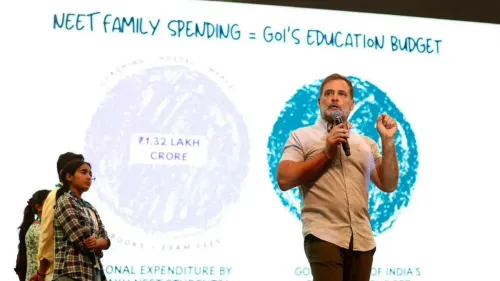
Congress general secretary Priyanka Gandhi Vadra has amplified Rahul Gandhi's Kota speech figures, contrasting Rs 1.32 lakh crore in annual NEET coaching costs with India's Rs 1.40 lakh crore education budget and Rs 16 lakh crore in corporate loan write-offs, sharpening the party's student-welfare campaign.
Key Takeaways
Congress general secretary Priyanka Gandhi Vadra posted on 17 June 2026 amplifying figures from Rahul Gandhi 's speech in Kota .
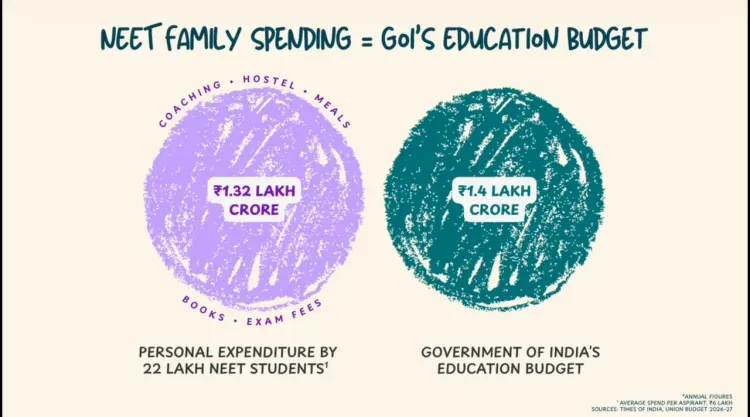
Money 'extracted by the system' from NEET students and families is cited as Rs 1.32 lakh crore annually, covering an estimated 22 lakh students .
India's total education budget is cited at Rs 1.40 lakh crore — nearly equal to the aggregate coaching expenditure figure.
Priyanka Gandhi added that the Government of India has forfeited Rs 16 lakh crore in loans to 'favourite businessmen' — more than ten times the coaching-cost figure.
The post is tagged #ChhatronKiGoonj , part of Congress's broader student-welfare campaign ahead of upcoming elections.
The figures originate in Rahul Gandhi 's speech and have not been independently verified from established public records.
Congress general secretary Priyanka Gandhi Vadra on Wednesday, 17 June 2026 amplified figures cited by Rahul Gandhi in a speech at Kota, drawing a sharp contrast between what families spend on NEET coaching, India's total education budget, and corporate loan write-offs by the central government.
Context
Posting on X, Priyanka Gandhi Vadra highlighted three numbers from her brother's address. She wrote that money 'extracted by the system' from NEET students and their families — estimated at 22 lakh students per year — amounts to Rs 1.32 lakh crore, nearly matching India's entire education budget of Rs 1.40 lakh crore. She then added her own data point: loans forfeited by the Government of India to 'its favourite businessmen' stand at Rs 16 lakh crore.
The post was tagged #ChhatronKiGoonj ('The Resonance of Students'), a hashtag Congress has used to frame student-centric campaign messaging. The figures cited originate in Rahul Gandhi's speech and have not been independently verified from established public records.
Policy Backdrop
NEET became the mandatory single-window medical entrance examination nationwide from 2016, replacing state-level tests. Critics have since argued that the centralised exam has fuelled demand for expensive private coaching, concentrating aspirants in cities such as Kota, Rajasthan — India's largest residential coaching hub — and placing a heavy financial burden on middle-class and rural families.
The National Education Policy 2020 set a long-term target of raising public spending on education to 6 per cent of GDP. India's current education budget allocation, as cited in the post, stands at approximately Rs 1.40 lakh crore, a figure that opposition leaders argue falls far short of that ambition.
The contrast drawn between student household expenditure and corporate non-performing asset write-offs is a recurring theme in opposition politics. Large-scale debt write-offs by public-sector banks — covering loans advanced to corporate borrowers — have been a flashpoint in parliamentary debates for several years.
Stakeholders and Impact
NEET aspirants and their families, particularly from middle-income and rural backgrounds, bear the primary financial weight of coaching fees, hostel costs, study material, and repeated exam attempts. With an estimated 22 lakh students appearing for NEET annually, the aggregate household expenditure the post references is presented as rivalling the state's own investment in education.
The coaching industry, centred in Kota but spread across major cities, has grown into a multi-thousand-crore sector with limited regulatory oversight on fee structures. Simultaneously, opposition leaders have repeatedly pressed the government in Parliament on the quantum of corporate loans written off or technically 'forfeited' by banks — a figure Priyanka Gandhi Vadra puts at Rs 16 lakh crore, though the exact accounting methodology for such write-offs varies across official disclosures.
What's Next
The monsoon session of Parliament is expected to see renewed opposition pressure on both education budget adequacy and the regulatory framework governing coaching centres and NEET fee structures. Congress has indicated it will push for a parliamentary debate anchored in student welfare and equitable access to higher education.
The #ChhatronKiGoonj campaign signals that the party intends to sustain this narrative through the lead-up to state elections, using the education-versus-corporate-relief contrast as a mobilising frame for student and youth voters.
Point of View
Effectively tripling the rhetorical impact of the original speech. The juxtaposition of student household sacrifice against perceived corporate relief is one of the most durable opposition frames in Indian politics, and deploying it under a youth-focused hashtag signals a structured campaign rather than a one-off comment. With the monsoon session approaching, Congress appears to be building a parliamentary and electoral narrative around education under-investment, using NEET as the human face of a systemic critique. Whether the government responds with data on write-off methodology or new student-relief measures will determine how far this frame travels.
NationPress
17 Sept 2026
Frequently Asked Questions
What did Priyanka Gandhi say about NEET students and the education budget?
Priyanka Gandhi Vadra cited figures from Rahul Gandhi's Kota speech showing that families of 22 lakh NEET students spend Rs 1.32 lakh crore annually on coaching — nearly equal to India's entire education budget of Rs 1.40 lakh crore.
What is #ChhatronKiGoonj?
#ChhatronKiGoonj, meaning 'The Resonance of Students,' is a Congress campaign hashtag used to highlight student welfare issues, including the financial burden of competitive exam preparation.
How much has the government written off in corporate loans according to Priyanka Gandhi?
Priyanka Gandhi Vadra stated that the Government of India has forfeited Rs 16 lakh crore in loans to 'favourite businessmen,' though the exact accounting methodology for such write-offs varies across official disclosures.
What is NEET and why is coaching so expensive?
NEET is the National Eligibility cum Entrance Test, India's mandatory single-window medical entrance exam since 2016. The centralised format has driven demand for private coaching in cities like Kota, pushing household expenditure sharply higher for aspirants.
What is India's education budget for 2026?
India's education budget is cited in the post as approximately Rs 1.40 lakh crore; the figure is used by Congress to argue that public investment in education is inadequate relative to household spending on private coaching.