Did Punjab and Haryana Experience a 90% Decline in Stubble Burning?
Synopsis
A groundbreaking reduction of 90% in stubble burning incidents has been observed in Punjab and Haryana during the 2025 paddy harvesting season compared to two years earlier. This achievement is attributed to enhanced monitoring and enforcement mechanisms implemented by the government to combat air pollution.
Key Takeaways
90% reduction in stubble burning incidents in Punjab and Haryana in 2025.
Enhanced monitoring through satellite data and flying squads.
Deployment of 10,500 field operatives in Punjab for effective oversight.
Implementation of a standardized protocol for tracking incidents.
Coordination with local officials for immediate action on burning incidents.
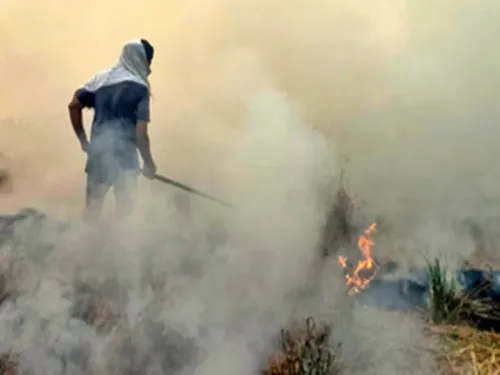
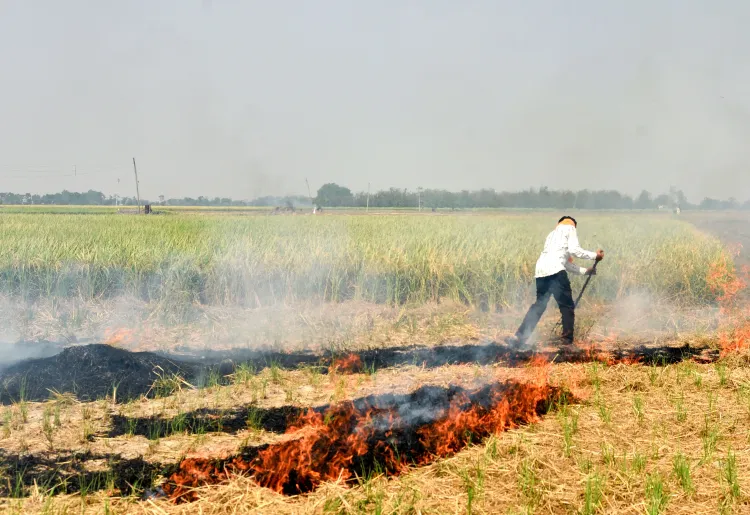
New Delhi, Feb 5 (NationPress) Punjab and Haryana have reported a remarkable 90% reduction in fire incidents during the 2025 paddy harvesting season compared to the same timeframe in 2022, as disclosed to Parliament on Thursday.
To bolster the monitoring of stubble burning incidents, night-time patrolling by enforcement agencies has been intensified, as stated by the Minister of State for Environment, Forest and Climate Change, Kirti Vardhan Singh, in a written response to the Rajya Sabha.
The Central government has implemented a comprehensive mechanism for tracking paddy stubble burning across the states of Punjab, Haryana, Uttar Pradesh, Rajasthan, and the NCT of Delhi to address air pollution stemming from stubble burning, he noted.
A standardized protocol for assessing crop residue burning incidents using satellite data was developed by ISRO, in collaboration with State Remote Sensing Centres and the Indian Agricultural Research Institute (IARI), and was issued by the Commission for Air Quality Management in the National Capital Region and surrounding areas in August 2021, the minister elaborated.
Active fire locations of stubble ('parali') burning are detected in real-time during satellite passes. Additionally, burn scar areas are evaluated using appropriate satellite data, he added.
The reporting of paddy stubble burning incidents, as per the established protocol during the paddy harvesting season, is facilitated through the Remote Sensing Centre. This ensures that alerts are dispatched to field operatives for prompt action on stubble burning cases, he emphasized.
This protocol is utilized for monitoring crop residue burning incidents, with IARI's CREAMS Laboratory publishing daily fire event data for Haryana, Delhi, Punjab, Uttar Pradesh, Madhya Pradesh, and Rajasthan based on this methodology.
Regional monitoring of stubble burning via satellite data has proven effective. However, frequent satellite passes enhance detection efficiency, he remarked.
During the stubble burning season of 2025 (from October 1 to November 30), 31 flying squads from CPCB were deployed to support CAQM in intensifying monitoring and enforcement against paddy stubble burning incidents in 18 districts of Punjab and 13 districts of Haryana, Singh mentioned.
These teams provide daily updates, photographic documentation, and compliance reports. The flying squads coordinated with state government officials, nodal officers, and district officers, submitting daily reports to CAQM, he noted.
Monitoring also occurs through the appointment of officials at various administrative levels and the deployment of the Parali Protection Force.
In Punjab, 10,500 field operatives have been designated to oversee and mitigate stubble fire incidents in 2025. Furthermore, the Parali Protection Force comprises 1,700 personnel deployed at the block level, in addition to nodal and cluster officers, to effectively enforce measures against stubble burning.
Similarly, 10,000 nodal officers have been appointed in Haryana to ensure effective enforcement of stubble burning prevention measures, Singh concluded.
Point of View
It is crucial to acknowledge the significant strides made by Punjab and Haryana in reducing stubble burning incidents. This progress not only reflects the effectiveness of government policies but also emphasizes the importance of cooperative efforts in tackling environmental challenges. The commitment to improving air quality and addressing pollution must remain a priority for all states.
NationPress
22 Sept 2026
Frequently Asked Questions
What caused the reduction in stubble burning in Punjab and Haryana?
The reduction is attributed to enhanced monitoring, enforcement measures by the government, and the implementation of a standardized protocol for tracking stubble burning incidents.
How was the reduction measured?
The reduction was measured by comparing fire incidents in the 2025 paddy harvesting season to those in 2022.
What role does satellite data play in monitoring stubble burning?
Satellite data is used to detect active fire locations and assess burn scar areas, improving the efficiency of monitoring stubble burning incidents.
How many teams were deployed for monitoring in Punjab and Haryana?
A total of 31 flying squads from CPCB were deployed to assist CAQM in monitoring and enforcement actions across the states.
What is the Parali Protection Force?
The Parali Protection Force consists of personnel designated to enforce measures against stubble burning at the block level and support local monitoring efforts.