Shivraj Singh Chouhan Holds Key Meeting on Stubble Burning
Synopsis
Agriculture Minister Shivraj Singh Chouhan and Environment Minister Bhupender Yadav met at Krishi Bhawan on June 16, 2026, to plan a pre-sowing strategy against paddy stubble burning, announcing real-time monitoring, hotspot surveillance, model villages, and a public awareness drive ahead of the 2026 kharif harvest.
Key Takeaways
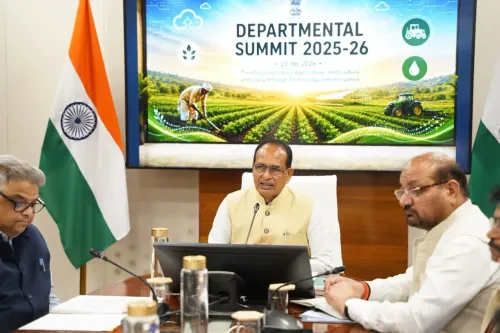
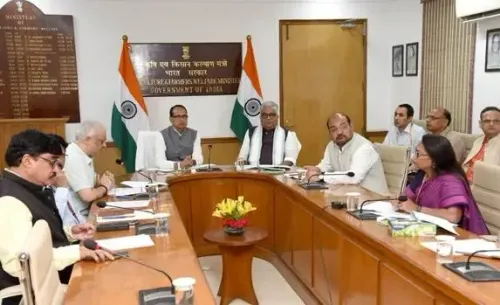
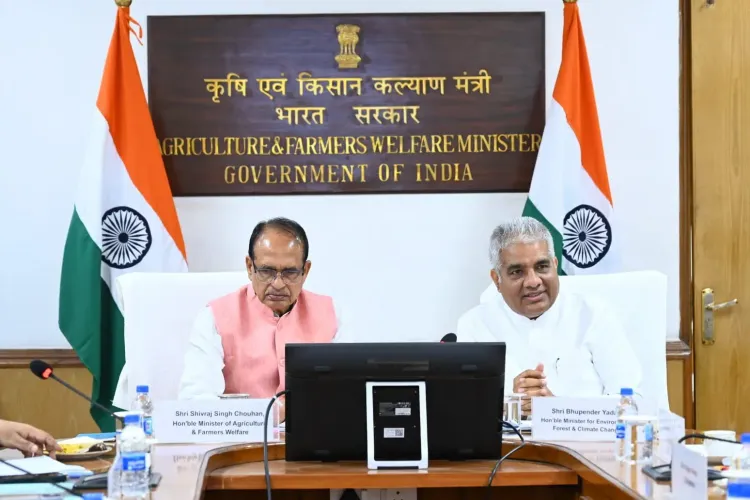
Agriculture Minister Shivraj Singh Chouhan and Environment Minister Bhupender Yadav held a joint meeting at Krishi Bhawan, New Delhi on June 16, 2026 on stubble burning.
For the first time, planning will begin at the paddy sowing stage rather than after harvest, marking a shift from reactive to preventive policy.
Key action points include real-time monitoring , hotspot district surveillance , promotion of model villages , and a mass awareness campaign .
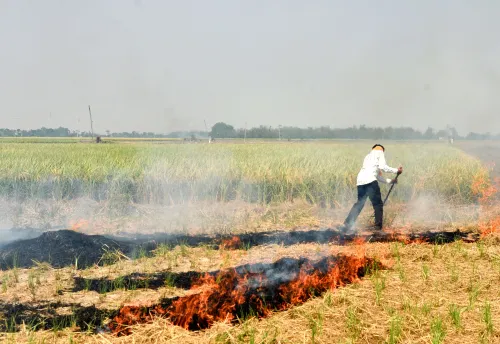
Stubble burning contributes an estimated 30–40 per cent of Delhi-NCR's PM2.5 pollution during October–November .
The Crop Residue Management scheme (launched 2018 ) and the National Clean Air Programme (launched 2019 ) form the existing policy backbone for this effort.
Implementation will be tested against the 2026 kharif harvest season in Punjab , Haryana , and Uttar Pradesh .
Union Agriculture Minister Shivraj Singh Chouhan held a high-level inter-ministerial meeting on stubble burning management at Krishi Bhawan, New Delhi, on Tuesday, June 16, 2026, alongside Union Environment Minister Bhupender Yadav. The two ministers reviewed a comprehensive action plan to curb paddy straw burning, with both ministries presenting proposals covering technology, monitoring, and public outreach.
Context
Chouhan announced the meeting on X, stating: 'Is baar hamne tay kiya hai ki dhan ki buwai ke samay se hi aisi yojana banayi jaye jisse parali jalane ki ghatnayen na hon' — ('This time we have decided that a plan will be drawn up from the time of paddy sowing itself so that incidents of stubble burning do not occur'). The shift from reactive post-harvest enforcement to pre-sowing planning marks a significant change in approach.
Chouhan underlined that stubble burning harms not only the environment but also 'Dharti Mata' (Mother Earth) — depleting soil fertility and intensifying air pollution. Both ministries made formal presentations at the meeting, signalling coordinated ownership of the problem.
Policy Backdrop
The Crop Residue Management (CRM) scheme, launched in 2018, has been the government's primary instrument, providing subsidies for machinery and custom-hiring centres in Punjab, Haryana, and Uttar Pradesh to manage paddy straw in the field rather than burning it. Bio-decomposer trials were expanded under the scheme in 2021.
The National Clean Air Programme (NCAP), introduced in 2019, targets 131 cities and explicitly addresses agricultural residue burning as a contributor to particulate pollution. Following Supreme Court directives in 2019-2020, the Centre was required to produce joint agriculture-environment action plans for winter pollution control — making Tuesday's meeting a continuation of that court-mandated coordination framework.
Stakeholders and Impact
Stubble burning in the paddy belt of Punjab and Haryana contributes an estimated 30–40 per cent of Delhi-NCR's PM2.5 load during October–November, when post-harvest fires peak. Farmers in these states have historically resorted to burning because it is the fastest and cheapest way to clear fields between the kharif and rabi seasons.
The action points announced include real-time monitoring of fire incidents, special surveillance of hotspot districts, promotion of model villages that have successfully managed stubble, adoption of modern technologies for residue handling, organised collection and utilisation of paddy straw, and a broad public awareness campaign. Millions of Delhi-NCR residents who bear the health burden of seasonal smog are direct beneficiaries of effective implementation.
What's Next
The immediate test will be state-level rollout of real-time monitoring dashboards and the identification of model villages before the 2026 kharif harvest, when paddy fields in northwest India are cleared between October and November. Parliamentary scrutiny of fund utilisation under the CRM scheme is also likely as the season approaches.
With pre-sowing planning now the stated intent, the agriculture and environment ministries will need to align with state governments in Punjab, Haryana, and Uttar Pradesh well before harvest time — a coordination challenge that will define whether this inter-ministerial push translates into measurable reduction in farm fires this year.
Point of View
Months before harvest fires typically ignite, suggesting the government is serious about breaking the annual cycle of crisis management. By framing the problem as one that must be addressed from the sowing stage, Chouhan is effectively shifting accountability upstream to planning rather than downstream to enforcement. The inter-ministerial format also signals an attempt to end the blame-sharing between agriculture and environment wings that has historically diluted accountability. Whether this intent survives the political economy of Punjab and Haryana — where farmer pushback against burning bans has been fierce — remains the central question heading into the 2026 kharif season.
NationPress
15 Sept 2026
Frequently Asked Questions
What was decided at the Shivraj Singh Chouhan stubble burning meeting on June 16?
The meeting decided to begin anti-stubble-burning planning from the paddy sowing stage itself, and announced real-time monitoring of fire incidents, special surveillance of hotspot districts, promotion of model villages, adoption of modern residue-management technologies, organised paddy straw collection, and a large-scale public awareness campaign.
Why is stubble burning a problem in India?
Stubble burning depletes soil fertility, releases harmful particulate matter, and is estimated to contribute 30–40 per cent of Delhi-NCR's PM2.5 pollution during October–November when post-harvest fires peak in Punjab and Haryana.
What is the Crop Residue Management scheme?
The Crop Residue Management (CRM) scheme was launched in 2018 by the Ministry of Agriculture to provide subsidies for machinery and custom-hiring centres in Punjab, Haryana, and Uttar Pradesh, enabling farmers to manage paddy straw in the field rather than burning it.
Who is Bhupender Yadav and why was he at this meeting?
Bhupender Yadav is India's Union Minister of Environment, Forest and Climate Change, responsible for air quality and pollution control. He co-chaired the June 16 meeting because stubble burning is both an agricultural and an environmental issue requiring coordinated action between his ministry and the Agriculture Ministry.
What is real-time monitoring of stubble burning?
Real-time monitoring refers to the use of satellite data and digital dashboards to track active farm fire incidents as they occur, allowing authorities to identify hotspot districts and respond quickly rather than relying on post-season assessments.