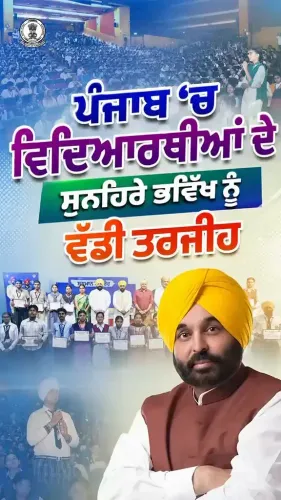
Punjab Govt Ferries 15,500 Girls to School Daily
Synopsis
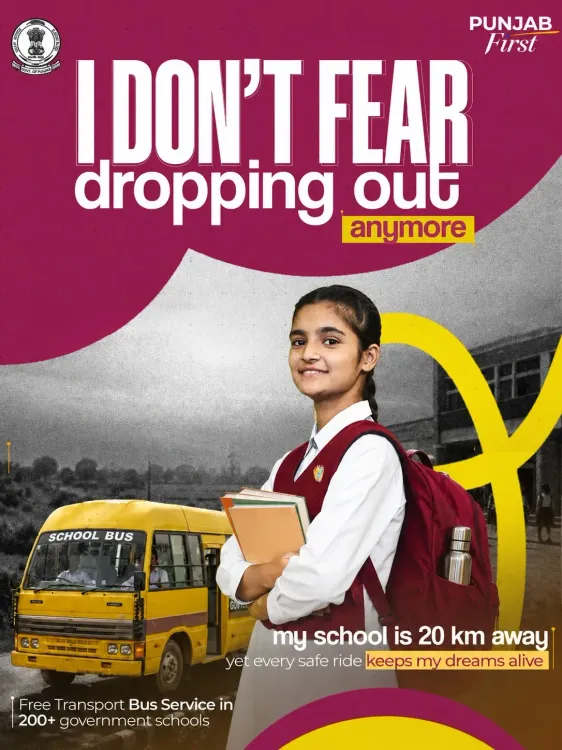
The Chief Minister's Office of Punjab announced on 14 July 2026 that the state government is transporting 15,500 girl students to school daily, covering distances of up to 20 km, as part of its drive to eliminate dropout caused by distance and safety concerns.
Key Takeaways
The Punjab Government is providing safe daily school transport to 15,500 girl students as of 14 July 2026 .
Coverage extends to distances of 10 km to 20 km , addressing one of the most common reasons for secondary-level dropout among girls.
The initiative aligns with the Right to Education Act, 2009 and the centrally sponsored Beti Bachao Beti Padhao scheme launched in 2015 .
The announcement was made under the #PunjabProgressReport hashtag, indicating it is part of a structured public accountability exercise.
Rural and semi-urban girl students enrolled in government secondary schools are the primary beneficiaries.
Upcoming state education statistics and budget sessions will indicate whether coverage is set to expand further.
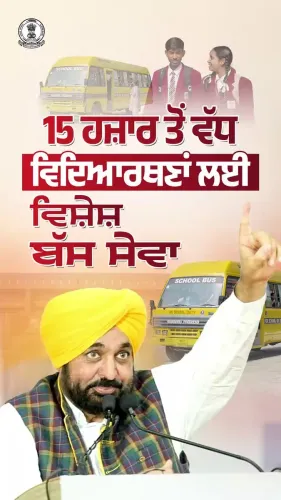
The Chief Minister's Office of Punjab announced on Tuesday, 14 July 2026 that the Punjab Government is providing daily safe transport to 15,500 girl students, covering distances of up to 20 kilometres to ensure no girl drops out of school due to distance or safety concerns.
Context
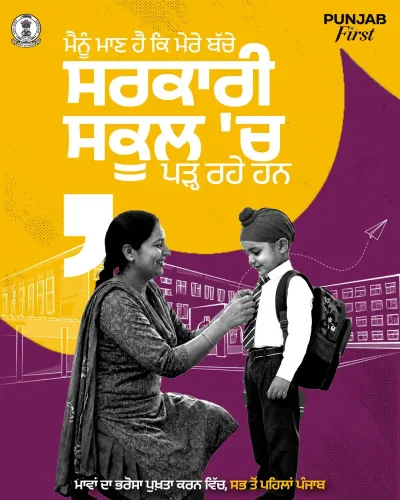
The official post from the Chief Minister's Office of Punjab stated: 'No fear of dropout, no barrier of distance. Punjab Government empowers 15,500 students daily, ensuring every girl reaches her school safely, whether 10 km or 20 km away, with her dreams alive and future secure.' The announcement was shared under the hashtags #PunjabFirst and #PunjabProgressReport, signalling it as part of a broader governance accountability drive.
Distance from school remains one of the most documented reasons for secondary-level dropout among girls in rural India. Families in villages often cite the absence of safe, reliable transport as a barrier to continuing their daughters' education beyond primary grades.
Policy Backdrop
The Right of Children to Free and Compulsory Education Act, 2009 legally obligated states to address distance-related barriers to schooling. The centrally sponsored Beti Bachao Beti Padhao scheme, launched in 2015, further directed state governments to strengthen girl-child education outcomes through targeted interventions.
Punjab's daily transport initiative fits within a well-established pattern across Indian states, where governments have operationalised central mandates by deploying buses, e-rickshaws, and escorted vehicles for girl students at the secondary level. Schemes under the Samagra Shiksha Abhiyan (SSA) have historically provided financial support for such state-level transport programmes aimed at gender parity in enrolment.
Stakeholders and Impact
The primary beneficiaries are girl students in rural and semi-urban Punjab, particularly those enrolled in government secondary and senior-secondary schools located far from their homes. Rural households that would otherwise keep daughters at home due to distance or safety concerns stand to gain directly from this daily coverage.
Beyond individual families, sustained enrolment of girls at the secondary level has documented downstream effects on literacy rates, age of marriage, and economic participation. Keeping 15,500 girls in school daily represents a cumulative educational investment whose returns extend well beyond the school year.
What's Next
Observers will watch for Punjab's next annual education statistics to assess whether the transport initiative translates into measurable improvement in girl-student retention and pass rates at the secondary level. Any expansion of coverage — in terms of student numbers, districts, or distance thresholds — is likely to feature in upcoming state budget announcements.
The government's use of the #PunjabProgressReport tag suggests periodic public reporting on such metrics, which could make this a recurring accountability benchmark for the administration.
Point of View
500 girl students is a concrete, measurable operationalisation of national education equity mandates rather than a new policy invention — its significance lies in scale and consistency of delivery. The announcement under the #PunjabProgressReport tag reflects a deliberate shift by the state administration toward quantified, verifiable governance communication. If the numbers hold up in official education statistics, this programme would represent one of the larger active girl-student transport operations among Indian states. The real test will come when retention and pass-rate data are published, converting a daily logistics figure into a learning outcome.
NationPress
13 Oct 2026
Frequently Asked Questions
How many girl students does the Punjab Government transport to school daily?
The Chief Minister's Office of Punjab stated on 14 July 2026 that the state government transports 15,500 girl students to school every day.
What is the maximum distance covered under Punjab's girl student transport scheme?
The scheme covers distances of up to 20 kilometres , with the post specifically citing both 10 km and 20 km as distances within the programme's reach.
Why does Punjab provide transport specifically for girl students?
Distance from school and safety concerns are among the leading causes of dropout for girl students at the secondary level in India . The transport initiative aims to remove both barriers and keep girls enrolled.
Is Punjab's school transport scheme linked to any central government programme?
The initiative aligns with the Right of Children to Free and Compulsory Education Act, 2009 and the Beti Bachao Beti Padhao scheme launched in 2015 , both of which direct states to address distance and gender-parity barriers in schooling.
What is the Punjab Progress Report hashtag?
#PunjabProgressReport is a hashtag used by the Chief Minister's Office of Punjab to share updates on the state government's policy and welfare programme outcomes as part of a public accountability exercise.