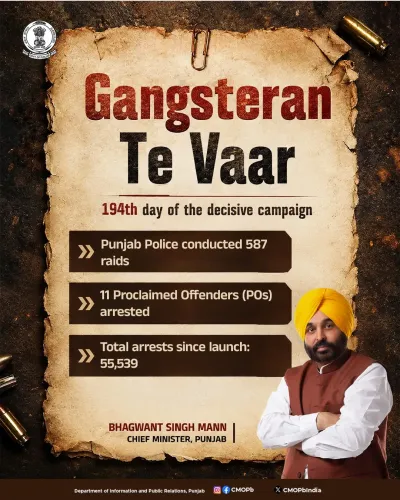
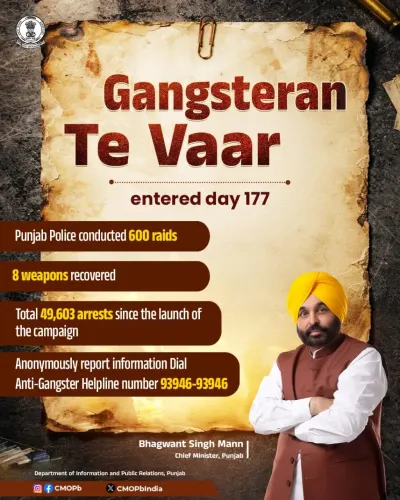
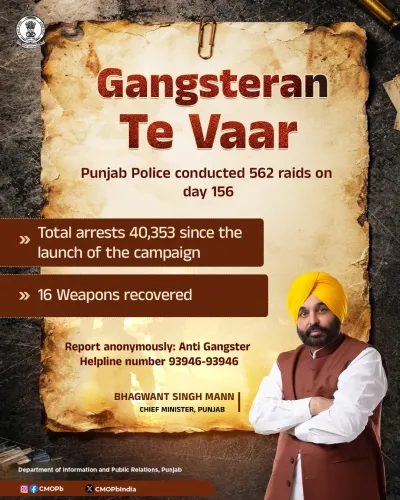
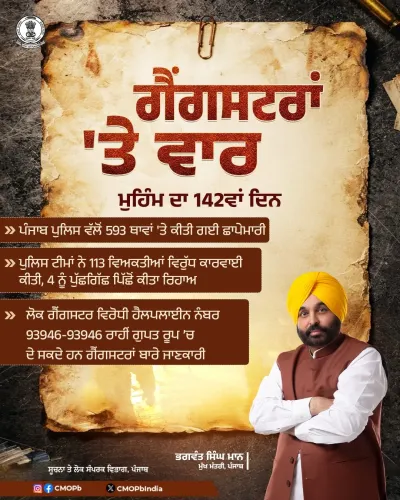
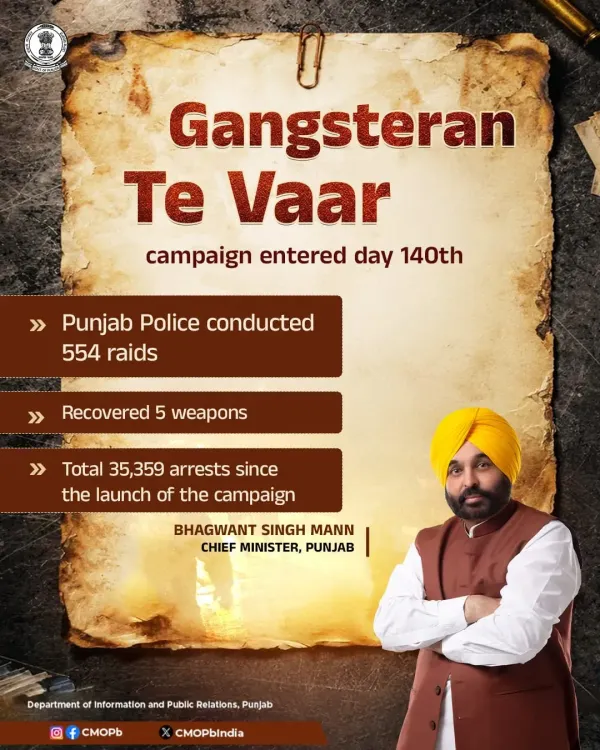
Punjab Police conducts 554 raids on Day 140 of Gangsteran Te Vaar
Synopsis
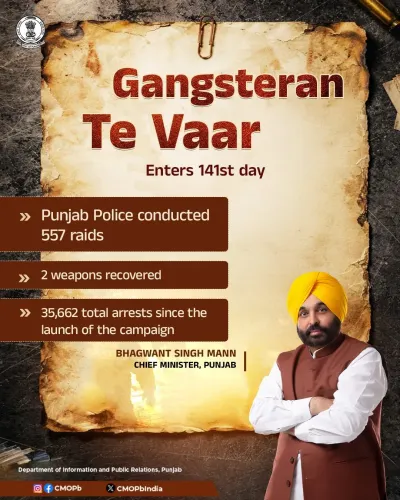
On Day 140 of the Gangsteran Te Vaar campaign, Punjab Police conducted 554 raids at mapped locations linked to gangster associates, recovered five weapons, and raised the campaign's total arrest count to 35,359, the Chief Minister's Office announced on June 9, 2026.
Key Takeaways
554 raids were conducted on Day 140 of the Gangsteran Te Vaar campaign across Punjab .
Police recovered five weapons during the latest round of operations.
Cumulative arrests since the campaign's launch have reached 35,359 .
Raids targeted pre-identified and geographically mapped locations linked to gangster associates.
The campaign is a flagship law-and-order initiative of the Bhagwant Mann -led AAP government in Punjab.
Punjab's proximity to the Pakistan border makes sustained anti-gangster operations a long-standing state security priority.
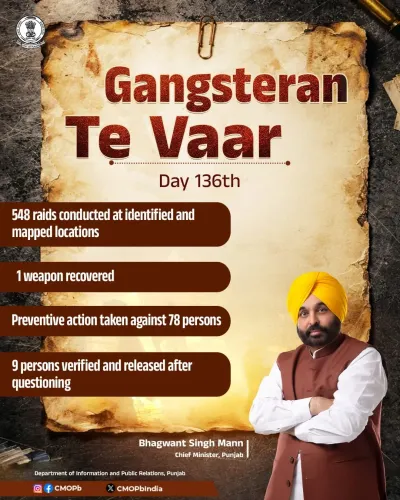
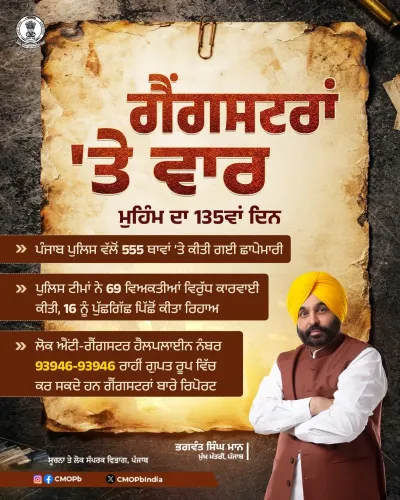
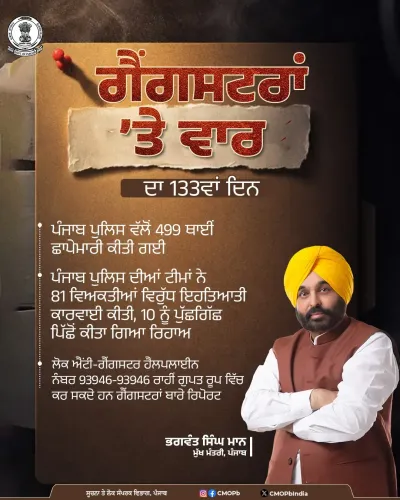
The Chief Minister's Office of Punjab announced on Tuesday, June 9, 2026 that Punjab Police conducted 554 raids at identified and mapped locations linked to associates of gangsters across the state, marking the 140th day of the ongoing Gangsteran Te Vaar (War on Gangsters) campaign.
Context
The CMO Punjab stated that police teams arrested individuals and recovered five weapons during the latest round of operations. The cumulative arrest count since the campaign's launch has reached 35,359, according to the official post. The raids targeted locations that had been pre-identified and geographically mapped as part of a systematic network-disruption strategy.
The Gangsteran Te Vaar campaign is a statewide anti-gangster policing drive that focuses on raids on mapped locations and the targeting of associates within criminal networks, rather than only pursuing principal offenders.
Policy Backdrop
Punjab, a northern Indian state sharing an international border with Pakistan, has faced persistent challenges of cross-border smuggling, narcotics trafficking and organised crime. Successive state administrations since the mid-2010s have periodically launched special drives against organised crime and narcotics networks.
The Aam Aadmi Party government led by Chief Minister Bhagwant Mann, which came to power in March 2022, had committed in its election manifesto to dismantling drug syndicates and gangster networks through sustained police action. The Gangsteran Te Vaar campaign represents the current administration's flagship operational response to that commitment.
Stakeholders and Impact
The campaign's stated focus on mapping associate networks — rather than targeting only known gang leaders — reflects a broader intelligence-led policing model intended to disrupt the logistical and financial infrastructure that supports organised crime. Residents of Punjab have a direct stake in the outcomes, given the state's documented vulnerability to gang-linked violence and narcotics.
The recovery of weapons during raids is significant in the context of Punjab's internal security concerns. Each firearms seizure is treated as a metric of operational success in disrupting the supply chains that armed criminal networks depend upon.
What's Next
Analysts and civil society groups are likely to watch for the release of official crime statistics that measure the campaign's impact on gang-related incidents, extortion cases and drug seizures beyond arrest numbers alone. Any follow-up legislative action in the Punjab Vidhan Sabha to strengthen police powers or formalise the network-mapping methodology would signal a shift from operational to institutional consolidation of the campaign's gains.
As the campaign crosses the 140-day mark with arrests now exceeding 35,000, the government faces increasing pressure to demonstrate that sustained policing operations are translating into measurable reductions in gang activity on the ground.
Point of View
000 cumulative arrests in 140 days is a politically significant milestone for the AAP government, which staked its credibility on breaking the nexus between crime, drugs and politics. However, the campaign's long-term legitimacy will hinge on whether these operational numbers translate into verifiable reductions in gang-related violence and extortion, metrics that are harder to manage than arrest tallies. The sustained pace also raises questions about judicial capacity and due process that the government will need to address as the campaign matures.
NationPress
19 Sept 2026
Frequently Asked Questions
What is the Gangsteran Te Vaar campaign in Punjab?
'Gangsteran Te Vaar' is a statewide anti-gangster policing campaign launched by the Punjab government that involves systematic raids on mapped locations linked to gangster associates, mass arrests, and weapons recovery operations aimed at dismantling organised criminal networks.
How many arrests have been made in the Gangsteran Te Vaar campaign?
As of Day 140 of the campaign, the total number of arrests made under Gangsteran Te Vaar has reached 35,359 , according to the Chief Minister's Office of Punjab.
How many raids did Punjab Police conduct on Day 140 of Gangsteran Te Vaar?
Punjab Police conducted 554 raids at identified and mapped locations linked to gangster associates across the state on the 140th day of the campaign.
Who launched the Gangsteran Te Vaar campaign?
The campaign was launched by the Aam Aadmi Party government in Punjab under Chief Minister Bhagwant Mann , who took office in March 2022 with a manifesto commitment to dismantle drug syndicates and gangster networks.
Why is Punjab particularly vulnerable to organised crime and gangster activity?
Punjab shares an international border with Pakistan, making it susceptible to cross-border smuggling, narcotics trafficking and the financing of criminal networks. The state also has a historical legacy of militancy that shaped the infrastructure later exploited by organised crime groups.