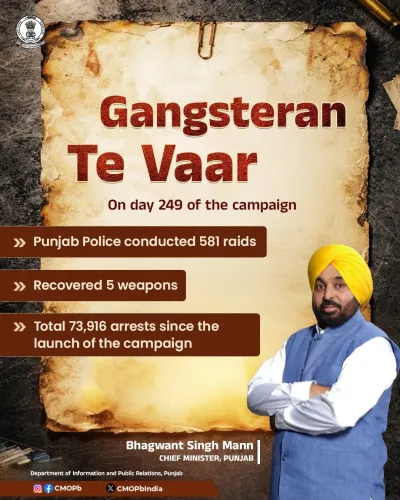
Punjab Police hits Day 211 of 'Gangsteran Te Vaar' with 610 raids

Synopsis
Punjab Police conducted 610 raids on Day 211 of the 'Gangsteran Te Vaar' anti-gangster campaign, arresting individuals with five weapons and three Proclaimed Offenders, pushing total arrests since the drive's launch to 62,221.
Key Takeaways
610 raids were conducted on Day 211 of the Gangsteran Te Vaar campaign across Punjab on 20 August 2026 .
Police arrested individuals found with five weapons during the day's operations.
Three Proclaimed Offenders (POs) — court-declared absconders — were apprehended.
Total arrests since the campaign's launch have reached 62,221 .
Raids targeted pre-identified, intelligence-mapped locations linked to gangster associates across the state.
The campaign reflects Punjab's ongoing strategy of sustained, data-driven pressure on organised crime networks.
Six hundred and ten raids in a single day. That is the operational tempo Punjab Police maintained on Day 211 of the state's sweeping anti-gangster drive, Gangsteran Te Vaar — a campaign that has now logged more than 62,221 arrests since it was first launched. The Chief Minister's Office of Punjab confirmed the latest figures on Thursday, 20 August 2026, signalling no let-up in what has become one of the state's most sustained law-enforcement operations in recent memory.
610 raids, five weapons, three fugitives caught
On Day 211 alone, police teams swept through identified and mapped locations tied to gangster associates across the state, resulting in arrests of individuals found with five weapons. Three Proclaimed Offenders (POs) — individuals who had been declared absconders by a court — were also picked up during the day's operations. The simultaneous targeting of both active associates and court-declared fugitives underlines the dual-track pressure the campaign applies: disrupting networks in real time while closing cold-case warrants.
Why 'Gangsteran Te Vaar' matters in Punjab's security calculus
Punjab has long contended with organised crime networks whose tentacles reach into extortion, targeted violence, and drug trafficking. The challenge is structural: cross-border geography, porous supply routes, and a history of gang recruitment from economically marginalised pockets of the state have made dismantling these syndicates a slow, grinding task for successive governments. Gangsteran Te Vaar — loosely translated as 'Strike on Gangsters' — represents the current administration's attempt to break that cycle through sheer operational persistence: daily raids, systematic mapping of associate networks, and a running public tally designed to signal institutional resolve.
A cumulative arrest figure of 62,221 over 211 days averages to roughly 295 arrests per day — a pace that reflects both the scale of the problem and the volume of resources being deployed. Whether those numbers translate into a measurable drop in gang-related incidents across Punjab is the question that will define the campaign's legacy.
The mapped-location strategy at the heart of the drive
Central to the operation is the use of intelligence-mapped locations — addresses and premises linked to known gangster associates that police have pre-identified and can raid at scale. The 610 raids on Day 211 were not random sweeps; they were targeted hits on a pre-built grid. This methodology, combining data-driven mapping with high-frequency execution, is increasingly the template for organised-crime crackdowns in urban and semi-urban India.
The campaign's daily disclosures also serve a secondary purpose: public accountability. By publishing raid counts, arrest tallies, and weapon seizures every day, the CMO keeps the pressure visible — on the police to perform, and on criminal networks to reckon with an operation that shows no sign of winding down.
Point of View
000 arrests across 211 days, the campaign is now a core plank of the Punjab government's law-and-order narrative heading into a period of heightened political scrutiny. The mapped-location methodology also marks a shift from reactive policing to pre-emptive network disruption, a model other state governments will be watching. The real test, however, is whether sustained arrests translate into a structural decline in gang activity — or simply churn through the lower rungs of criminal hierarchies while command structures adapt.
NationPress
5 Oct 2026
Frequently Asked Questions
What is the 'Gangsteran Te Vaar' campaign in Punjab?
'Gangsteran Te Vaar' — meaning 'Strike on Gangsters' — is a statewide anti-gangster operation run by Punjab Police that involves daily raids on intelligence-mapped locations linked to organised crime associates across the state.
How many arrests have been made under Gangsteran Te Vaar?
As of Day 211 of the campaign, total arrests have reached 62,221 since the operation was launched.
What happened on Day 211 of the Gangsteran Te Vaar campaign?
On Day 211, Punjab Police conducted 610 raids , arrested individuals found with five weapons , and apprehended three Proclaimed Offenders who had been declared absconders by courts.
What are Proclaimed Offenders (POs) in the context of Punjab Police operations?
Proclaimed Offenders are individuals formally declared absconders by a court after failing to appear when summoned. Arresting POs is a separate legal priority alongside the campaign's broader anti-gangster mandate.
Why does Punjab face a persistent organised crime problem?
Punjab's cross-border geography, historical gang recruitment from economically vulnerable communities, and links between organised crime and drug trafficking have made dismantling criminal networks a long-standing challenge for successive state governments.