Punjab Police Conduct 829 Raids on Day 165 of Gangsteran Te Vaar
Synopsis
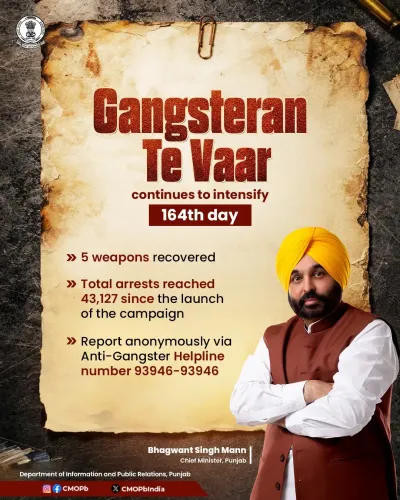
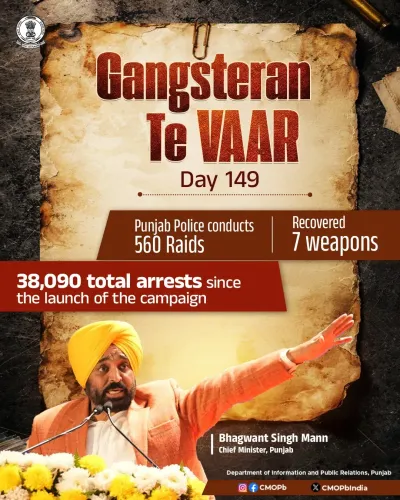
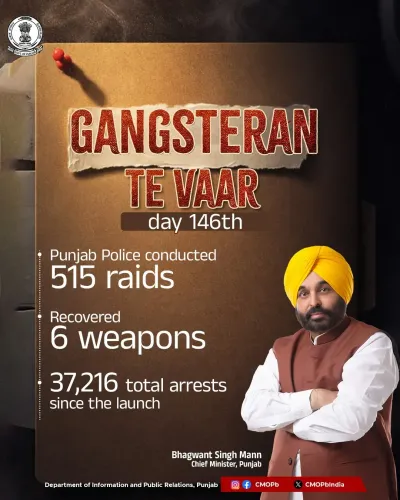
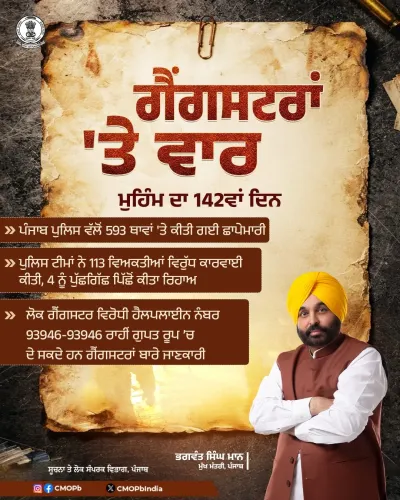
Punjab Police conducted 829 raids and arrested multiple individuals on Day 165 of the Gangsteran Te Vaar campaign, recovering 15 weapons. The Chief Minister's Office of Punjab confirmed the cumulative arrest toll has reached 43,697 since the campaign's launch, underscoring the state's sustained push against organised criminal networks.
Key Takeaways
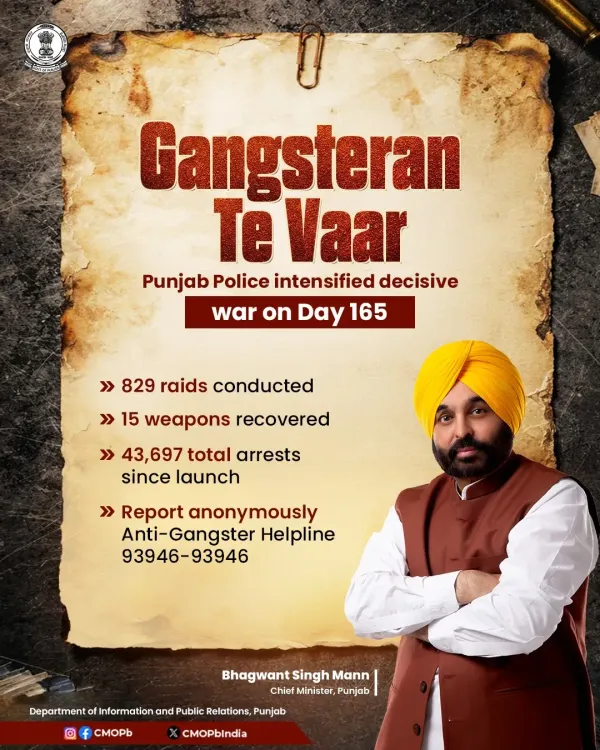
829 raids were conducted by Punjab Police on Day 165 of the Gangsteran Te Vaar campaign, targeting locations linked to gangster associates.
15 weapons were recovered during the day's operations, adding to the campaign's cumulative seizure tally.
Total arrests under the campaign have reached 43,697 since its launch.
The campaign relies on intelligence-based mapping of gangster-linked locations to enable coordinated, simultaneous raids across Punjab .
The Chief Minister's Office of Punjab announced the update on July 5, 2026 , continuing a pattern of daily public accountability on the drive.
The operation targets organised criminal networks involved in extortion, drug trafficking, and gang violence in Punjab .
The Chief Minister's Office of Punjab announced on Sunday, July 5, 2026, that Punjab Police conducted 829 raids on the 165th day of the ongoing anti-gangster drive 'Gangsteran Te Vaar', targeting locations linked to associates of gangsters across the state.
In a post on X, the Chief Minister's Office stated: 'As the decisive Gangsteran Te Vaar campaign enters its 165th day, Punjab Police conducted 829 raids at identified and mapped locations linked to associates of gangsters across the state.' The day's operations resulted in multiple arrests and the recovery of 15 weapons, pushing the cumulative arrest count to 43,697 since the campaign's launch.
Context
Gangsteran Te Vaar — loosely translated from Punjabi as 'Strike Against Gangsters' — is a sustained, intelligence-led policing drive by Punjab Police aimed at dismantling organised criminal networks operating within the state. The campaign relies on systematic mapping of gangster associates, safe houses, and logistics nodes, followed by coordinated raid operations across police districts. Day-by-day updates from the Chief Minister's Office of Punjab have become a regular feature of the state government's public communication, signalling both operational tempo and political accountability.Policy Backdrop
Punjab has contended with entrenched organised crime networks for over a decade, with gang activity intersecting drug trafficking, extortion rackets, and targeted violence. Successive state governments have launched policing drives, but the current campaign's scale — with raids now numbering in the hundreds on a single day — reflects a more intensive, data-driven approach. Punjab Police have used intelligence-based mapping to identify and catalogue locations associated with gang ecosystems, enabling rapid, simultaneous operations across multiple districts. This model mirrors broader trends in Indian state policing, where technology-assisted surveillance is increasingly paired with ground-level enforcement.Stakeholders and Impact
For Punjab's residents, particularly in districts historically troubled by gang violence, the sustained pace of operations signals continued state pressure on criminal networks. The recovery of 15 weapons on a single day — added to the campaign's cumulative haul — is significant given the role of illegal firearms in gang-related violence across the state. Gang associates and their support networks face heightened risk of arrest as police mapping efforts mature. Civil liberties observers, however, note that large-scale raid operations must be balanced against due process protections for individuals who may be tangentially linked to, rather than active participants in, criminal activity.What's Next
Punjab Police are expected to continue issuing daily operational updates as the Gangsteran Te Vaar campaign progresses. The government's stated metric of total arrests — now at 43,697 — will likely be cited in forthcoming assessments of the campaign's deterrent effect. Analysts and opposition parties will watch whether the arrest tallies translate into measurable reductions in gang-linked violence and whether prosecutions follow at a commensurate rate. Any official mid-campaign review or policy statement from the Chief Minister's Office could signal the next phase of the drive.Point of View
697 is a striking number that will define the campaign's legacy, but its credibility will ultimately rest on downstream outcomes: conviction rates, seizure of gang assets, and sustained reductions in violent crime. The weapon-recovery metric is particularly telling, as illegal firearms are the primary enabler of gang-related killings in Punjab. If the campaign's intelligence-mapping model proves durable, it could serve as a template for other Indian states grappling with entrenched organised crime.
NationPress
5 Jul 2026
Frequently Asked Questions
What is the Gangsteran Te Vaar campaign in Punjab?
Gangsteran Te Vaar is an ongoing Punjab Police anti-gangster drive that conducts intelligence-led raids on locations linked to gangsters and their associates across the state, with the goal of dismantling organised criminal networks.
How many arrests have been made under Gangsteran Te Vaar?
As of Day 165 of the campaign, on July 5, 2026, the total number of arrests under Gangsteran Te Vaar has reached 43,697 since the drive was launched.
How many raids did Punjab Police conduct on Day 165?
Punjab Police conducted 829 raids at identified and mapped locations linked to gangster associates on the 165th day of the Gangsteran Te Vaar campaign.
How many weapons were recovered in the latest Gangsteran Te Vaar operation?
15 weapons were recovered by Punjab Police during the Day 165 operations of the Gangsteran Te Vaar campaign on July 5, 2026.
Why is Punjab Police targeting gangster associates in these raids?
Punjab Police target gangster associates because they form the logistics and support network that enables gang activity such as extortion, drug trafficking, and violence; disrupting these networks is central to the campaign's strategy.