Punjab Police Conducts 897 Raids on Day 175 of Gangsteran Te Vaar

Synopsis
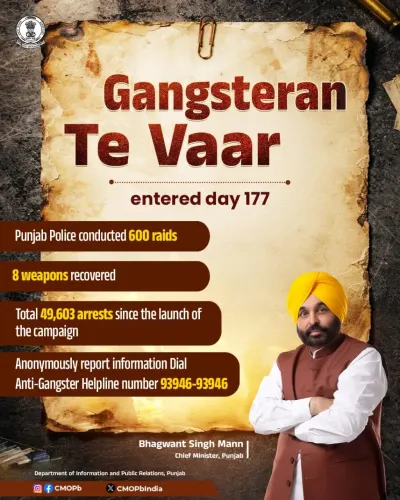
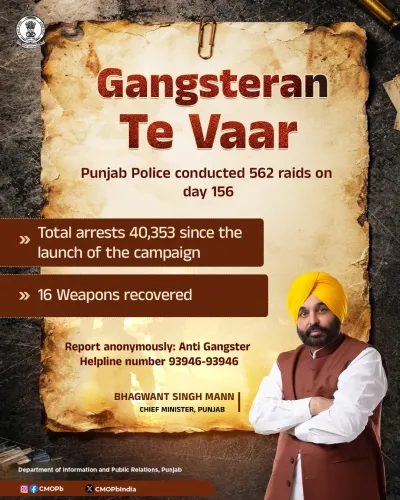
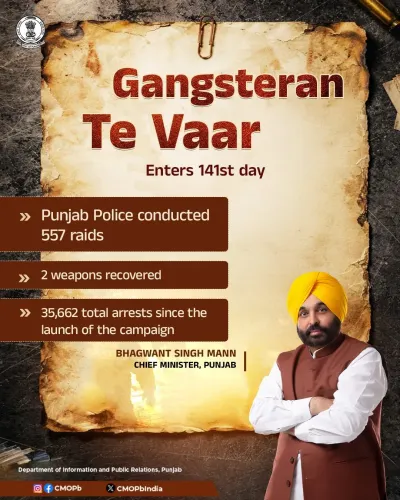
Punjab Police conducted 897 raids on Day 175 of the 'Gangsteran Te Vaar' anti-gangster campaign, recovering six sharp-edged weapons and pushing total arrests since the campaign's launch to 48,755, the Chief Minister's Office of Punjab announced on 15 July 2026.
Key Takeaways
897 raids were conducted by Punjab Police on Day 175 of the 'Gangsteran Te Vaar' campaign, targeting locations mapped as linked to gangster associates.
Police recovered six sharp-edged weapons during the day's operations and made fresh arrests.
Cumulative arrests since the campaign's launch have reached 48,755 .
The campaign uses an intelligence-based model focused on mapping and repeatedly raiding locations connected to criminal networks, not just individual gangsters.
The operation spans multiple districts across Punjab , a state with a documented history of organised crime challenges including extortion and drug-linked gangs.
The Chief Minister's Office of Punjab announced on Wednesday, 15 July 2026, that Punjab Police conducted 897 raids at identified and mapped locations linked to gangster associates across the state, marking the 175th day of the ongoing 'Gangsteran Te Vaar' anti-gangster campaign.
What Happened
On Day 175 of the campaign, police teams carried out raids at locations systematically identified through intelligence mapping of networks connected to known gangsters. During the day's operations, officers arrested multiple individuals and recovered six sharp-edged weapons. The cumulative arrest tally since the campaign's launch has now reached 48,755.Context
Punjab has long grappled with organised crime challenges, including extortion networks, drug-linked gangs and inter-gang violence, some of which carry cross-border dimensions. The 'Gangsteran Te Vaar' — roughly translated as 'Strike Against Gangsters' — reflects a sustained, intelligence-led policing model that emphasises systematic location mapping and repeated raids rather than isolated high-profile operations. The campaign's structure — tracking daily raid counts, arrests and weapon recoveries — is consistent with state-level internal security strategies adopted across several Indian states facing comparable organised crime pressures.Policy Backdrop
Punjab Police's approach under this campaign prioritises the disruption of associate networks surrounding gangsters, not merely the gangsters themselves. By targeting mapped locations linked to associates, the operation aims to erode the logistical and social infrastructure that sustains criminal syndicates. This intelligence-based, cumulative-pressure model has been a feature of large-scale anti-organised crime drives at the state level in India, where single-encounter operations have increasingly given way to sustained, data-driven campaigns. The recovery of sharp-edged weapons alongside arrests underscores the operational focus on dismantling active criminal capacity.Stakeholders and Impact
Residents across Punjab are the primary beneficiaries of sustained pressure on gang networks, which have historically been linked to extortion targeting businesses, farmers and ordinary citizens. Each round of raids and arrests is intended to signal to criminal networks that the state's enforcement capacity is persistent rather than episodic. The scale of the campaign — nearly 49,000 arrests across 175 days — indicates an operation that spans multiple districts and police jurisdictions across the state.What's Next
With the campaign now past the 175-day mark and cumulative arrests approaching 50,000, attention will turn to whether the operational tempo is sustained and whether supplementary measures — such as enhanced surveillance tools, special courts for expedited trials, or fresh legislative action in the Punjab Assembly — are introduced to consolidate gains. Daily and weekly updates from Punjab Police on raid tallies, arrest figures and weapon recoveries will continue to serve as the primary indicators of the campaign's trajectory.Point of View
000 signal a deliberate shift in Punjab's policing doctrine — from reactive, incident-driven responses to a sustained, data-driven attrition strategy against organised crime networks. The emphasis on raiding associate locations rather than pursuing only named gangsters reflects an understanding that criminal syndicates are ecosystems, not just individuals. For the ruling dispensation in Punjab, the daily cadence of publicly reported statistics also serves a political communication function, projecting governance credibility on law and order. The real test of the campaign's durability will come in whether the legal system can process the volume of arrests and whether conviction rates follow the raid tallies.
NationPress
13 Oct 2026
Frequently Asked Questions
What is the Gangsteran Te Vaar campaign in Punjab?
'Gangsteran Te Vaar' is an ongoing anti-gangster operation by Punjab Police that involves systematic, intelligence-led raids on locations mapped as linked to gangster networks and their associates across the state.
How many raids did Punjab Police conduct on Day 175 of Gangsteran Te Vaar?
Punjab Police conducted 897 raids on Day 175 of the Gangsteran Te Vaar campaign, targeting identified locations linked to gangster associates across Punjab.
What is the total number of arrests under Gangsteran Te Vaar?
As of Day 175, the total number of arrests since the launch of the Gangsteran Te Vaar campaign stands at 48,755 .
What weapons were recovered during the Day 175 raids?
During the Day 175 operations, Punjab Police recovered six sharp-edged weapons alongside making fresh arrests.
Why does Punjab face organised crime challenges?
Punjab has historically faced organised crime challenges including extortion networks, drug-linked gangs and inter-gang violence, some of which have cross-border dimensions, making sustained policing campaigns a recurring feature of the state's internal security strategy.