Punjab Police hits 81,837 arrests on Day 284 of Gangsteran Te Vaar
Synopsis
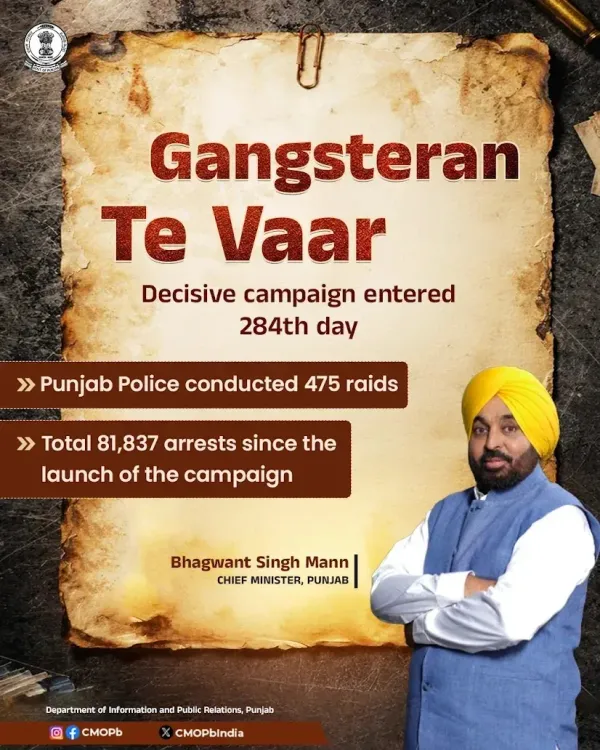
On Day 284 of the 'Gangsteran Te Vaar' campaign, Punjab Police conducted 475 raids at locations linked to gangster associates, pushing total arrests to 81,837. The Chief Minister's Office of Punjab announced the milestone on November 1, 2026, underscoring the Mann government's sustained anti-crime operational tempo.
Key Takeaways
475 raids were conducted on a single day — Day 284 — at intelligence-mapped locations linked to gangster associates across Punjab.
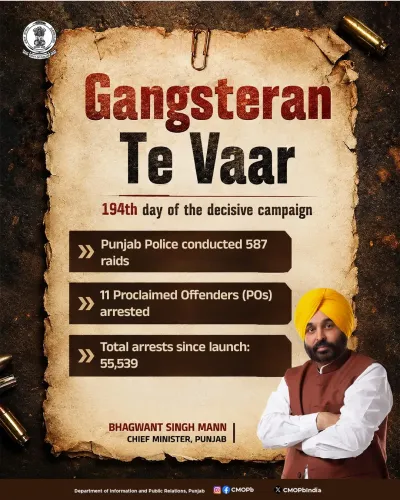
Cumulative arrests under the Gangsteran Te Vaar campaign have reached 81,837 since its launch.
The campaign averages over 287 arrests per day across its run, reflecting sustained high operational tempo by Punjab Police .
The crackdown targets associates and network nodes of gangsters, not just triggering operatives, using an intelligence-led raid model.
Chief Minister Bhagwant Mann has made the campaign a centrepiece of his government's law-and-order record since taking office in March 2022 .
Punjab's organised crime challenge spans extortion, contract killings and drug networks, several with cross-border linkages complicating enforcement.
Nearly ten months into one of Punjab's most sustained anti-crime offensives, the numbers keep climbing. The Chief Minister's Office of Punjab announced on Sunday, November 1, 2026 that Punjab Police conducted 475 raids in a single day across locations mapped to gangster associates — pushing the cumulative arrest count for the 'Gangsteran Te Vaar' campaign to 81,837 since its launch.
475 raids, one day: what Day 284 looked like on the ground
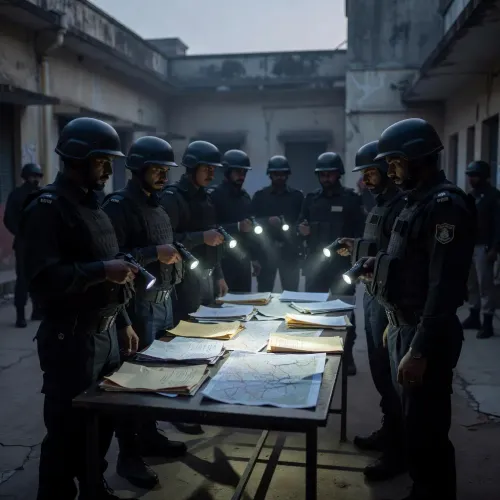
The raids on Day 284 were carried out at 'identified and mapped locations' — language that signals an intelligence-led operational model rather than sweeping dragnet policing. Teams moved on addresses linked to associates of active gangsters spread across the state, arresting individuals who added to the campaign's running tally. The sheer geographic spread of a single day's 475-raid operation points to a coordinated, multi-district mobilisation.
Nine months of sustained operational tempo
The Bhagwant Mann government launched intensified action against organised crime networks shortly after taking office in March 2022, building on earlier — but patchier — state-level efforts to dismantle gang infrastructure. Gangsteran Te Vaar ('The Strike Against Gangsters') emerged as the flagship expression of that intent: a named, numbered, daily-reported campaign designed as much to signal political will as to rack up operational results.
Punjab has long contended with organised crime groups woven into extortion rackets, contract-killing networks and drug supply chains — several with cross-border dimensions that complicate purely state-level enforcement. Mapping those networks, targeting their financial and logistical associates rather than only triggering-finger operatives, is the theory of change embedded in this campaign's design.
Why the arrest count matters — and what it doesn't tell us
At over 81,000 arrests across 284 days, the daily average sits above 287 arrests — a volume that reflects a state police force operating at sustained high tempo. For residents in districts historically bruised by gang extortion and drug violence, that tempo translates into a tangible change in street-level risk calculus. Gangster associates who once operated with relative impunity face a more aggressive legal environment.
What raw arrest numbers cannot confirm on their own is conviction rate, asset seizure or long-term disruption of command structures. Those metrics — crime statistics, court outcomes, extortion complaint trends — will ultimately determine whether the campaign's legacy is structural change or a well-publicised pressure cycle. The Mann administration has staked considerable political capital on Gangsteran Te Vaar being the former.
The scoreboard Punjab Police is building
Daily public reporting of raid and arrest tallies is itself a governance choice: it creates a real-time accountability loop, making each day's number a visible referendum on delivery. As the campaign pushes deeper into its ninth month with no announced end date, the question shifts from whether the crackdown is real to whether its pressure is permanent — and whether the courts and intelligence architecture can absorb the load the raids are generating.
For now, the scoreboard reads 81,837 — and Punjab Police is still counting.
Point of View
Asset recoveries and sustained crime-rate reductions are harder, and the gap between the two will define the campaign's true legacy. At 81,837 arrests and 284 days, the operation has clearly crossed from a launch announcement into institutionalised police behaviour, which is itself significant for a state where anti-gangster drives have historically run in short bursts. The deeper test is whether the intelligence-mapping model survives beyond any single political cycle and evolves into a durable structural reform rather than a high-visibility pressure campaign.
NationPress
1 Nov 2026
Frequently Asked Questions
What is the Gangsteran Te Vaar campaign in Punjab?
'Gangsteran Te Vaar' — meaning 'The Strike Against Gangsters' — is an ongoing Punjab Police operation launched under the Bhagwant Mann government to conduct raids and arrests targeting associates of active gangsters across the state, using intelligence-mapped locations as the basis for operations.
How many arrests have been made in Gangsteran Te Vaar so far?
As of Day 284 of the campaign (November 1, 2026), Punjab Police had made a cumulative total of 81,837 arrests since the launch of the Gangsteran Te Vaar operation.
How many raids did Punjab Police conduct on Day 284?
Punjab Police conducted 475 raids on Day 284 of the Gangsteran Te Vaar campaign, targeting identified locations linked to associates of gangsters across Punjab.
Who launched the Gangsteran Te Vaar campaign?
The campaign was launched under the Bhagwant Mann government, which took office in Punjab in March 2022. It reflects the state administration's sustained push against organised crime networks involved in extortion, contract killings and drug supply chains.
Why does Punjab face a persistent gangster problem?
Punjab has long been challenged by organised crime groups with roots in extortion, drug trafficking and contract killings, several of which have cross-border linkages. Successive state governments have pursued police-led crackdowns, but the current campaign represents the most sustained operational tempo in recent years.