Punjab Police hits Day 300 of 'Gangsteran Te Vaar' with 530 raids
Synopsis
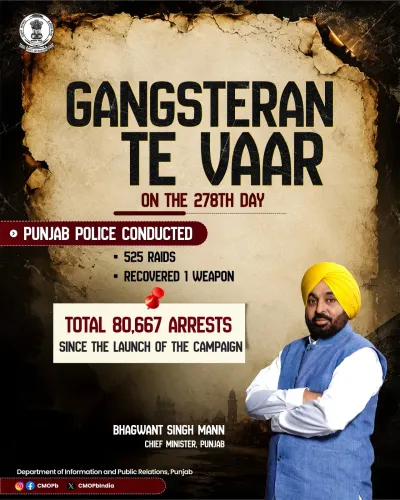
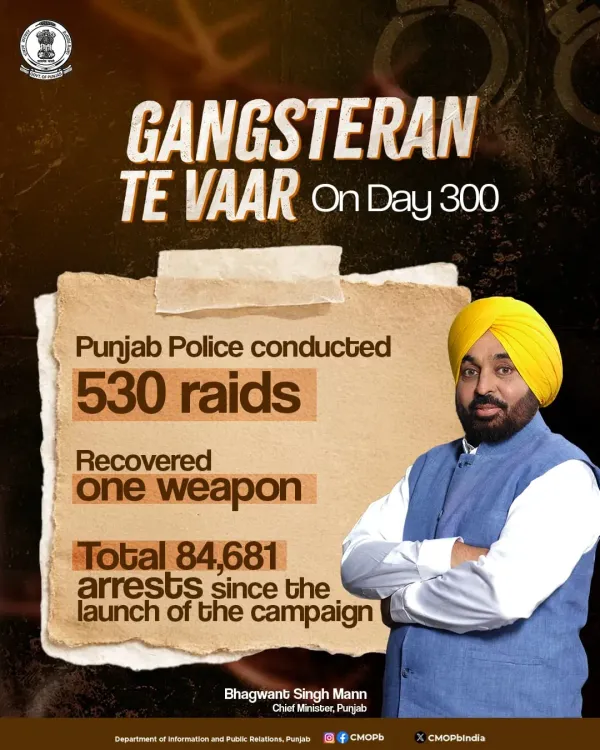
On Day 300 of 'Gangsteran Te Vaar', Punjab Police carried out 530 raids against gangster-linked locations across the state, arresting individuals and recovering a weapon. Total arrests since the campaign's launch have reached 84,681, the Chief Minister's Office of Punjab announced on November 17, 2026.
Key Takeaways
Day 300 of the 'Gangsteran Te Vaar' anti-gangster campaign was marked on November 17, 2026 .
Punjab Police conducted 530 raids in a single day at pre-mapped locations linked to gangster associates.
Arrests were made and one weapon was recovered during Day 300 operations.
The campaign's cumulative arrest total has reached 84,681 since its launch.
The drive was initiated under Chief Minister Bhagwant Mann 's AAP government, which identified eliminating gangster networks as a core priority after the 2022 Punjab assembly elections .
Punjab has historically faced organised crime linked to cross-border drug trafficking and extortion; this campaign represents a sustained rather than episodic response.
Three hundred days. 530 raids in a single day, stretched across identified and mapped locations tied to gangster networks — and a cumulative arrest tally that has now crossed 84,681. On Tuesday, November 17, 2026, the Chief Minister's Office of Punjab marked a significant milestone in the state's most sustained anti-crime offensive in recent memory.
What Day 300 looks like on the ground
Punjab Police fanned out across the state on Day 300 of the 'Gangsteran Te Vaar' (ਗੈਂਗਸਟਰਾਂ ਤੇ ਵਾਰ — 'Strike on Gangsters') campaign, conducting raids at locations pre-mapped as associate hubs of known criminals. Teams made multiple arrests and recovered one weapon during the day's operations, adding to what officials describe as a steadily growing haul since the drive was launched.
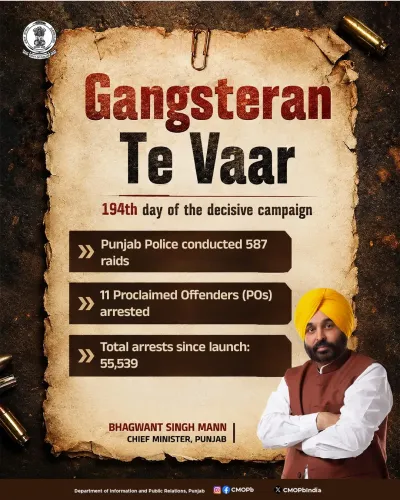
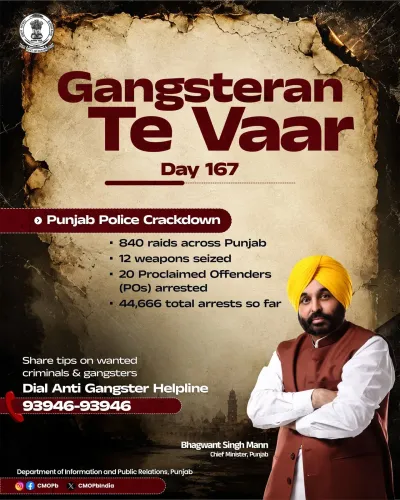
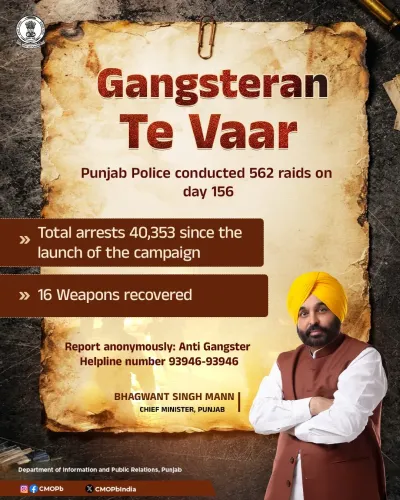
The numbers from the CMO's official post are stark: 84,681 total arrests since the campaign's inception, achieved through a relentless operational rhythm that has now held for 300 consecutive days without a visible pause.
The organised-crime problem Punjab set out to solve
Punjab's entanglement with gangster networks is not a new story. The state has long grappled with organised crime groups that draw oxygen from cross-border drug trafficking, extortion rackets, and — in some documented cases — links to overseas criminal syndicates. Successive governments attempted periodic crackdowns, but critics noted they tended to be episodic: a burst of raids followed by a gradual return to baseline.
When Chief Minister Bhagwant Mann and the Aam Aadmi Party came to power after the March 2022 Punjab assembly elections, dismantling gangster ecosystems was framed as a core administrative promise, not a campaign talking point. 'Gangsteran Te Vaar' — structured around daily raid counts, mapped associate networks, and publicly communicated cumulative data — reflects that sustained operational tempo.
Why the 300-day mark matters beyond the number
Policing campaigns typically lose intensity as they age. Political attention drifts, field units tire, and the bureaucratic machinery that sustains mass operations tends to wind down. A 300-day run at this reported scale — averaging well over 84,000 arrests — signals either a genuine structural shift in how Punjab Police is being deployed, or a communications strategy designed to keep public confidence high, or both.
The Mann government's choice to publicly telegraph daily raid counts and cumulative tallies is itself a governance signal: accountability through transparency, with each day's numbers functioning as a public audit. Whether the arrest-to-conviction pipeline ultimately validates the scale of the operation is the question Punjab's law-and-order debate will return to in the state assembly.
Point of View
Publicly communicated, and relentless in cadence. By broadcasting daily raid counts and a cumulative arrest figure now above 84,000, the CMO is effectively turning a law-enforcement operation into a performance-accountability instrument. The strategy carries real political stakes — Punjab's crime and drug-trafficking problem has historically been an electoral flashpoint, and sustaining visible momentum builds a credibility buffer heading into future assembly cycles. The harder question, one that opposition benches will inevitably raise, is whether arrest volume translates into durable dismantling of gangster networks or simply cycles associates through the system without breaking the underlying infrastructure.
NationPress
17 Nov 2026
Frequently Asked Questions
What is the 'Gangsteran Te Vaar' campaign in Punjab?
'Gangsteran Te Vaar' — meaning 'Strike on Gangsters' — is an ongoing Punjab Police anti-crime drive launched under Chief Minister Bhagwant Mann's AAP government to conduct targeted raids on associates of known gangsters and dismantle organised crime networks across the state.
How many arrests have been made in the Gangsteran Te Vaar campaign?
As of Day 300 of the campaign on November 17, 2026, the total number of arrests made since the drive's launch has reached 84,681 , according to the Chief Minister's Office of Punjab.
How many raids did Punjab Police conduct on Day 300?
Punjab Police conducted 530 raids at identified and mapped locations linked to gangster associates across the state on Day 300 of the 'Gangsteran Te Vaar' campaign.
Why did the AAP government in Punjab launch an anti-gangster campaign?
Following the March 2022 Punjab assembly elections, the incoming AAP government under Bhagwant Mann identified the elimination of gangster networks — often linked to cross-border drug trafficking and extortion — as a core administrative priority.
What was recovered during the Day 300 operations of Gangsteran Te Vaar?
During Day 300 operations on November 17, 2026, Punjab Police teams made arrests and recovered one weapon , according to the official announcement from the Chief Minister's Office of Punjab.