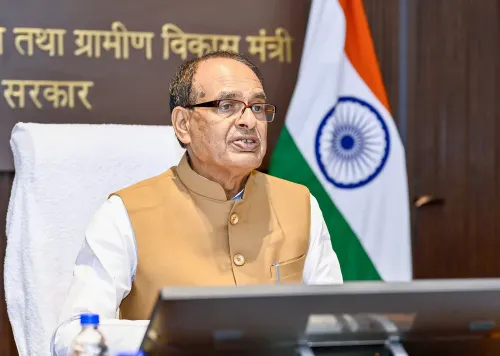
Chouhan: Horticulture output set to hit 386.9 MT in 2025-26
Synopsis
Union Agriculture Minister Shivraj Singh Chouhan announces India's horticulture output is projected to reach 3,869.15 lakh MT in 2025-26 — a 4.36% rise over 2024-25 — citing the third advance estimate and attributing growth to crop diversification under PM Modi.
Key Takeaways
India's horticulture production is projected at 3,869.15 lakh metric tonnes in 2025-26 per the third advance estimate.
This marks an increase of 161.77 lakh metric tonnes , or 4.36% , over the 3,707.38 lakh MT recorded in 2024-25 .
Union Agriculture Minister Shivraj Singh Chouhan linked the growth to agricultural diversification and benefits of government schemes under PM Narendra Modi .
The Mission for Integrated Development of Horticulture (MIDH) , launched in 2014-15 , is the flagship central scheme driving area expansion, productivity, and post-harvest management in the sector.
The figures are based on the third advance estimate ; the final 2025-26 horticulture production number will be published later in the crop year cycle.
Fresh horticulture scheme allocations in the upcoming Union Budget will be a key indicator of the government's next policy step.
India's farms are quietly staging a green revolution of a different kind — one measured not in wheat and rice, but in fruits, vegetables, and flowers. Union Agriculture Minister Shivraj Singh Chouhan announced on Tuesday, November 17 that the country's total horticulture production is projected to reach 3,869.15 lakh metric tonnes in 2025-26, citing the third advance estimate released by his ministry.
The figure represents a jump of 161.77 lakh metric tonnes — a 4.36% increase over the 3,707.38 lakh metric tonnes recorded in 2024-25. Chouhan credited the surge to farmers embracing agricultural diversification under Prime Minister Narendra Modi's leadership, writing: 'Kisan apni mehnat aur parishram se Modi sarkar ki yojanaon ka labh uthate hue lagatar record paidawar karne mein safal ho rahe hain' — 'Farmers, through their own hard work and effort, are succeeding in achieving record yields by availing the benefits of the Modi government's schemes.'
From staples to high-value crops: the diversification push
The shift is not accidental. The Mission for Integrated Development of Horticulture (MIDH), launched in 2014-15, has been the central government's primary instrument to push farmers toward fruits, vegetables, spices, and floriculture — crops that typically command better market prices than conventional cereals. The mission covers area expansion, productivity enhancement, and post-harvest management, addressing the full value chain from seed to shelf.
Successive advance estimates — the agriculture ministry issues multiple rounds each crop year — have tracked this incremental shift. Each successive round of projections this year has pointed upward, lending credibility to the final number when it arrives. That said, the third advance estimate remains a projection; the definitive figure will come with the final estimate later in the cycle.
What the 4.36% growth means for farmers and markets
A 4.36% year-on-year rise in a sector already producing nearly 387 million tonnes annually is not a rounding error — it is tens of millions of additional tonnes reaching mandis, cold chains, and export channels. Higher horticulture volumes, if matched by adequate processing and logistics infrastructure, translate into better farm-gate realisations for growers and steadier prices for consumers. The challenge, historically, has been that bumper harvests in perishables can crash local prices before the surplus reaches processing units.
Chouhan's post signals that the government intends to keep diversification — and its headline numbers — front and centre as it heads toward the next Union Budget cycle, where fresh scheme allocations for horticulture will be closely watched.
India's farmers have proven they can grow the numbers. Whether the infrastructure keeps pace will define whether those numbers become income.
Point of View
But the government will need to show that post-harvest infrastructure and price-realisation for farmers are keeping pace with raw output. MIDH has been the backbone of this push since 2014, and successive advance estimates trending upward give the ministry a data-backed narrative. The real political test comes when the final estimates land and when Budget allocations reveal whether the government is prepared to invest in cold-chain and processing capacity at the scale the numbers now demand.
NationPress
17 Nov 2026
Frequently Asked Questions
What is India's projected horticulture production for 2025-26?
According to the third advance estimate cited by Union Agriculture Minister Shivraj Singh Chouhan, India's total horticulture production in 2025-26 is projected at 3,869.15 lakh metric tonnes , up from 3,707.38 lakh MT in 2024-25.
By how much has India's horticulture output grown compared to last year?
The projected increase is 161.77 lakh metric tonnes , representing a year-on-year growth of 4.36% over the 2024-25 figure.
What is the Mission for Integrated Development of Horticulture (MIDH)?
MIDH is a central government scheme launched in 2014-15 to promote expansion of horticultural crop areas, improve productivity, and strengthen post-harvest management including storage and processing infrastructure.
What is an advance estimate in Indian agriculture statistics?
Advance estimates are periodic projections of crop production issued by the Ministry of Agriculture and Farmers Welfare during and after the growing season, before the final official figures are published. Multiple rounds — first, second, third, and final — are released each crop year.
What is agricultural diversification and why does the government promote it?
Agricultural diversification means shifting farmers from traditional staple crops like wheat and rice to higher-value crops such as fruits, vegetables, spices, and flowers. The government promotes it to improve farmer incomes, make better use of land and water resources, and reduce over-dependence on a narrow set of commodities.