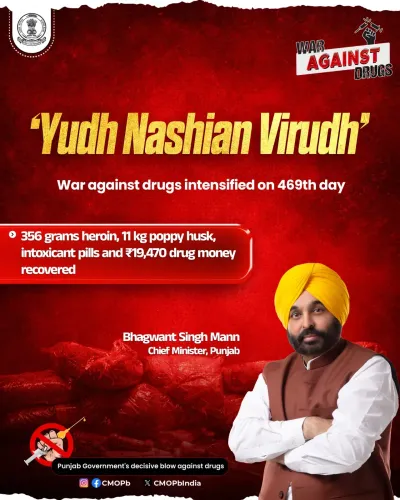
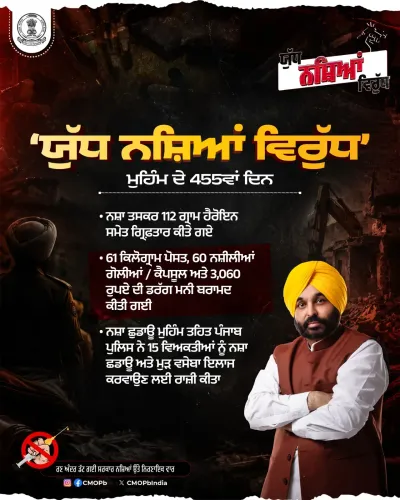
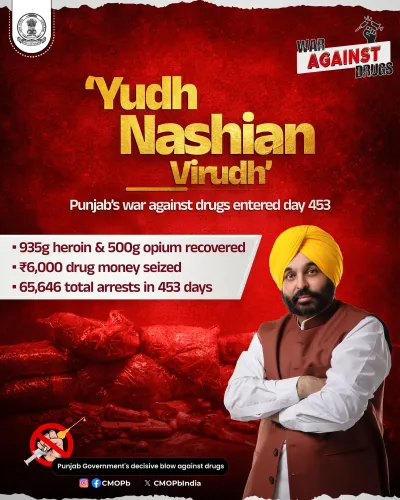
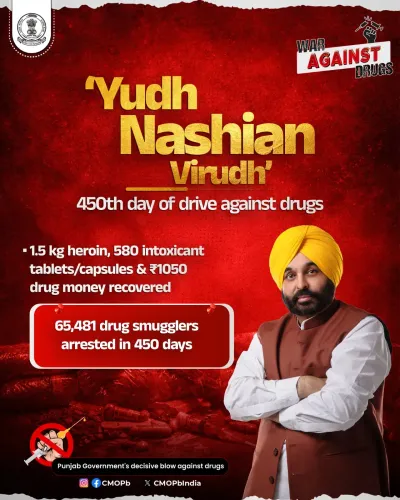
Punjab Police hits Day 516 of 'Yudh Nashian Virudh', nears 75,000 arrests
Synopsis
Punjab Police completed Day 516 of 'Yudh Nashian Virudh' on 31 July 2026, seizing 1.1 kg heroin, 900 g opium, and 1,747 pills, pushing cumulative arrests to 74,995. Separately, 16 persons were referred to de-addiction treatment under the campaign's rehabilitation arm.
Key Takeaways
Day 516 of 'Yudh Nashian Virudh' was reported by the Chief Minister's Office of Punjab on 31 July 2026 .
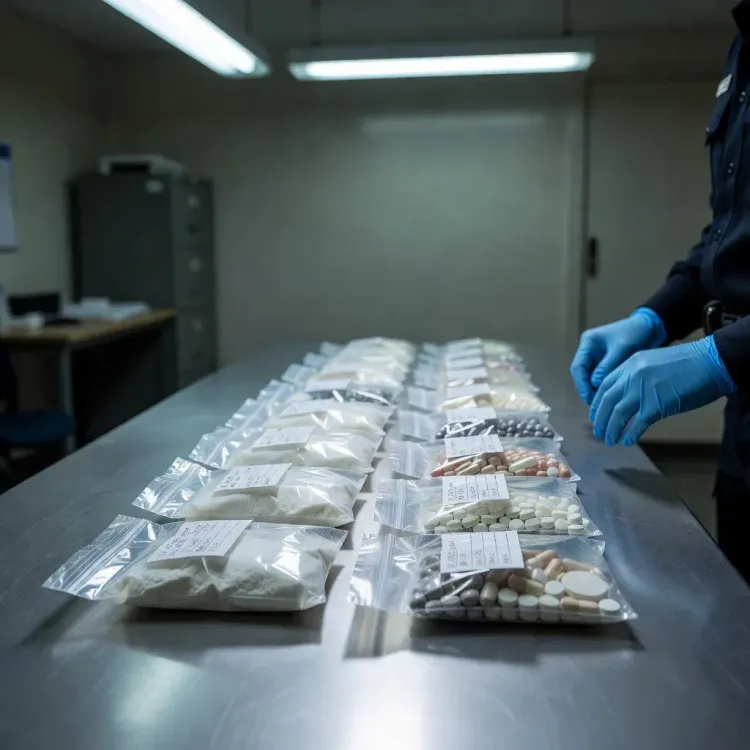
Punjab Police seized 1.1 kg heroin , 900 g opium , and 1,747 intoxicant pills from arrested drug smugglers on that day.
Cumulative arrests under the campaign have reached 74,995 in 515 days , approaching the 75,000 milestone. ₹1,300 in drug money was also recovered from the arrested smugglers.
16 persons were persuaded to enter voluntary de-addiction and rehabilitation treatment on Day 516.
The campaign was launched after the 2022 Punjab assembly elections by Chief Minister Bhagwant Mann 's Aam Aadmi Party government.
Nearly 75,000 drug smugglers behind bars, 1.1 kg of heroin off the streets in a single day, and a campaign that has not paused once in 516 consecutive days — Punjab's war on narcotics is grinding forward with the kind of operational persistence that defines a long-game strategy. The Chief Minister's Office of Punjab confirmed on 31 July 2026 that Punjab Police sustained its Yudh Nashian Virudh ('War Against Drugs') drive through its 516th day, adding fresh seizures and arrests to a cumulative tally that now stands at 74,995 drug smugglers arrested in 515 days.
What Day 516 yielded: heroin, opium, and ₹1,300 in drug money
The day's haul, recovered from newly arrested smugglers, included 1.1 kg heroin, 900 grams opium, 1,747 intoxicant pills, and ₹1,300 in suspected drug proceeds. The figures are modest in isolation — but they are additive. Every day's seizure feeds into a cumulative ledger that now spans well over a year of unbroken enforcement, making Yudh Nashian Virudh one of the longest continuously reported anti-narcotics drives in Punjab's recent history.
The rehabilitation arm: 16 more convinced to seek help
Enforcement alone has never solved Punjab's drug crisis, and the campaign's architects appear to know it. Alongside the arrests, Punjab Police on Day 516 convinced 16 persons to voluntarily enter de-addiction and rehabilitation treatment — a quieter metric, but arguably the more consequential one. The demand-side intervention reflects the dual mandate built into Yudh Nashian Virudh since its launch in the aftermath of the 2022 Punjab assembly elections, when Chief Minister Bhagwant Mann and the Aam Aadmi Party government made drug eradication a centrepiece pledge.
Punjab's long fight: why the numbers matter beyond the daily bulletin
Punjab's geography — sharing borders with Pakistan and sitting at the end of the so-called 'Golden Crescent' trafficking corridor — has made it a chronic entry point for heroin and other narcotics. Successive state governments have launched crackdowns; what distinguishes the current drive is the daily public reporting cadence, which creates political accountability through transparency. Nearly 75,000 arrests in under 18 months is a striking operational figure, though independent verification of cumulative totals remains limited. The rehabilitation numbers — trickling in at a few dozen per day — point to the harder, slower work of breaking the cycle of addiction rather than simply clearing supply chains.
The campaign's next test is whether the enforcement intensity translates into measurable drops in addiction rates and trafficking volumes — data that monthly or quarterly consolidated reports will eventually have to answer for.
Point of View
000 arrest milestone is a headline-ready number, but analysts will watch whether the modest daily rehabilitation figures — a few dozen at a time — eventually scale into a structural reduction in addiction prevalence. Punjab's drug crisis has outlasted multiple crackdowns, and the real measure of this campaign will be long-term demand-side data, not just supply-side seizure tallies. The transparency-through-daily-bulletins model is, however, a governance innovation worth tracking as a template for accountability.
NationPress
31 Jul 2026
Frequently Asked Questions
What is 'Yudh Nashian Virudh'?
'Yudh Nashian Virudh' means 'War Against Drugs' in Punjabi. It is a statewide anti-narcotics campaign launched by the Bhagwant Mann-led Aam Aadmi Party government in Punjab after the 2022 assembly elections, combining daily police enforcement against drug smugglers with de-addiction and rehabilitation outreach.
How many drug smugglers have been arrested in Punjab's anti-drug drive so far?
According to the Chief Minister's Office of Punjab, the total number of drug smugglers arrested under the 'Yudh Nashian Virudh' campaign reached 74,995 as of 515 days into the drive, with Day 516 adding fresh arrests on 31 July 2026.
What drugs were seized by Punjab Police on Day 516?
On Day 516 of 'Yudh Nashian Virudh', Punjab Police recovered 1.1 kg heroin, 900 grams opium, 1,747 intoxicant pills, and ₹1,300 in suspected drug money from arrested smugglers.
Does the Punjab anti-drug campaign include rehabilitation, or only arrests?
Yes, the campaign has a de-addiction component. On Day 516 alone, Punjab Police convinced 16 persons to voluntarily undergo de-addiction and rehabilitation treatment, reflecting the dual enforcement-plus-rehabilitation mandate of the drive.
Why is Punjab particularly vulnerable to drug trafficking?
Punjab shares an international border with Pakistan and sits along trafficking routes linked to the 'Golden Crescent' — Afghanistan, Iran, and Pakistan — making it a historically significant entry point for heroin and opiates into India.