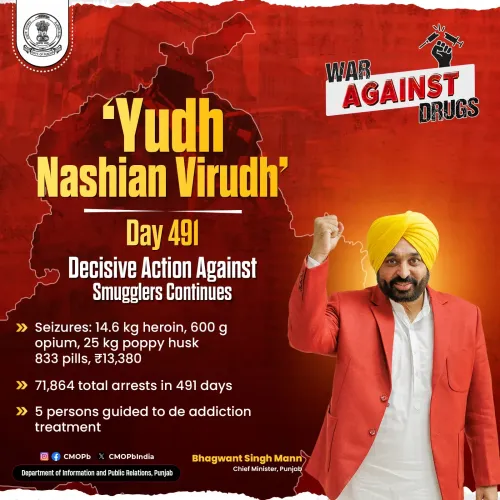
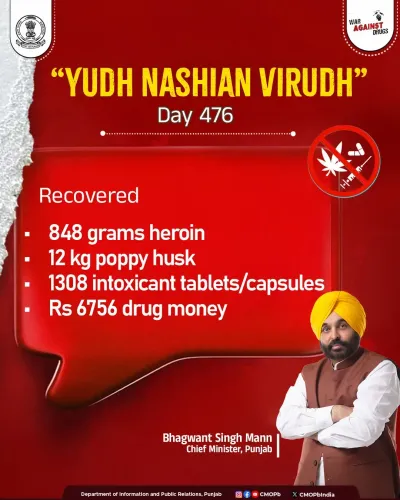
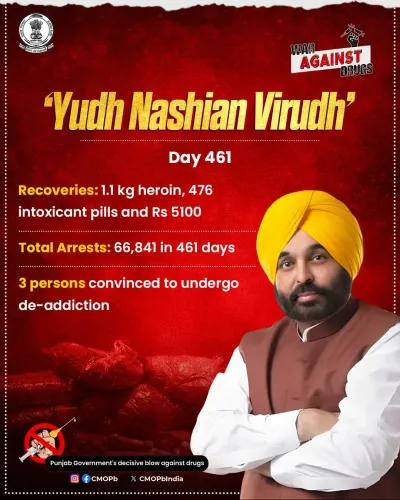
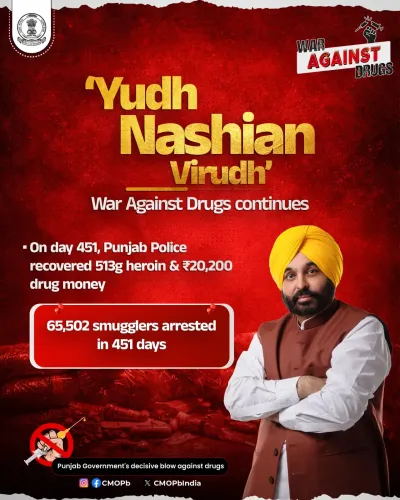
Punjab Police hits Day 594 of Yudh Nashian Virudh, arrests drug smugglers
Synopsis
Punjab Police completed Day 594 of the Yudh Nashian Virudh anti-drug campaign, arresting fresh drug smugglers, seizing 1.7 kg heroin and ₹1.72 lakh drug money, and pushing total arrests to 85,969 since the AAP government launched the drive in 2022.
Key Takeaways
Day 594 of the Yudh Nashian Virudh campaign was completed on October 17, 2026 .
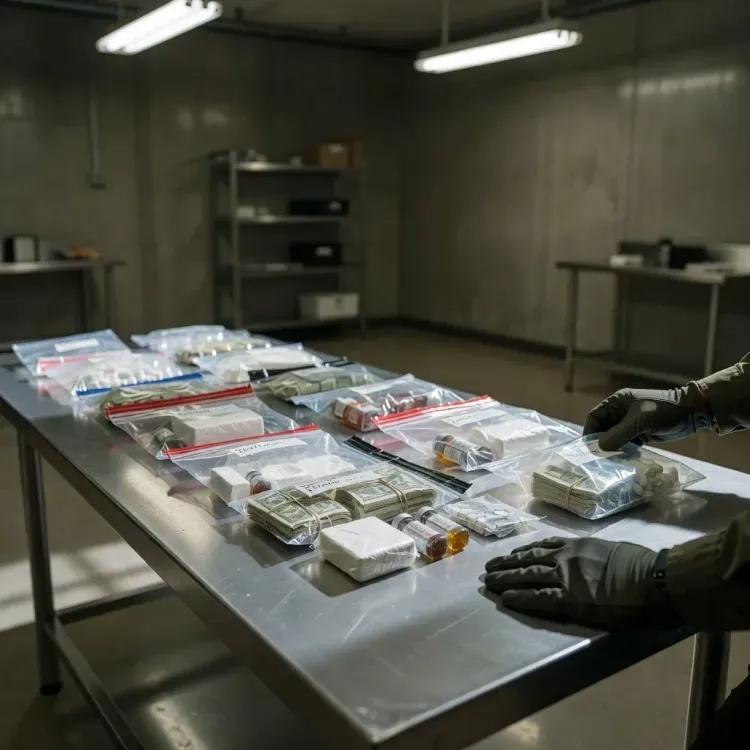
Police recovered 1.7 kg heroin , 351 intoxicant pills , and ₹1.72 lakh in drug money in the latest operations.
Cumulative arrests since the campaign's launch have reached 85,969 drug smugglers .
31 persons were persuaded to enter de-addiction and rehabilitation treatment on Day 594 alone.
The campaign was launched in 2022 by the AAP government under Chief Minister Bhagwant Mann as a flagship anti-narcotics initiative.
Daily public disclosure of figures is a core design feature, creating political accountability for sustained enforcement.
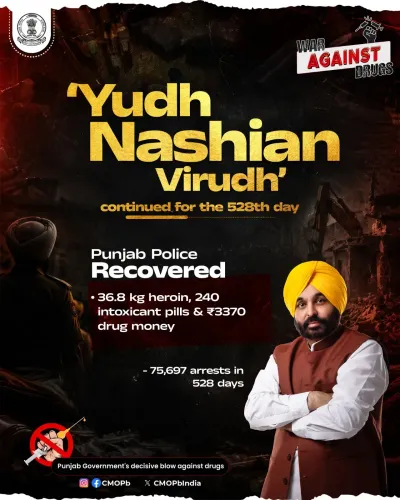
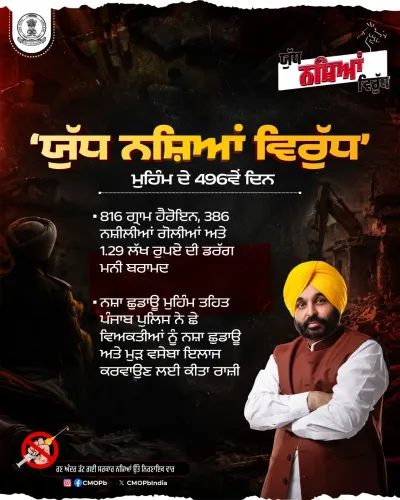
A campaign that started as a political promise is now a relentless daily drumbeat — and on its 594th consecutive day, Punjab Police's anti-drug drive Yudh Nashian Virudh ('War Against Drugs') added more names to a growing ledger of accountability. The Chief Minister's Office of Punjab announced on Saturday, October 17, 2026, that fresh arrests pushed the campaign's cumulative tally to 85,969 drug smugglers detained since the drive began.
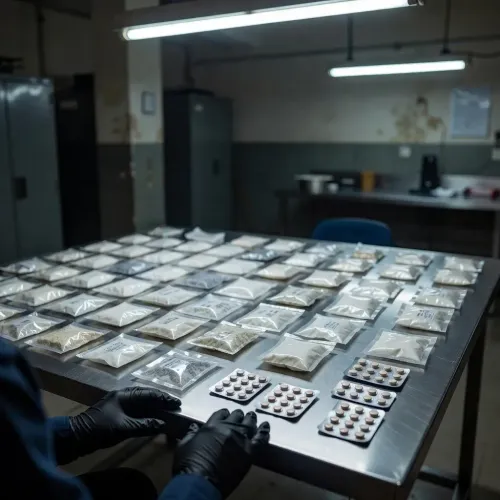
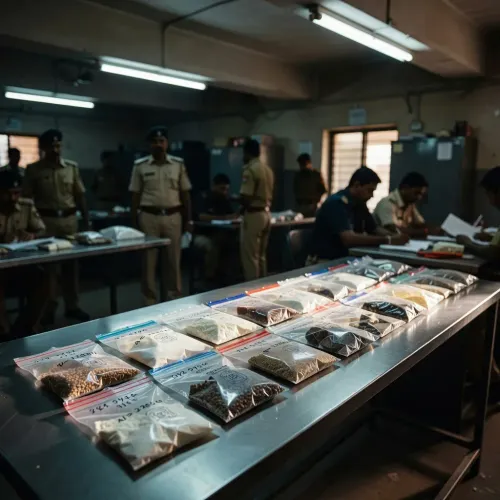
In the latest single-day sweep, police teams seized 1.7 kg of heroin, 351 intoxicant pills, and ₹1.72 lakh in suspected drug money — recoveries that, while individually modest, form part of a systematic pressure strategy designed to disrupt supply chains at every link, from street-level peddlers to mid-tier traffickers.
Why daily public reporting is itself the policy
The AAP government under Chief Minister Bhagwant Mann, which came to power in 2022, engineered the campaign with a deliberate transparency feature: every single day's numbers go public. That design choice is not incidental. Punjab had watched earlier enforcement spurts flare and fade without accountability. By locking the government into a daily disclosure rhythm, the administration created a self-reinforcing pressure loop — one that makes it politically costly to quietly wind down operations. The cumulative 85,969-arrest figure, whatever its composition, is a number the government now owns in full public view.The rehabilitation arm: 31 more persons referred on Day 594
Enforcement alone has never solved a drug crisis, and the campaign's architects appear to know it. Alongside the arrests and seizures, Punjab Police reported convincing 31 persons on this single day to voluntarily enter de-addiction and rehabilitation treatment. The dual-track approach — arresting supply-side actors while simultaneously routing demand-side individuals toward treatment — reflects a public-health framing that distinguishes users from traffickers in both messaging and outcome. Punjab's drug challenge is structurally stubborn. The state shares a long border with Pakistan through which narcotics have historically entered India, and internal distribution networks have deep roots across districts. Successive governments have acknowledged the crisis; the current administration's distinguishing bet is that relentless, transparent, daily pressure — visible to families, to the press, and to the police hierarchy itself — can shift the baseline over time. Day 595 will bring another update. That predictability is, by design, the whole point.Point of View
Embedding anti-drug enforcement into the state's institutional identity. The rehabilitation referral numbers, while small on a per-day basis, signal an attempt to avoid the trap of pure enforcement-driven approaches that have historically failed to reduce demand. The real test, however, lies in whether treatment infrastructure is scaling proportionally — a question the cumulative referral figures will eventually force into the open.
NationPress
17 Oct 2026
Frequently Asked Questions
What is the Yudh Nashian Virudh campaign in Punjab?
Yudh Nashian Virudh, meaning 'War Against Drugs,' is an ongoing anti-narcotics drive launched by the AAP government in Punjab in 2022 under Chief Minister Bhagwant Mann. It involves daily police operations against drug smugglers and traffickers, with results reported publicly every day.
How many drug smugglers have been arrested under Yudh Nashian Virudh?
As of Day 594 on October 17, 2026, the cumulative number of drug smugglers arrested under the campaign has reached 85,969.
What was seized in the latest Yudh Nashian Virudh operation?
In the Day 594 operations, Punjab Police recovered 1.7 kg of heroin, 351 intoxicant pills, and ₹1.72 lakh in suspected drug money.
Does Punjab Police only arrest drug dealers, or does it also help addicts?
The campaign has a dual track — enforcement against traffickers and smugglers, and rehabilitation referrals for users. On Day 594, police convinced 31 persons to undergo de-addiction and rehabilitation treatment.
Why does Punjab have a drug problem?
Punjab's drug challenge is linked to its border with Pakistan, through which narcotics have historically entered India, combined with internal distribution networks across the state. Successive governments have attempted enforcement campaigns; the current AAP administration's approach emphasises daily public accountability.