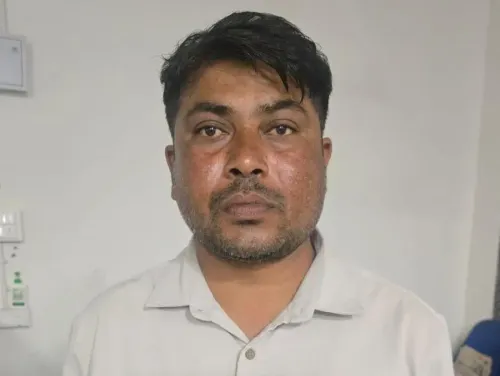
Punjab VB Nabs Sangrur ASI Red-Handed for Rs 7,000 Bribe
Synopsis
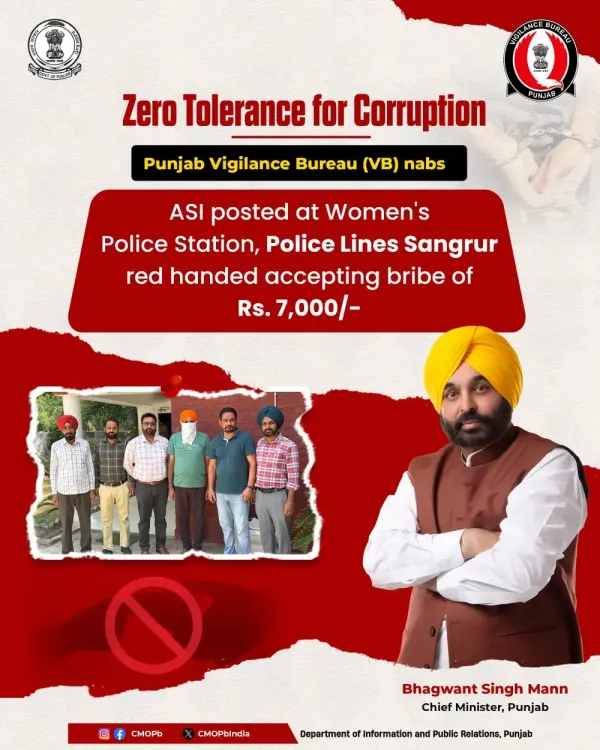
The Punjab Vigilance Bureau arrested ASI Kamaljit Singh of the Women's Police Station, Police Lines Sangrur, red-handed while accepting a Rs 7,000 bribe on 15 July 2026, as part of the state government's ongoing anti-corruption drive under its zero-tolerance policy.
Key Takeaways
The Punjab Vigilance Bureau arrested ASI Kamaljit Singh on 15 July 2026 in a red-handed bribe trap operation.
The accused was posted at the Women's Police Station, Police Lines, Sangrur at the time of arrest.
The bribe amount involved was Rs 7,000 .
The arrest is part of an ongoing anti-corruption drive by the Punjab government under its stated zero-tolerance policy.
The Aam Aadmi Party government in Punjab has used VB trap operations as a key tool to demonstrate its anti-graft mandate since coming to power in March 2022 .
Criminal proceedings under the Prevention of Corruption Act and departmental action are expected to follow.
The Chief Minister's Office of Punjab announced on Wednesday, 15 July 2026 that the Punjab Vigilance Bureau (VB) has arrested an Assistant Sub-Inspector (local rank) posted at the Women's Police Station, Police Lines, Sangrur, while he was allegedly accepting a bribe of Rs 7,000 from a complainant.
Context
The accused officer, ASI Kamaljit Singh, was caught red-handed by VB teams as part of an ongoing drive against corruption in the state. The arrest was made at the Women's Police Station within the Police Lines complex in Sangrur district, a facility that handles cases specifically involving women complainants.
The CMO Punjab post described the action as part of a broader anti-graft campaign, tagging it under #ZeroTolerance and #PunjabGovtInitiatives — indicating the government's intent to frame individual arrests as part of a systemic policy push.
Policy Backdrop
The Punjab Vigilance Bureau functions as the state government's primary agency for investigating bribery and misconduct by public servants, including police personnel. It operates independently of the regular police chain of command, allowing it to conduct sting operations and trap accused officials.
The Aam Aadmi Party came to power in Punjab in March 2022 on an explicit anti-corruption mandate, making zero-tolerance against bribe-taking a central plank of its governance agenda. Since then, the VB has periodically publicised arrests of government employees at various levels — from lower-level functionaries to gazetted officers — to reinforce this messaging.
Similar anti-corruption drives have been a feature of AAP-governed states, with trap operations and red-handed arrests used as both a deterrent and a public-communication tool.
Stakeholders and Impact
The immediate impact falls on citizens who interact with police stations — particularly women complainants who approach Women's Police Stations expecting a safe and unbiased environment. Bribery at such sensitive facilities compounds the vulnerability of those already seeking redress for grievances.
For the state's Punjab Police force, the arrest of a serving ASI at a Women's Police Station carries reputational weight. Departmental proceedings alongside criminal charges under the Prevention of Corruption Act are the standard follow-up in such trap cases, potentially affecting the accused's service record and pension.
Anti-corruption watchdogs and civil society groups in Punjab have long flagged petty bribery at police stations as a persistent problem, and publicly announced arrests are seen as one mechanism to signal institutional accountability.
What's Next
Following the red-handed arrest, the VB is expected to register a formal case under relevant sections of the Prevention of Corruption Act and present the accused before a competent court. Departmental action by the Punjab Police hierarchy is also likely to be initiated in parallel.
Observers will watch whether the Sangrur district police command issues any internal directives to station-level personnel on bribe prevention, and whether the VB's ongoing drive yields further arrests in the coming days — a pattern that has been observed in earlier anti-corruption campaigns by the state government.
Point of View
Which has built its Punjab identity around rooting out corruption within the state machinery itself. By publicising the VB's trap operation through the official CMO handle, the government signals that no department, including the police, is exempt from scrutiny. However, the Rs 7,000 bribe amount also underscores a persistent reality: petty corruption at the station level remains an everyday problem for ordinary citizens, and periodic arrests, while symbolically significant, are not by themselves a structural solution. The real test of the zero-tolerance policy will be in the consistency and outcome of prosecutions, not just the frequency of trap operations.
NationPress
15 Jul 2026
Frequently Asked Questions
Who is ASI Kamaljit Singh arrested by Punjab Vigilance Bureau?
ASI Kamaljit Singh (local rank) is a Punjab Police officer who was posted at the Women's Police Station, Police Lines, Sangrur. He was arrested on 15 July 2026 by the Punjab Vigilance Bureau while allegedly accepting a bribe of Rs 7,000.
What is the Punjab Vigilance Bureau and what does it do?
The Punjab Vigilance Bureau is a state government agency tasked with investigating corruption, bribery, and misconduct by public servants in Punjab, including police personnel. It conducts trap operations to catch officials red-handed while accepting bribes.
What action will be taken against the arrested ASI in Punjab?
Following a red-handed arrest, the VB typically registers a case under the Prevention of Corruption Act and produces the accused in court. Parallel departmental proceedings by the Punjab Police are also expected, which can affect the officer's service and pension.
What is Punjab's zero-tolerance policy on corruption?
The Aam Aadmi Party government, which came to power in Punjab in March 2022, has declared a zero-tolerance stance on corruption. The Punjab Vigilance Bureau regularly conducts drives targeting bribe-taking officials across departments as part of this policy.
How common are police bribery arrests in Punjab?
The Punjab Vigilance Bureau has periodically arrested police personnel and other government employees in bribe trap operations since 2022. These arrests span various ranks and departments and are regularly publicised by the government as evidence of its anti-corruption agenda.