Puri Backs GOBARdhan Push to 10x India's Biogas Output
Synopsis
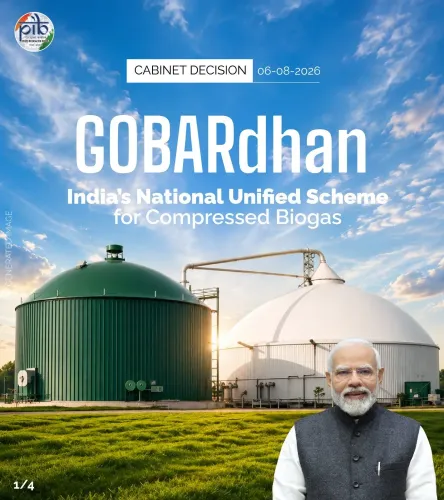
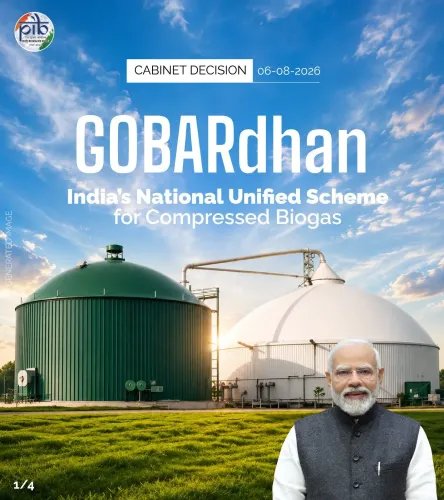
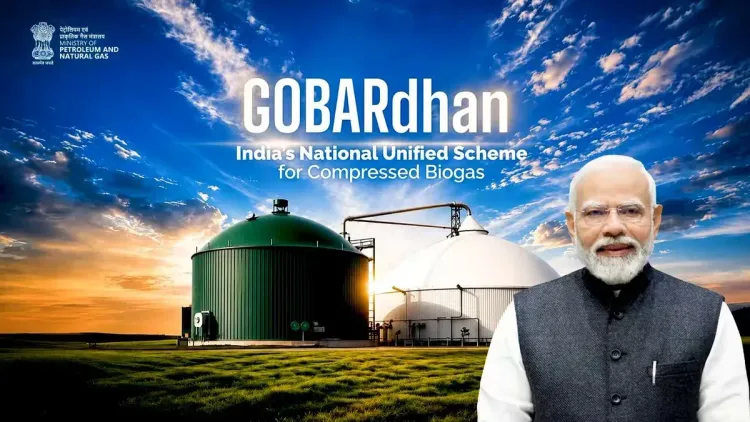
Union Petroleum Minister Hardeep Singh Puri has backed the Cabinet-approved ₹23,731 crore GOBARdhan scheme expansion, which targets a nearly 10-fold increase in India's Compressed Biogas production by converting agricultural residue and organic waste into clean fuel.
Key Takeaways
The Union Cabinet has approved an outlay of ₹23,731 crore for the expanded GOBARdhan scheme.
The scheme targets a ~10-fold increase in India's Compressed Biogas (CBG) production capacity.
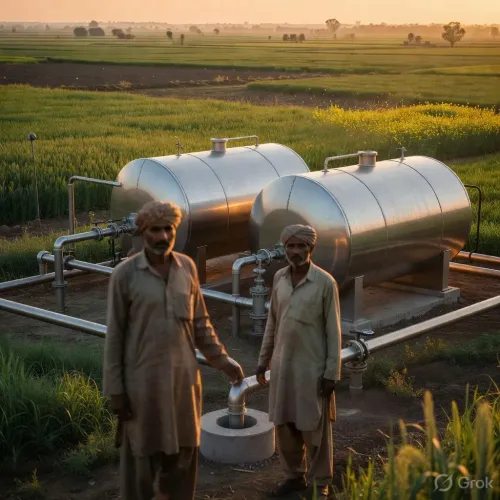
Feedstocks include cow dung, paddy stubble, crop residue and municipal organic waste .
GOBARdhan was originally launched in 2018 under Swachh Bharat Mission-Gramin; the SATAT initiative, also from 2018, targeted 5,000 CBG plants for automotive fuel use.
The Ministry of Petroleum and Natural Gas is the nodal ministry for CBG production targets and offtake arrangements.
Stated benefits span farmer income, rural entrepreneurship, private investment and energy security .
India's farm fields and city bins may soon power its kitchens and fuel pumps — and Union Petroleum Minister Hardeep Singh Puri wants the country to know exactly how. On Tuesday, 11 August 2026, Puri took to X to champion the Cabinet-approved expansion of the GOBARdhan scheme, framing it as a civilisational pivot: turning cow dung, paddy stubble, crop residue and municipal organic waste into Compressed Biogas (CBG) — and doing it at a scale India has never attempted before.
What the Cabinet Cleared — and What It Promises
The Union Cabinet has approved an outlay of ₹23,731 crore for the GOBARdhan scheme, with the stated goal of scaling up domestic CBG production by approximately 10 times the current level. The scheme — whose full name, Galvanizing Organic Bio-Agro Resources Dhan, signals its rural DNA — was first launched in 2018 under the Swachh Bharat Mission-Gramin, targeting biogas generation from organic waste at the village level. This latest Cabinet sanction marks a dramatic acceleration of that original vision.
Puri listed the downstream benefits in crisp sequence: new income streams for farmers and livestock owners, momentum for the rural economy, entrepreneurship openings for youth, a fresh lane for private investment, and — the strategic headline — a stronger foundation for India's energy security.
From SATAT to GOBARdhan: The CBG Policy Arc
The push did not begin here. In October 2018, the government launched the SATAT (Sustainable Alternative Towards Affordable Transportation) initiative, targeting 5,000 CBG plants to supply compressed biogas as an automotive fuel — a direct substitute for CNG at retail pumps. GOBARdhan, running in parallel under the rural sanitation umbrella, added the feedstock layer: waste-to-energy conversion at the source, in villages and municipalities.
Together, the two programmes form the spine of India's biogas policy — one building the supply chain, the other creating the market. The new Cabinet outlay is designed to knit them into a single, scaled-up industrial push.
Waste to Wealth: The Bigger Frame
Puri's post explicitly invokes the 'Waste to Wealth' and Atmanirbhar Bharat frameworks — and the logic is hard to argue with. India generates millions of tonnes of agricultural residue annually; stubble burning alone is a seasonal air-quality crisis across the Indo-Gangetic plain. Converting that residue into CBG simultaneously addresses three pressure points: rural income, urban air quality, and crude oil import dependence.
The Ministry of Petroleum and Natural Gas, as the nodal ministry for CBG offtake and production targets, sits at the centre of this convergence — which is precisely why a petroleum minister, not an agriculture or rural development minister, is the loudest voice in the room. Green energy, in the government's framing, is no longer a niche environmental file. It is an energy-security file.
What Needs to Happen Next
The approved outlay sets the financial architecture. The test now is plant-level execution — how quickly new CBG facilities come online, whether private investors follow the government's lead, and whether farmers actually see the promised income from selling organic feedstock. India's biofuel programmes have historically been ambitious on paper and uneven on the ground. A 10-fold production jump is a target, not yet a trajectory.
If the rollout matches the rhetoric, India's green energy transition will have found its most scalable rural engine yet. If it stalls, the gap between policy announcement and village reality will widen — and that gap has a political cost too.
Point of View
Rather than an agriculture or environment minister, at the centre of the announcement, the government is signalling that CBG is now mainstream fuel policy, not a pilot project. The 10-fold production target is politically bold, but India's track record on biofuel scale-up suggests the real test will be private-sector participation and farm-gate feedstock logistics. How quickly plants actually commission will determine whether this becomes a genuine energy pivot or another well-funded scheme that underperforms in execution.
NationPress
11 Aug 2026
Frequently Asked Questions
What is the GOBARdhan scheme and what does it do?
GOBARdhan — short for 'Galvanizing Organic Bio-Agro Resources Dhan' — converts cattle dung, agricultural residue and organic municipal waste into Compressed Biogas (CBG) and bio-fertiliser. It was launched in 2018 under the Swachh Bharat Mission-Gramin and has now received a major Cabinet-approved funding boost.
How much money has the Cabinet approved for GOBARdhan?
The Union Cabinet has approved an outlay of ₹23,731 crore for the expanded GOBARdhan scheme, according to Union Petroleum Minister Hardeep Singh Puri's post on 11 August 2026.
What is Compressed Biogas (CBG) and how is it different from regular biogas?
Compressed Biogas is biogas that has been purified and compressed to a pressure similar to CNG, making it suitable as a direct substitute for natural gas in vehicles and for piped supply. Unlike raw biogas, CBG can be bottled, transported and retailed at fuel stations.
What is the SATAT initiative and how does it relate to GOBARdhan?
SATAT (Sustainable Alternative Towards Affordable Transportation) was launched in October 2018 to set up 5,000 CBG plants and create a commercial market for biogas as automotive fuel. GOBARdhan focuses on waste-to-energy conversion at the source; together they form the two pillars of India's CBG policy.
How will GOBARdhan benefit farmers?
Farmers and livestock owners can sell cattle dung, paddy stubble and other crop residue as feedstock to CBG plants, creating a direct income stream from materials that were previously burned or discarded. The scheme also opens rural entrepreneurship opportunities around plant operation and bio-fertiliser distribution.