CM Bhupendra Patel Hails ₹23,731 Cr GOBARdhan Scheme Approval
Synopsis
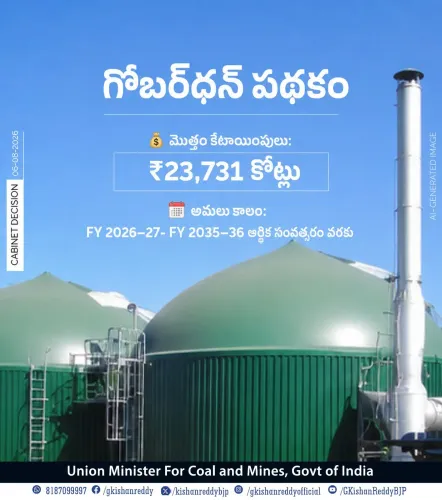
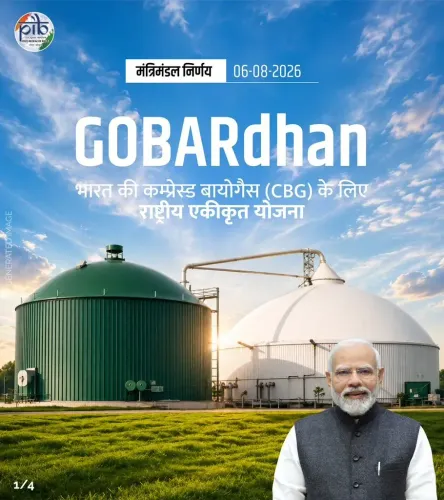
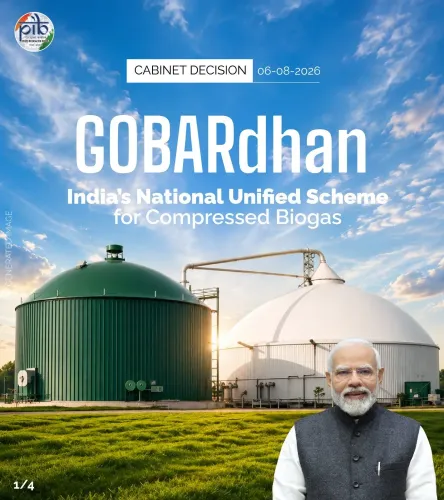
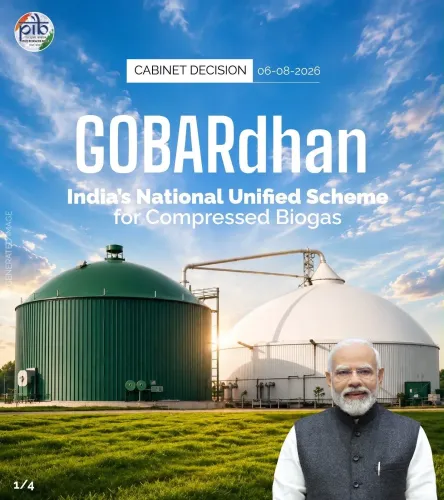
The Union Cabinet, chaired by PM Narendra Modi, approved a revamped GOBARdhan scheme with a ₹23,731 crore budget to scale Compressed Biogas production 10-fold. Gujarat CM Bhupendra Patel hailed the decision as a landmark step for clean energy, rural entrepreneurship, and Atmanirbhar Bharat.
Key Takeaways
The Union Cabinet approved the GOBARdhan scheme with a budget of ₹23,731 crore , chaired by PM Narendra Modi .
The scheme targets a 10-fold increase in Compressed Biogas (CBG) production across India.
GOBARdhan converts cattle dung and organic waste into CBG and bio-fertiliser under the Swachh Bharat Mission (Gramin) framework.
The plan is structured around 6 growth engines aimed at benefiting farmers, rural entrepreneurs, and private investors.
The scheme advances India's Atmanirbhar Bharat goals by substituting imported natural gas with domestically produced CBG.
Gujarat CM Bhupendra Patel called the decision a 'revolutionary step' toward green energy on 6 August 2026 .
India's rural waste is about to get a radical second life. Gujarat Chief Minister Bhupendra Patel on Thursday, 6 August 2026 welcomed the Union Cabinet's approval of the revamped GOBARdhan scheme — backed by a ₹23,731 crore outlay — calling it a historic decision that will turbocharge the country's clean-energy ambitions.
What the Cabinet Cleared — and Why the Number Matters
The scheme, approved under Prime Minister Narendra Modi's chairmanship, targets a 10-fold increase in Compressed Biogas (CBG) production nationwide. GOBARdhan — an acronym for Galvanizing Organic Bio-Agro Resources Dhan — converts cattle dung, crop residue, and organic municipal waste into CBG and bio-fertiliser. The Cabinet's fresh commitment signals that what began as a pilot-stage component of the Swachh Bharat Mission (Gramin) in the 2018-19 Union Budget is now being scaled into a full industrial programme.
CM Patel described the plan as built on '6 major growth engines' — an integrated framework designed to pull in farmers, rural entrepreneurs, and private capital simultaneously. In his post on X, he expressed gratitude to the Prime Minister, calling the move a 'krāntikāri kadam' (revolutionary step) toward green energy and Atmanirbhar Bharat.
From Dung to Dollars: The Waste-to-Wealth Logic
India generates hundreds of millions of tonnes of cattle dung and agricultural waste annually — a resource that currently contributes to methane emissions and rural pollution. CBG, chemically identical to Compressed Natural Gas (CNG), can substitute imported natural gas directly in vehicles, industries, and city gas distribution networks. Scaling it tenfold is not just an environmental play; it is a hard import-substitution bet.
The National Policy on Biofuels 2018 had already set blending targets and opened waste-to-energy pathways. The National Bioenergy Programme extended that architecture. This cabinet decision, if the research community's broader pattern holds, represents the most capital-intensive commitment yet to that multi-year roadmap — and the first time a dedicated, integrated budget of this scale has been attached to CBG expansion.
Who Gains — Farmers, Entrepreneurs, and the Grid
For farmers, GOBARdhan offers a direct revenue stream: selling dung and crop waste to CBG plants rather than burning stubble or letting waste accumulate. Rural entrepreneurs can set up or operate biogas units under the scheme's private-investment incentives. And for the broader energy grid, every unit of CBG produced domestically is one less unit of natural gas imported — a strategic buffer as global energy prices remain volatile.
CM Patel's endorsement carries political weight in a state that has positioned itself as a renewable-energy hub, home to large solar and wind installations. Gujarat's existing gas-distribution infrastructure also makes it a natural early adopter for any CBG scale-up.
The real test now shifts to implementation: how fast states and private developers can commission new CBG plants, and whether the production targets translate from cabinet files into cubic metres of clean fuel. That pipeline — of plants, not promises — is what the ₹23,731 crore will ultimately be judged against.
Point of View
Not a footnote. CM Patel's vocal endorsement fits a pattern of BJP state leaders amplifying central scheme launches to reinforce the party's development narrative ahead of electoral cycles. The 10x production target is politically bold; whether the private-investment incentives and state-level rollout machinery can match that ambition will define the scheme's legacy. Analysts watching India's import bill and rural income data will find this a dual-purpose policy worth tracking closely.
NationPress
21 Sept 2026
Frequently Asked Questions
What is the GOBARdhan scheme?
GOBARdhan (Galvanizing Organic Bio-Agro Resources Dhan) is a central government scheme that converts cattle dung, crop residue, and organic waste into Compressed Biogas (CBG) and bio-fertiliser. It was first launched as part of the Swachh Bharat Mission (Gramin) in the 2018-19 Union Budget.
How much money has the government approved for GOBARdhan in 2026?
The Union Cabinet approved a budget of ₹23,731 crore for the revamped GOBARdhan scheme, as announced on 6 August 2026.
What is Compressed Biogas (CBG) and how is it used?
Compressed Biogas is chemically similar to Compressed Natural Gas (CNG) and can be used as fuel in vehicles, industries, and city gas networks. It is produced from organic waste such as cattle dung and agricultural residue, making it a renewable alternative to imported natural gas.
What did Gujarat CM Bhupendra Patel say about the GOBARdhan scheme?
CM Bhupendra Patel called the Cabinet approval a historic and revolutionary decision, praising PM Modi for advancing clean energy and the Waste-to-Wealth vision. He noted the scheme would create new opportunities for farmers, rural entrepreneurs, and private investors through 6 integrated growth engines.
Who benefits from the GOBARdhan scheme?
The scheme is designed to benefit farmers by giving them a revenue stream from selling organic waste, rural entrepreneurs who can set up or operate CBG plants, and private investors attracted by the scheme's incentive structure. It also benefits the broader economy by reducing dependence on imported natural gas.