Puri Hails Press as Democracy's Pillar on National Press Day
Synopsis
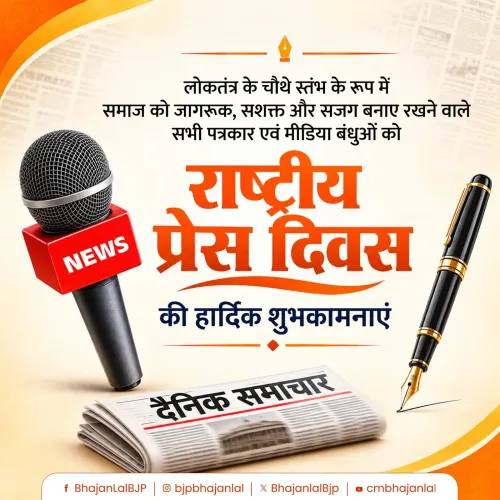
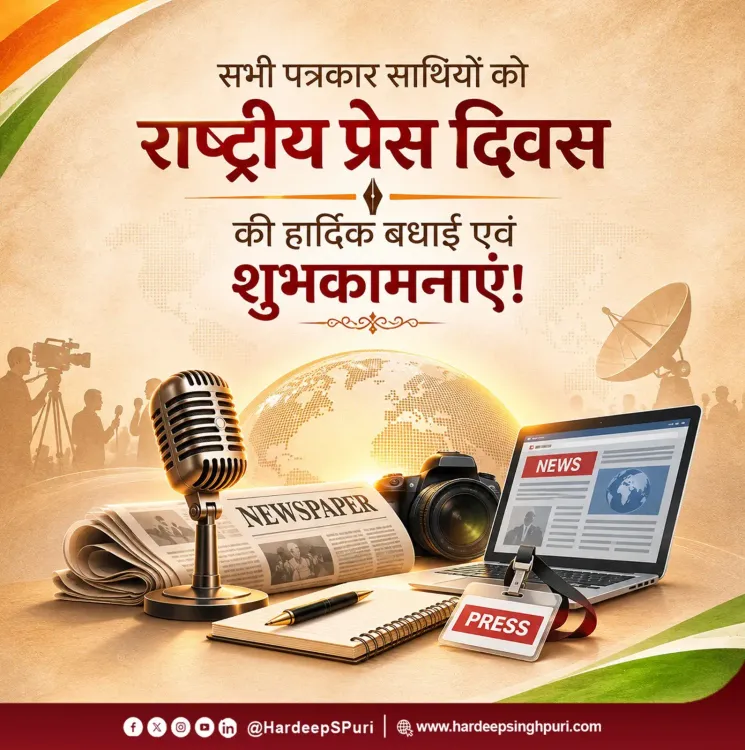
On National Press Day, 16 November 2026, Union Petroleum Minister Hardeep Singh Puri honoured journalists in a bilingual post, calling a free and robust press an essential pillar of democracy and urging commitment to truth, impartiality, and ethical values.
Key Takeaways
Union Petroleum Minister Hardeep Singh Puri marked National Press Day on 16 November 2026 with a bilingual tribute to India's media fraternity.
He described a free and robust press as 'an essential pillar of democracy.' National Press Day commemorates the founding of the Press Council of India , the statutory body for press standards and freedom.
The minister stressed that prioritising public-interest issues and delivering accurate, credible information are journalism's core responsibilities.
He tagged the Ministry of Information and Broadcasting and the Press Information Bureau , reflecting the institutional dimension of the observance.
The post carries no new policy announcement; it forms part of annual public communication by Union ministers on the occasion.
Every 16 November, India pauses to salute the journalists who keep democracy honest — and Union Petroleum Minister Hardeep Singh Puri added his voice to that chorus on National Press Day 2026, calling a free and robust press 'an essential pillar of democracy.'
In a bilingual post on X, Minister Puri extended warm greetings to journalists and media professionals across the country, recognising their role in surfacing stories 'from every corner,' raising difficult questions, and amplifying issues that demand public attention. The Hindi portion of his message drove the point deeper: 'सत्य, निष्पक्षता और नैतिक मूल्यों के प्रति आपकी प्रतिबद्धता लोकतंत्र की मजबूती और समाज की जागरूकता का आधार है' — 'Your commitment to truth, impartiality and ethical values is the foundation of a stronger democracy and an aware society.'
Why November 16 carries weight for the Indian press
National Press Day marks the founding of the Press Council of India, the statutory body established to preserve press freedom and maintain journalistic standards. The date serves as an annual checkpoint — a moment for the profession, the government, and the public to reflect on the health of the fourth estate under Article 19(1)(a) of the Constitution, which guarantees freedom of speech and expression.
Minister Puri tagged the Ministry of Information and Broadcasting and the Press Information Bureau in his post, signalling the institutional acknowledgement that runs alongside the personal tribute. Union ministers routinely issue such greetings on the occasion; the gesture carries symbolic weight even when no new policy is announced.
The dual demand journalism must meet
What distinguishes Puri's message is the dual burden he places on the press: not just to inform, but to prioritise public-interest issues and deliver accurate, credible information — 'जनहित के मुद्दों को प्रमुखता देना तथा समाज तक सही और विश्वसनीय जानकारी पहुँचाना.' In an era of viral misinformation, that framing is pointed. Accuracy and ethics, he argues, are not ideals — they are the structural load-bearing walls of democratic life.
The reminder lands at a time when the relationship between governments and newsrooms is under scrutiny across the globe. India's own media landscape — sprawling, multilingual, and fiercely competitive — makes the call for impartiality and ethical rigour as relevant as ever.
A press that asks hard questions is not an inconvenience to democracy. It is democracy doing its job.
Point of View
Reaching both English and Hindi audiences simultaneously, reflects the breadth of India's media landscape. By explicitly linking journalistic ethics to democratic strength, the message subtly sets a standard of accountability the press is expected to meet — a soft but unmistakable signal that press freedom and press responsibility are framed as inseparable.
NationPress
16 Nov 2026
Frequently Asked Questions
What is National Press Day in India?
National Press Day is observed every year on 16 November to mark the founding of the Press Council of India , a statutory body that upholds press freedom and journalistic standards.
What did Hardeep Singh Puri say on National Press Day 2026?
Union Petroleum Minister Hardeep Singh Puri called a free and robust press 'an essential pillar of democracy' and praised journalists for their commitment to truth, impartiality, and ethical values.
When was the Press Council of India founded?
The Press Council of India was founded on 16 November , which is why the date is commemorated annually as National Press Day.
What is the constitutional basis for press freedom in India?
Article 19(1)(a) of the Indian Constitution guarantees freedom of speech and expression, which forms the constitutional foundation of press freedom in India.
Which government bodies did Hardeep Puri tag on National Press Day?
Minister Puri tagged the Ministry of Information and Broadcasting and the Press Information Bureau in his National Press Day post on X.