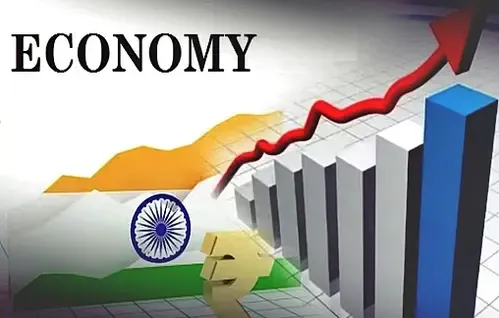
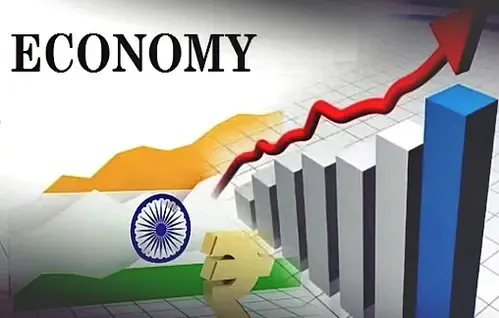
India GDP grows 7.8% in Q1 FY27, retains fastest-growing major economy tag
Synopsis
India's 7.8% Q1 FY27 GDP growth isn't just a headline — it's backed by a rare alignment of signals: record vehicle sales across every segment, 14-year-high bank credit growth, a historic low in bad loans, the strongest quarterly FDI in 15 years, and merchandise exports at an all-time monthly high. The breadth of the data makes this harder to dismiss as a statistical outlier.
Key Takeaways
India's GDP grew 7.8 per cent in Q1 FY27 (April–June) , the fastest among all major economies.
China grew 4.3 per cent ; the US posted 2.1 per cent ; most large European economies came in at 1 per cent or below .
Domestic passenger-vehicle sales hit a record 4.58 lakh units in July, up 34.3 per cent year-on-year.
Public-sector banks posted a record net profit of ₹1.98 lakh crore in FY26 and a historic low gross bad-loan ratio of 1.9 per cent .
Merchandise exports reached an all-time monthly high of $44.24 billion in July, up 19.6 per cent .
Gross inward FDI rose 14.8 per cent to $30.7 billion in Q1 FY27 — the strongest quarterly inflow in at least 15 years .
India's economy expanded at 7.8 per cent in the April–June quarter of FY27, cementing its position as the world's fastest-growing major economy and outpacing every comparable large economy tracked in the period. The data, released on 31 August, arrives alongside a sweep of high-frequency indicators that together paint a picture of broad-based domestic momentum.
India Leads the Global Growth Table
Among major economies, Malaysia and Singapore posted growth of 6.0 per cent and 5.9 per cent respectively, while Indonesia grew 5.29 per cent and China recorded 4.3 per cent. The United States grew at 2.1 per cent, and most large European economies came in at roughly 1 per cent or below. India's margin over the next-fastest large economy is, notably, not a narrow one.
Vehicle Sales Signal Demand Across the Income Spectrum
Domestic passenger-vehicle sales reached 4.58 lakh units in July 2026, up 34.3 per cent year-on-year — the strongest July on record, according to official figures. A senior official noted that a car purchase ripples through steel, tyres, glass, electronics, finance, insurance, dealerships, repairs and fuel retail, supporting activity across large factories and small businesses alike.
Retail tractor sales jumped 28.1 per cent to 1.17 lakh units, also a best-ever July. The official pointed out that farmers typically commit to a tractor purchase when they anticipate better crop prospects, stronger cash flow and sufficient confidence to invest — making the tractor figure a forward-looking rural sentiment indicator.
The two-wheeler segment rose 28.3 per cent to 18.18 lakh units and three-wheelers increased 16.2 per cent to 1.34 lakh units. Total retail registrations climbed 25.9 per cent to 25.91 lakh units, with every major vehicle category recording its strongest July this year.
Tax, Payments and Energy Data Confirm the Breadth
GST revenue grew 15.4 per cent in July, while digital-payment volumes rose 16.6 per cent and transaction value by 18.2 per cent. Electricity demand increased 10.7 per cent, petrol consumption rose 9.2 per cent and diesel use climbed 10 per cent. According to the official, each series measures a distinct slice of economic life, yet all point in the same direction: people and businesses are buying, paying, travelling, producing and shipping more than a year ago.
Industrial production grew 6.7 per cent in July and manufacturing output expanded 7.3 per cent, with 19 of 23 manufacturing sub-groups recording expansion. Coal India's offtake reached 64.19 million tonnes in July, up 18.4 per cent and the highest ever for the month. Railway freight originating rose 8.9 per cent, port cargo 8.8 per cent and electricity generation 7.3 per cent in July 2026.
Banking Sector Hits Multi-Year Milestones
Overall bank credit grew at its fastest pace in over a decade in Q1 FY26. In a notable structural shift, public-sector banks surpassed private-sector banks in credit growth for the first time in 14 years. Public-sector banks also recorded their highest-ever annual net profit of ₹1.98 lakh crore in FY2025-26, while their gross bad-loan ratio fell to a historic low of 1.9 per cent.
Exports and FDI Add External Validation
Merchandise exports rose 19.6 per cent to $44.24 billion in July — the highest-ever monthly export value. Engineering-goods exports increased 17.7 per cent, electronics surged 57.4 per cent and chemicals rose 14.4 per cent, indicating Indian producers are winning higher-value orders in global markets. Gross inward FDI reached approximately $30.7 billion in April–June 2026, up 14.8 per cent and the strongest quarterly inflow in at least 15 years. With domestic demand, credit, exports and foreign investment all reinforcing each other, the near-term growth trajectory appears well-supported — though sustaining 7.8 per cent will depend on how global headwinds evolve through the rest of FY27.
Point of View
But the more telling story is the convergence of independent data streams — GST, digital payments, freight, fuel, credit — all moving in the same direction simultaneously. That breadth is harder to engineer or misread than a single GDP number. The structural shift worth watching is public-sector banks outgrowing private lenders in credit for the first time in 14 years: if that reflects genuine balance-sheet recovery rather than mandated lending, it changes the medium-term credit story materially. The risk, as always, is that global demand softness — particularly in the US and Europe — could clip the export momentum that is now contributing meaningfully to the growth mix.
NationPress
31 Aug 2026
Frequently Asked Questions
What was India's GDP growth rate in Q1 FY27?
India's GDP grew at 7.8 per cent in the April–June quarter of FY27, making it the world's fastest-growing major economy for the period. This compares with China's 4.3 per cent and the US's 2.1 per cent in the same timeframe.
How do India's vehicle sales in July 2026 reflect economic health?
Domestic passenger-vehicle sales reached a record 4.58 lakh units in July 2026, up 34.3 per cent year-on-year. Tractor and two-wheeler sales also hit all-time July highs, signalling rising demand across both urban and rural income segments.
What milestone did India's public-sector banks achieve?
Public-sector banks surpassed private-sector banks in credit growth for the first time in 14 years and posted a record annual net profit of ₹1.98 lakh crore in FY2025-26. Their gross bad-loan ratio also fell to a historic low of 1.9 per cent.
How strong were India's merchandise exports in July 2026?
Merchandise exports rose 19.6 per cent to $44.24 billion in July 2026, the highest-ever monthly export figure. Electronics exports led sectoral growth at 57.4 per cent, followed by engineering goods at 17.7 per cent and chemicals at 14.4 per cent.
What was India's FDI inflow in Q1 FY27?
Gross inward FDI reached approximately $30.7 billion in April–June 2026, up 14.8 per cent year-on-year and the strongest quarterly inflow in at least 15 years, according to official data.