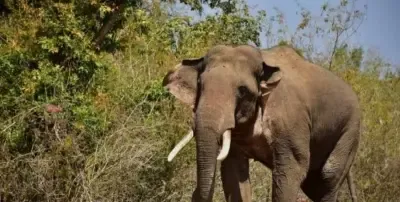
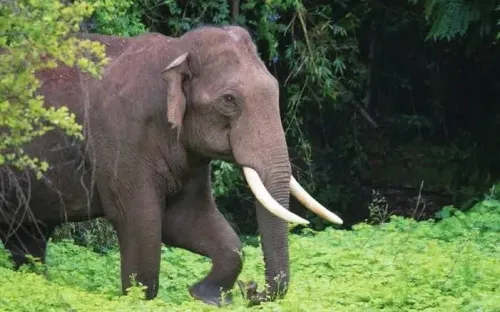
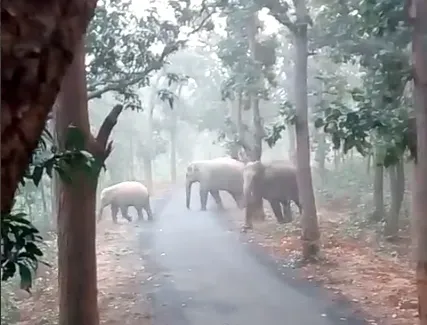
Radio collar fitted to Bhuvaneshwari herd elephant in Hassan's Belur Range
Synopsis
Karnataka's Forest Department has radio-collared a wild elephant from the Bhuvaneshwari herd in Hassan — the third such herd in the district to be fitted with an indigenous collar. The move comes after a foreign-made collar on the same herd failed when its battery died, leaving a critical monitoring gap. The data will now guide real-time alerts before elephants reach villages.
Key Takeaways
Karnataka's Forest Department fitted an indigenous radio collar on a Bhuvaneshwari herd elephant in Belur Range, Hassan on 10 August .
A foreign-made collar on the same herd had stopped working after its battery expired roughly three years ago .
The operation was supervised by veterinary officers from Bandipur Tiger Reserve , Mysuru Circle , and Bhadra Tiger Reserve .
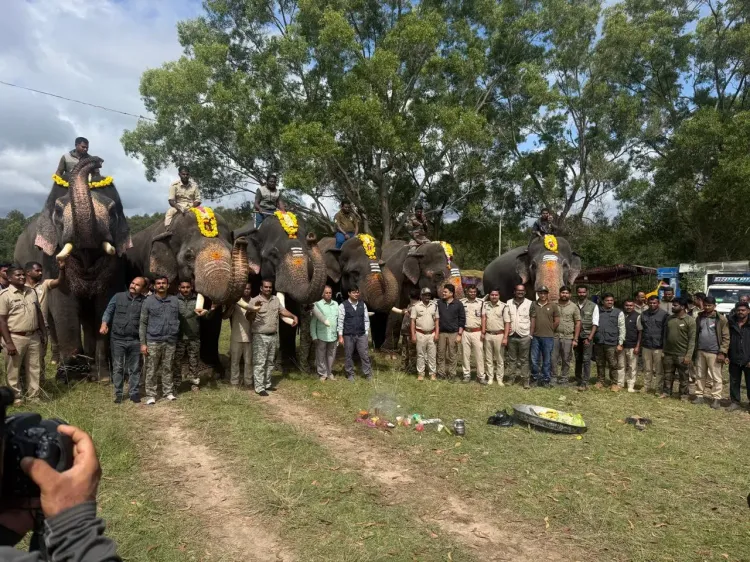
Six kumki elephants from Nagarahole and Dubare camps assisted in safely capturing the animal.
Indigenous radio collars have now been fitted to elephants from three different wild herds in Hassan district.
Tracking data will help officials issue early warnings before the elephant approaches villages or farmland.
Karnataka's Forest Department on Monday, 10 August successfully fitted an indigenous radio collar on a wild elephant belonging to the Bhuvaneshwari herd in the Belur Range of Hassan district, in a bid to continuously monitor the animal's movements and reduce human-elephant conflict in the region.
Why the Operation Was Needed
A foreign-made radio collar had been fitted on another elephant from the same herd approximately three years ago, but it ceased functioning once its battery life expired. The lapse left forest officials unable to track the animal's location through radio telemetry, creating a monitoring blind spot in a district where elephant-human contact is a recurring concern. The new indigenous collar is designed to address that gap.
How the Operation Was Carried Out
The collaring was conducted under the supervision of veterinary officers Wasim of Bandipur Tiger Reserve, Adarsh of Mysuru Circle, and Vinayak of Bhadra Tiger Reserve. Six kumki elephants were deployed to assist in safely capturing the wild elephant: Ekalavya from the Nagarahole Elephant Camp, and Prashanth, Dhananjaya, Eshwara, Lakshmana, and Ajjayya from the Dubare Elephant Camp. Following capture, the elephant underwent necessary veterinary examinations and precautionary checks before the collar was fitted. It was subsequently released safely back into the forest.
What the Tracking Data Will Enable
According to the Forest Department, the radio collar will allow officials to monitor the elephant's movements on a continuous basis. The data gathered will help map the animal's movement patterns, home range, and key elephant corridors. Critically, the tracking system will enable rapid response whenever the elephant approaches villages or agricultural land, giving communities advance warning and reducing the risk of conflict.
Broader Significance for Hassan District
With this latest operation, indigenous radio collars have now been fitted to elephants from three separate wild elephant herds in Hassan district, according to the Forest Department. This marks a steady expansion of the department's technology-driven monitoring programme. Hassan and its adjoining forest ranges have long been a flashpoint for human-elephant conflict, with elephants frequently straying into farmland and settlements along the forest fringe. Radio telemetry, combined with rapid field response, is increasingly the department's frontline tool for managing that pressure. This comes amid a broader Karnataka push to deploy indigenous collars after earlier reliance on imported equipment proved vulnerable to battery and maintenance issues.
Point of View
A gap that carries real human safety consequences in conflict-prone districts like Hassan. The fact that three herds are now collared is progress, but the harder question is whether real-time tracking is matched by equally real-time field response capacity. Collar data is only as useful as the ground teams that act on it. As human-elephant conflict continues to cost lives and livelihoods across the Western Ghats fringe, the department's monitoring technology is outpacing its response infrastructure — and that is the gap worth watching.
NationPress
25 Sept 2026
Frequently Asked Questions
Why was a radio collar fitted on the Bhuvaneshwari herd elephant in Hassan?
The Forest Department fitted the collar to continuously monitor the elephant's movements, map its range and corridors, and enable rapid response before it reaches villages or farmland, thereby reducing human-elephant conflict. An earlier foreign-made collar on the herd had stopped functioning after its battery expired.
What is an indigenous radio collar and how does it differ from earlier collars used?
An indigenous radio collar is domestically manufactured tracking equipment fitted on wild elephants to transmit location data via radio telemetry. Unlike the foreign-made collar previously used on the Bhuvaneshwari herd — which failed when its battery ran out — the indigenous version is part of Karnataka's effort to use locally sourced, maintainable equipment for wildlife monitoring.
Which officials and elephants were involved in the collaring operation?
The operation was supervised by veterinary officers Wasim of Bandipur Tiger Reserve, Adarsh of Mysuru Circle, and Vinayak of Bhadra Tiger Reserve. Six kumki elephants — Ekalavya from Nagarahole Elephant Camp and Prashanth, Dhananjaya, Eshwara, Lakshmana, and Ajjayya from Dubare Elephant Camp — assisted in safely capturing the wild elephant.
How many elephant herds in Hassan district now have radio collars?
Following this operation, elephants from three different wild elephant herds in Hassan district have been fitted with indigenous radio collars, according to the Forest Department.
How will the radio collar help reduce human-elephant conflict?
The collar transmits real-time location data, allowing forest officials to track the elephant's movement patterns and corridors. When the animal approaches human settlements or agricultural land, officials can respond quickly and alert nearby communities, reducing the risk of dangerous encounters.