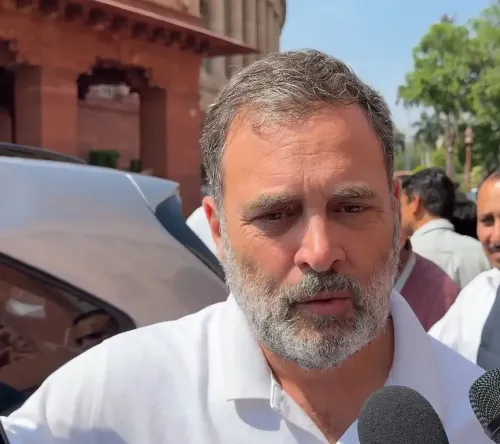
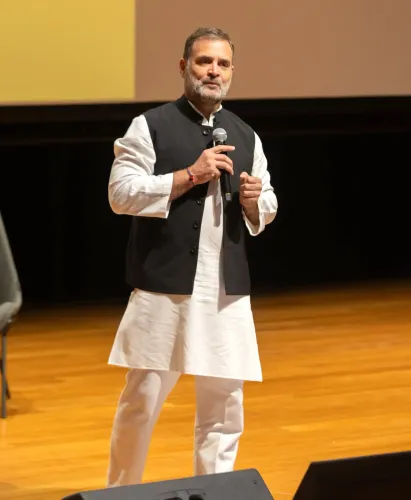
Rahul Gandhi: 'A compromised PM can never sit at this table'
Synopsis
Congress leader Rahul Gandhi posted on X claiming India's PM would have a seat at a key international table if Congress were in power, calling the current PM 'compromised' and unfit for high-level global diplomacy.
Key Takeaways
Congress leader Rahul Gandhi posted on X on 20 November 2026 asserting that a 'compromised PM' cannot represent India at a high-level international table.
Gandhi claimed that if Congress were in power , India's Prime Minister would be present at the forum in question.
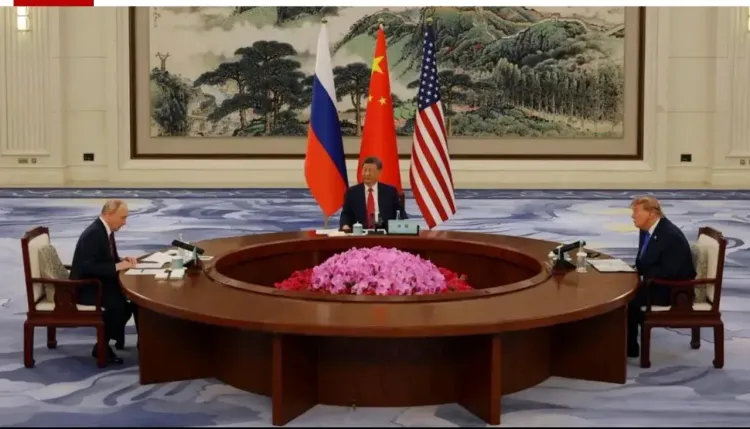
The post was accompanied by an image, though the specific meeting or forum referenced was not explicitly named.
The charge targets Prime Minister Narendra Modi and the BJP -led government's international diplomatic standing.
Indian National Congress last held national power in 2014 and has consistently critiqued the current government's foreign-policy posture.
Responses from the Ministry of External Affairs or ruling party have not yet been issued as of the time of publication.
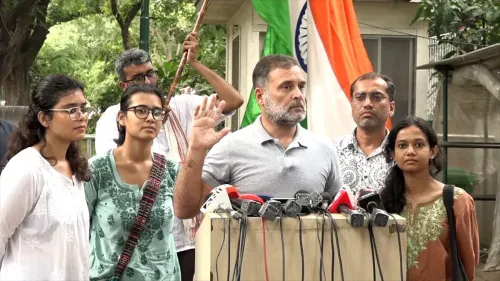
A sharp diplomatic barb landed on Friday, 20 November 2026, when Congress leader Rahul Gandhi, Leader of the Opposition in Lok Sabha, posted a pointed assertion on X — claiming that a 'compromised' prime minister cannot occupy India's seat at a high-level international forum, and that only a Congress-led government would have put India there.
Gandhi's post read: 'If Congress were in power, India's Prime Minister would be sitting at this table. A compromised PM can never sit at this table.' The statement, accompanied by an image, was aimed squarely at Prime Minister Narendra Modi and carried a loaded subtext — that the current government's standing on the world stage is, in the opposition's view, diminished by what Gandhi terms a 'compromise.'
The 'table' at the centre of the charge
Gandhi did not specify the meeting or forum in question, but the framing — 'this table' — suggests a multilateral gathering of significant weight, one where India's absence or reduced representation could be presented as diplomatically consequential. Opposition parties have periodically drawn this contrast, arguing that India's global positioning under the BJP-led government falls short of its potential. The specific forum remains unidentified from available information.
The charge of a 'compromised PM' is a staple of Gandhi's political vocabulary — a sweeping indictment he has used to question Modi's credibility in bilateral and multilateral diplomacy. Whether the allegation refers to economic ties, strategic dependencies, or personal conduct, Gandhi left it deliberately open, letting the image attached to the post carry the implied context.
Congress's diplomatic counter-narrative
The Indian National Congress, which last held national power in 2014, has consistently framed its foreign-policy critique around the idea that it built India's multilateral credibility — through the Non-Aligned Movement, the G20 architecture, and India's historic role in the Global South. Gandhi's post revives that counter-narrative with urgency, positioning Congress not just as an opposition party but as the rightful steward of India's seat at consequential global tables.
Responses from the Ministry of External Affairs or ruling party spokespersons, should they come, will likely contest both the characterisation of Modi's standing and the implicit claim that Congress would have fared differently. That rebuttal, if it arrives, will add the next chapter to a foreign-policy debate that the opposition is clearly keen to keep alive heading into future electoral cycles.
The question Gandhi is really asking his audience is a simple, devastating one: does India have an empty chair where it matters most?
Point of View
Then daring the government to defend itself. The genius and the weakness of the framing are the same thing: its deliberate ambiguity. By not naming the table, Gandhi forces viewers to project their own anxieties about India's global clout onto the image. What the Congress party is really doing is building a long-arc foreign-policy brief against Modi ahead of the next electoral cycle, repositioning itself as the natural party of India's multilateral ambitions — a role it held for decades before 2014. Whether voters connect diplomatic optics to ballot choices remains the central open question.
NationPress
20 Nov 2026
Frequently Asked Questions
What did Rahul Gandhi say about the PM and the international table?
Rahul Gandhi posted on X on 20 November 2026 that if Congress were in power, India's Prime Minister would be present at a high-level international forum, adding that a 'compromised PM can never sit at this table.'
Which meeting or forum is Rahul Gandhi referring to?
Gandhi did not explicitly name the meeting or forum in his post. The specific table he referenced could not be independently identified from available information at the time of publication.
What does Rahul Gandhi mean by 'compromised PM'?
Gandhi uses the phrase 'compromised PM' as a broad political charge against Prime Minister Narendra Modi, implying that Modi's credibility or independence in international diplomacy is weakened, though the post does not specify the nature of the alleged compromise.
How has Congress criticised Modi's foreign policy before?
Congress has periodically argued that India's global standing and multilateral influence have declined under the BJP-led government since 2014, contrasting it with what the party describes as its own track record of building India's diplomatic credibility.
Has the government responded to Rahul Gandhi's post?
As of publication, no formal response from the Ministry of External Affairs or ruling party spokespersons had been issued regarding Gandhi's 20 November 2026 post.