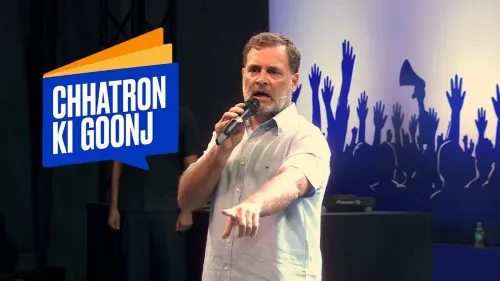
Rahul Gandhi Accuses PMO of Targeting Ambedkar, Phule Texts

Synopsis
Congress leader Rahul Gandhi has alleged that an anonymous social media post branding Ambedkar and Phule texts as 'poison' was followed within 24 hours by a PMO-directed Education Ministry query to central universities — framing it as evidence of ideological interference in Indian higher education.
Key Takeaways
Rahul Gandhi alleged on September 30, 2026 that an anonymous post labelling Ambedkar's and Phule's works as 'poison' preceded a Ministry of Education data call to central universities by a single day.
Gandhi claimed the PMO directed the Ministry of Education to ask all central universities for syllabus details and enrolment figures for courses featuring these texts.
Ambedkar 's Annihilation of Caste (1936) and Jyotiba Phule 's Gulamgiri (1873) are widely taught across Indian sociology, history, and constitutional-studies programmes.
The National Education Policy 2020 gave UGC a mandate to coordinate curriculum updates, a framework opposition leaders say enables ideological interference.
The Ministry of Education had not issued a public clarification on the alleged data request at the time of publishing.
Gandhi drew a pointed contrast: a prime minister 'silent on paper leaks and unemployment' but 'immediately responsive to internet trolls.'
An anonymous social media post calling B.R. Ambedkar's Annihilation of Caste and Jyotiba Phule's Gulamgiri 'poison' for young minds was followed, within 24 hours, by a data-call from the Ministry of Education to all central universities — and Congress leader Rahul Gandhi has seized on that sequence as evidence of what he calls a government at war with social justice education. Gandhi posted the allegation on Wednesday, September 30, 2026, sharpening a battle-line over who controls what India's students read.
The sequence Gandhi is pointing to
In his post, Gandhi described the chain of events with precision: an anonymous account on X flagged several foundational social-reform texts as intellectually dangerous to youth; the very next day — a Sunday — the Prime Minister's Office purportedly directed the Ministry of Education to write to all central universities seeking syllabus details and enrolment data for courses featuring such content. Gandhi translated that sequence into a political charge: 'The Prime Minister who stays silent on paper leaks, unemployment and student safety acts immediately at the nudge of internet trolls.'
The Ministry of Education has not issued a public clarification on the nature or scope of the data request as of the time of publishing. NationPress could not independently verify the specific PMO directive or the precise timing of the anonymous post relative to the ministry's communication.
Why Ambedkar and Phule sit at the centre of this row
B.R. Ambedkar's Annihilation of Caste — originally a speech written in 1936 — is among the most cited texts in any course on Indian sociology, constitutional history, or Dalit studies. Jyotiba Phule's Gulamgiri, published in 1873, argued that caste hierarchy was a form of slavery and advocated universal education for lower castes; it is taught across history and social-science programmes. Both authors are enshrined in the national consciousness: Ambedkar as the principal drafter of the Indian Constitution, Phule as a foundational figure of the 19th-century social reform movement. Any suggestion that these texts promote harmful ideas carries immediate symbolic and electoral weight, particularly with Dalit and OBC voter blocs.
A recurring fault-line in Indian higher education
The row lands inside a long-running tension. Since the National Education Policy 2020 directed universities to update curricula toward 'value-based' and multidisciplinary content under UGC coordination, opposition parties and faculty bodies have repeatedly raised questions about whether that framing gives the central government room to reshape syllabi along ideological lines. Curriculum-related data requests from the ministry to central universities are not new — but the alleged timing and trigger described by Gandhi give this one a sharper edge.
Gandhi's framing is direct: 'Modi ji is against social justice and equality. His entire system hates education because he does not want students to think or ask questions.' Whether or not the operational details he describes are confirmed, the political argument is clear — the Congress is positioning the government as hostile to the intellectual heritage of India's most revered social reformers, and doing so with a specific, time-stamped sequence of events as its anchor.
With central university students, faculty unions, and Ambedkarite political networks all watching, the Ministry of Education's next move — clarification, denial, or silence — will define where this controversy travels.
Point of View
Verifiable-sounding sequence of events with a broader ideological charge, making the allegation harder to dismiss than a general accusation. The invocation of Ambedkar and Phule is not incidental — both figures command cross-caste reverence that cuts into the BJP's own Dalit outreach. If the Ministry of Education confirms or cannot credibly deny the data request, the government faces a narrative in which it appears to be policing the intellectual legacy of the Constitution's own author. The episode also feeds a growing opposition argument that the NEP 2020's curriculum-reform architecture is being used for political content control rather than academic improvement — a charge that resonates on campuses ahead of state election cycles.
NationPress
30 Sept 2026
Frequently Asked Questions
What did Rahul Gandhi allege about the PMO and education ministry?
Gandhi alleged that within 24 hours of an anonymous social media post branding Ambedkar's and Phule's books as 'poison' for youth, the PMO directed the Ministry of Education to query all central universities for syllabus details and student enrolment in courses featuring such texts.
Which books are at the centre of this controversy?
B.R. Ambedkar's 'Annihilation of Caste' (1936) and Jyotiba Phule's 'Gulamgiri' (1873) are the primary texts cited. Both are foundational works on caste oppression widely included in Indian university curricula.
Has the Ministry of Education responded to Rahul Gandhi's allegation?
As of September 30, 2026, the Ministry of Education had not issued a public clarification or denial regarding the alleged syllabus data request to central universities.
What is India's National Education Policy 2020 and why is it relevant?
The NEP 2020, approved by the Modi government, directed higher education institutions to update curricula toward multidisciplinary and value-based content under UGC coordination. Opposition leaders have argued this gives the central government scope to influence university syllabi.
Why are Ambedkar and Phule politically significant in this debate?
B.R. Ambedkar drafted the Indian Constitution and is revered by Dalit communities nationwide; Jyotiba Phule is a foundational figure of the 19th-century social reform movement. Any move seen as targeting their texts carries significant symbolic and electoral weight across Dalit and OBC communities.