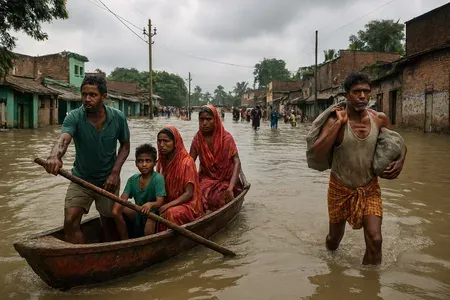
Bihar CM Office Orders Flood Relief Surge, NDRF-SDRF on Alert

Synopsis
The Chief Minister's Office of Bihar on September 30, 2026 issued directives ordering officials to maximise aid to flood-affected families, maintain continuous river and embankment surveillance, deploy adequate boats, and sustain NDRF and SDRF operations to accelerate relief and rescue efforts.
Key Takeaways
The Chief Minister's Office of Bihar issued flood relief directives on September 30, 2026 .
Officials ordered to provide all possible assistance to flood-affected families across the state.
Continuous monitoring of river water levels and embankments mandated.
Adequate deployment of boats specified as a direct operational requirement.
Both NDRF (national) and SDRF (state) forces ordered to maintain presence and accelerate rescue operations.
Directives reflect Bihar's standard high-alert protocol under the Disaster Management Act, 2005 framework.
With rivers swelling and embankments under pressure, the Chief Minister's Office of Bihar issued sharp directives on Wednesday, September 30, 2026 — ordering officials to throw every available resource at flood-affected families across the state and to keep rescue operations in high gear.
The directives, shared on the CMO's official account, instructed officers to provide 'all possible assistance' (harsambhav sahayata) to flood-hit households, maintain round-the-clock surveillance of river water levels and embankments, ensure adequate deployment of boats, and sustain the presence of both the National Disaster Response Force (NDRF) and the State Disaster Response Force (SDRF) to accelerate relief and rescue work.
NDRF and SDRF: Bihar's twin lifelines in the water
The NDRF, constituted under the Disaster Management Act of 2005, is India's specialist rapid-response force for precisely these moments — trained for swift water rescues, medical evacuation, and search operations in submerged terrain. The SDRF mirrors that mandate at the state level, giving Bihar a layered response capability that can scale from a single breached embankment to a multi-district inundation. Their simultaneous deployment signals that the situation demands both central muscle and local reach.
Bihar's annual reckoning with rising rivers
This is not Bihar's first monsoon crisis — and it will not be the last. The state sits at the confluence of some of South Asia's most flood-prone river systems, including the Kosi and the Ganga, which reliably turn aggressive by late monsoon. Each year, the state government activates the same operational framework: continuous water-level monitoring, embankment patrolling, boat mobilisation, and coordinated NDRF-SDRF deployment. The directives issued on September 30 are a direct expression of that standing protocol, applied with renewed urgency as flood conditions intensified.
What the instructions demand from ground-level officers
The CMO's language is operational and specific, not ceremonial. Officials are required to ensure boats are available 'in adequate numbers' — a detail that matters enormously when road access is cut and water is the only highway into a marooned village. Continuous embankment monitoring is equally critical: a breach in one location can cascade into flooding across multiple districts within hours. The instruction to 'accelerate' relief and rescue work suggests the pace on the ground needed to be pushed higher.
For thousands of families in Bihar's flood-prone districts, these orders translate into whether help arrives today or next week. The state has the machinery — how fast it moves is what counts now.
Point of View
And inaction will have consequences.
NationPress
30 Sept 2026
Frequently Asked Questions
What instructions did the Bihar Chief Minister's Office give for flood relief?
The Bihar CMO directed officials on September 30, 2026 to provide all possible aid to flood-affected families, monitor river water levels and embankments continuously, arrange adequate boats, and keep NDRF and SDRF deployed to speed up relief and rescue operations.
What is NDRF and why is it deployed in Bihar floods?
The National Disaster Response Force (NDRF) is a specialised central force constituted under the Disaster Management Act, 2005, trained for rapid rescue and relief during natural disasters like floods. Bihar deploys it during annual monsoon flooding alongside the state-level SDRF.
Why does Bihar flood every year?
Bihar lies in the floodplains of major rivers including the Kosi and the Ganga, which swell significantly during the monsoon season. The state experiences annual flooding as a result, requiring regular activation of disaster management protocols.
What is the role of SDRF in Bihar flood relief?
The State Disaster Response Force (SDRF) is Bihar's state-level disaster response unit that works alongside the NDRF during flood emergencies, providing localised rescue, relief, and evacuation support across affected districts.
What does embankment monitoring mean in the context of Bihar floods?
Embankments are earthen barriers built along riverbanks to contain flood water. Continuous monitoring means officials watch for signs of weakness or breaches; a breach can cause sudden catastrophic flooding across multiple districts, so real-time surveillance is a critical preventive measure.