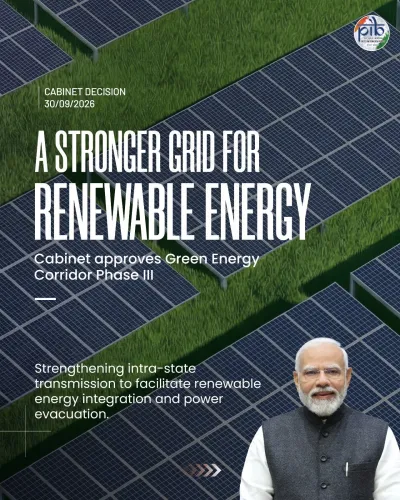
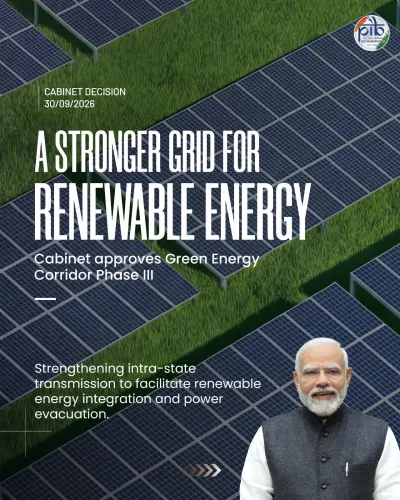
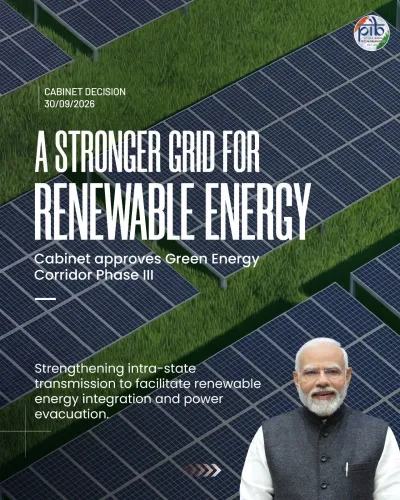
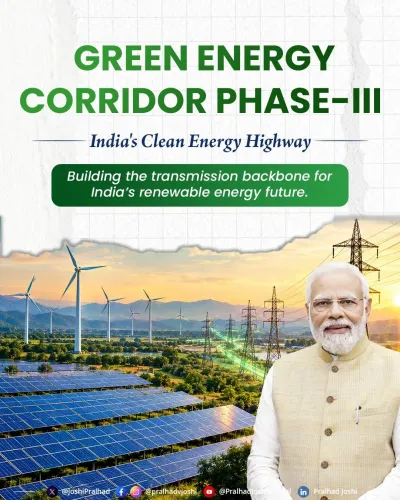
Cabinet Clears Green Energy Corridor Phase-III at ₹1.86 Lakh Crore
Synopsis
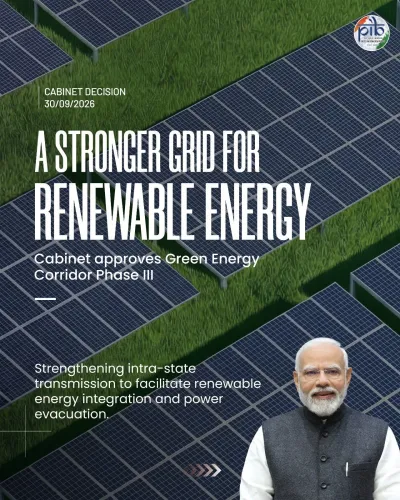
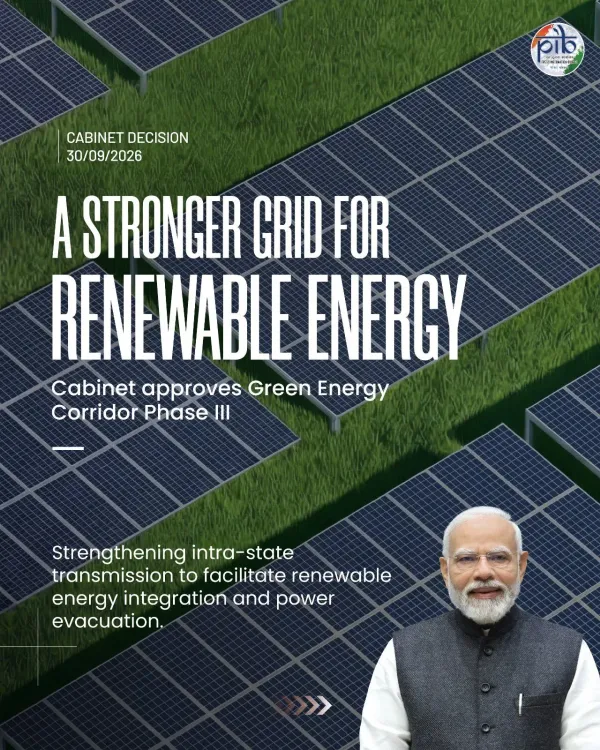
The Union Cabinet has approved Green Energy Corridor Phase-III with an outlay of ₹1.86 lakh crore. The scheme will build transmission infrastructure to evacuate 135 GW of renewable energy, integrate 50 GWh of battery storage, and support India's 500 GW non-fossil fuel target by 2030.
Key Takeaways
₹1.86 lakh crore outlay approved by the Union Cabinet for Green Energy Corridor Phase-III.
Scheme will enable evacuation of up to 135 GW of renewable energy through upgraded transmission infrastructure.
50 GWh of battery storage will be integrated to stabilise a grid with high shares of solar and wind power.
Green Energy Corridor Phase-I , approved in 2015 , covered intra-state transmission in five states; Phase-III adds storage as a core component.
The approval directly supports India's target of 500 GW non-fossil fuel capacity by 2030 .
Cabinet expects the scheme to strengthen energy security and keep power costs lower for consumers.
India just made its single largest bet on the wires that carry clean power. The Union Cabinet, chaired by Prime Minister Narendra Modi, has approved the Green Energy Corridor Phase-III scheme with an outlay of ₹1.86 lakh crore — a transmission-infrastructure push designed to evacuate up to 135 GW of renewable energy and anchor 50 GWh of battery storage across the national grid, Union Education Minister Dharmendra Pradhan announced on Wednesday, 30 September 2026.
What Phase-III actually builds — and why 135 GW matters
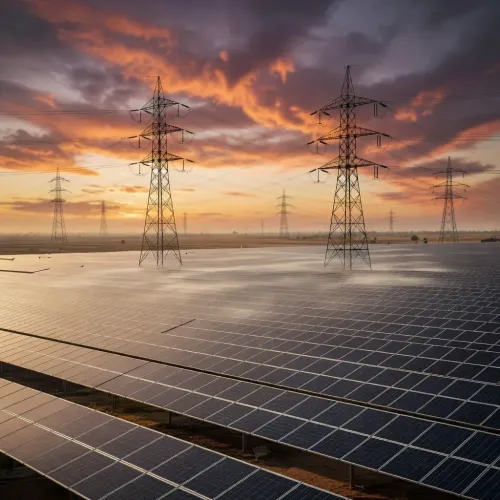
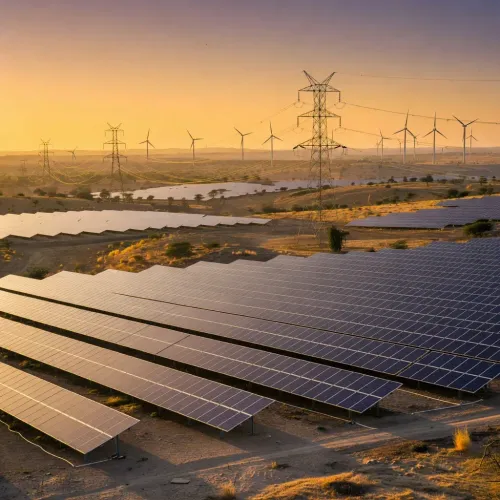
Generating renewable power and actually delivering it to homes and factories are two very different challenges. India's solar parks and wind farms increasingly sit in high-potential but remote corridors — Rajasthan, Gujarat, Tamil Nadu, the coasts — while demand clusters in industrial belts hundreds of kilometres away. Without dedicated high-voltage transmission lines, that clean power either strains ageing infrastructure or simply cannot move. Phase-III addresses precisely that bottleneck at scale.
The 135 GW evacuation capacity target is not incidental: it maps directly onto the pipeline of solar and wind projects India needs online to approach its 500 GW non-fossil fuel target by 2030. Miss the transmission build-out and the generation targets stall regardless of how many panels get installed. The cabinet decision, in effect, is as much about keeping that 2030 clock from slipping as it is about any single infrastructure project.
The 50 GWh storage anchor — steadying a variable grid
The scheme's most forward-looking element may be the 50 GWh battery storage component. Renewable energy is inherently variable — the sun sets, the wind drops — and a grid running on high shares of solar and wind needs somewhere to park excess generation and release it on demand. Fifty gigawatt-hours of storage changes the arithmetic of grid stability fundamentally, allowing system operators to smooth frequency swings and reduce curtailment of clean power that would otherwise be wasted.
This is where Phase-III breaks from its predecessors. Phase-I, approved in 2015, focused on intra-state transmission systems in states including Tamil Nadu, Rajasthan, Karnataka, Andhra Pradesh, and Maharashtra — essentially building the on-ramps for renewable power. Phase-III embeds storage into the architecture itself, signalling a more mature integration strategy.
Energy security, consumer costs, and the green economy case
The cabinet approval frames the scheme around three converging benefits: a greener economy, stronger energy security, and lower power costs for citizens. The logic is straightforward — a grid that can move and store renewable power efficiently reduces dependence on imported fossil fuels and smooths out price volatility that ultimately shows up in household electricity bills. For India's renewable energy developers and state power utilities, it also means a more predictable offtake environment: building a solar park is a far safer investment when the transmission backbone is committed.
Implementation detail — state-wise project awards, tendering timelines, and the precise configuration of the storage component — will now be the critical watch points as the scheme moves from cabinet approval to the ground.
With ₹1.86 lakh crore committed and a grid capable of handling 135 GW of clean power as the prize, India has drawn the transmission map it needs for a genuinely post-fossil grid. Now it has to build it on time.
Point of View
Not solar panel deployment alone. Embedding 50 GWh of battery storage within a transmission scheme — rather than treating it as a separate power-sector line item — is an architecturally significant move, and its execution will be closely watched by renewable energy developers pricing long-term projects. The scheme also lands at a moment when grid stability concerns around high variable-renewable penetration have become more acute, giving the storage component immediate policy relevance beyond optics.
NationPress
30 Sept 2026
Frequently Asked Questions
What is Green Energy Corridor Phase-III?
Green Energy Corridor Phase-III is a central government scheme approved by the Union Cabinet to build dedicated transmission infrastructure capable of evacuating up to 135 GW of renewable energy and integrating 50 GWh of battery storage into India's national grid, with an outlay of ₹1.86 lakh crore.
What is the total cost of Green Energy Corridor Phase-III?
The Union Cabinet has approved an outlay of ₹1.86 lakh crore for Green Energy Corridor Phase-III.
How does Green Energy Corridor Phase-III differ from Phase-I?
Phase-I, approved in 2015, focused on intra-state transmission systems in states like Tamil Nadu, Rajasthan, Karnataka, Andhra Pradesh, and Maharashtra. Phase-III operates at a significantly larger scale and, crucially, embeds 50 GWh of battery storage as a core component of the scheme rather than treating storage as a separate project.
What is India's renewable energy target by 2030?
India has set a target of achieving 500 GW of non-fossil fuel-based power capacity by 2030. The Green Energy Corridor Phase-III is designed to provide the transmission backbone needed to meet that target.
Why is battery storage included in a transmission scheme?
Battery storage is included because solar and wind power are variable — they generate power only when the sun shines or wind blows. Integrating 50 GWh of storage allows grid operators to store surplus clean power and release it on demand, preventing wasteful curtailment and maintaining grid frequency stability as India's renewable share grows.