White House Touts 'Great American Investment Boom' Under Trump

Synopsis
The White House declared a 'Great American Investment Boom' on 30 September 2026, crediting President Trump's America First policies — anchored by the 2017 corporate tax cut — for drawing trillions in new manufacturing, technology, and infrastructure investment into the United States.
Key Takeaways
The White House posted on 30 September 2026 claiming 'trillions of dollars' in new U.S. investment under Trump's America First agenda.
The Tax Cuts and Jobs Act of 2017 cut the corporate tax rate from 35% to 21% , forming the fiscal backbone of the investment push.
Key sectors highlighted under the America First framework include semiconductors, automobile manufacturing, and energy infrastructure .
The administration pairs tax incentives with import tariffs to make domestic production economically preferable to offshoring.
Independent verification of the 'trillions' figure will depend on Bureau of Economic Analysis quarterly reports on FDI and manufacturing construction spending.
A gap exists between announced investment commitments and actual capital deployment — economists will track both figures separately.
Trillions of dollars. That is the scale the White House is claiming for a manufacturing and technology investment surge it is attributing directly to President Donald Trump's 'America First' economic agenda — and on Wednesday, 30 September 2026, the administration's official communications account made that case in stark, capital-letter terms on X.
What the White House Is Claiming — and Why the Number Matters
The post declares a 'Great American INVESTMENT BOOM,' asserting that 'trillions of dollars in new investment in U.S. manufacturing, technology, and infrastructure have poured in' as a direct result of Trump's policy framework. The language is sweeping and deliberate — 'trillions,' plural, signals an ambition to define this moment as a generational economic turning point, not a routine quarterly uptick.
The America First framework has historically rested on three pillars: corporate tax reduction, aggressive deregulation, and tariff-backed pressure on trading partners to shift production back to American soil. The Tax Cuts and Jobs Act of 2017 anchored the tax dimension, slashing the corporate rate from 35% to 21% — the largest such cut in modern U.S. history — with the explicit goal of making domestic investment more attractive than offshoring.
Semiconductors, Autos, and the Onshoring Push
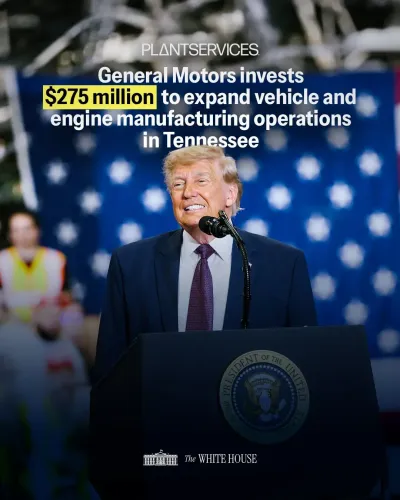
Throughout Trump's first term and into subsequent policy cycles, the White House repeatedly spotlighted investment announcements in high-visibility sectors: semiconductor fabrication plants, electric-vehicle and traditional auto manufacturing, and energy infrastructure. Each announcement was framed as proof that the policy combination — lower taxes at home, higher costs for imports — was working as intended.
The logic is straightforward: if it is cheaper to build in America than to import and pay a tariff, companies will build in America. Whether that calculation has translated into the 'trillions' figure cited in the post remains, at this stage, a claim the administration is making ahead of independent verification from bodies such as the Bureau of Economic Analysis, which tracks foreign direct investment and manufacturing construction spending on a quarterly basis.
What Independent Data Will Eventually Settle
Investment announcements and actual capital deployment are different animals. A company can announce a $10 billion chip plant and break ground years later — or not at all. Economists watching this space will look to BEA quarterly reports, manufacturing construction-spending data, and private-sector capital expenditure figures to put a verified number on what the White House is calling a boom.
For now, the administration's framing is a political and economic bet: that by the time those numbers are fully tallied, the 'America First' label will own the credit.
The data will either confirm the boom — or complicate the headline.
Point of View
One that has drawn genuine manufacturing announcements while also raising input costs for industries reliant on imported components. For India, the stakes are real: a sustained U.S. onshoring drive reshapes global supply chains, potentially redirecting investment that might otherwise flow to South and Southeast Asian manufacturing hubs. The next BEA data release will be the first hard test of whether 'trillions' is a verified milestone or a political headline.
NationPress
1 Oct 2026
Frequently Asked Questions
What is the 'Great American Investment Boom' the White House announced?
The White House used this phrase on 30 September 2026 to describe what it says is a surge of trillions of dollars in new investment in U.S. manufacturing, technology, and infrastructure, attributing it to President Trump's America First economic policies.
What are Trump's America First economic policies?
America First is a policy framework prioritising U.S. workers and industries through corporate tax reductions — most notably the 2017 cut from 35% to 21% — deregulation, and tariffs on imports designed to incentivise companies to produce domestically rather than offshore.
How does the 2017 Tax Cuts and Jobs Act relate to U.S. manufacturing investment?
The Tax Cuts and Jobs Act of 2017 lowered the U.S. corporate tax rate from 35% to 21%, making domestic investment more financially attractive. The Trump administration has cited this as a key driver of subsequent manufacturing and infrastructure spending announcements.
Which sectors are seeing the most investment under America First policies?
Semiconductor fabrication, automobile manufacturing, and energy infrastructure have been the most frequently highlighted sectors in White House investment announcements linked to the America First agenda.
How will the claimed trillions in investment be independently verified?
The U.S. Bureau of Economic Analysis publishes quarterly data on foreign direct investment and manufacturing construction spending. These reports are the primary independent benchmarks economists use to assess whether announced investment has translated into actual capital deployment.