White House Hosts Hispanic Heritage Month Celebration
Synopsis
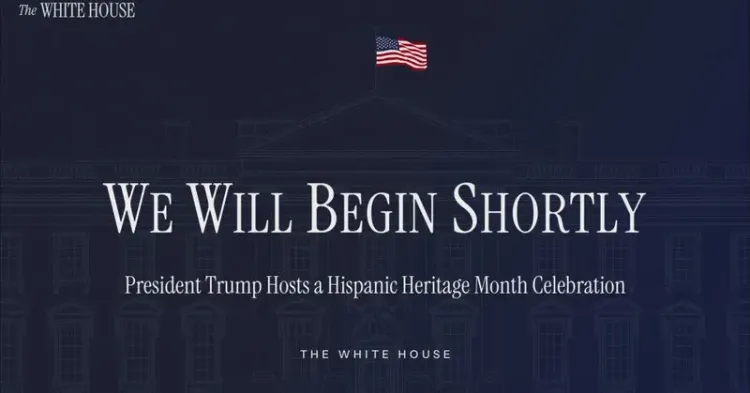
The White House hosted a Hispanic Heritage Month celebration on September 30, 2026, continuing a bipartisan presidential tradition of formally recognizing the history and contributions of Hispanic Americans during the annual observance that runs from September 15 to October 15.
Key Takeaways
The White House hosted a formal Hispanic Heritage Month celebration on September 30, 2026 .
Hispanic Heritage Month runs annually from September 15 to October 15 , spanning key Latin American and Mexican independence dates.
The observance originated as a one-week proclamation in 1968 and was expanded to a full month by Congress in 1988 .
Hosting such events is a bipartisan White House tradition maintained across multiple administrations.
Hispanic Americans number approximately 63 million , making them the largest ethnic minority in the United States.
Programming and community events continue through October 15 , the official close of the month.
A tradition that stretches across decades of American civic life got its moment in the spotlight once again — The White House hosted a Hispanic Heritage Month celebration on Wednesday, September 30, 2026, marking the final day of the observance's opening half with a formal event on the grounds of the Executive Office of the President.
A Month That Began as a Week
Hispanic Heritage Month runs annually from September 15 to October 15, a span chosen deliberately: September 15 marks independence day for five Latin American nations — Costa Rica, El Salvador, Guatemala, Honduras, and Nicaragua — while September 16 is Mexican Independence Day and October 12 is Día de la Raza. The observance was first proclaimed as a one-week recognition in 1968 under President Lyndon B. Johnson, then expanded to a full month by congressional resolution in 1988.
The White House event brings that legislative history into the present tense, translating a calendar designation into a visible act of recognition by the nation's executive leadership.
A Bipartisan Ritual at 1600 Pennsylvania Avenue
Hosting a formal Hispanic Heritage Month celebration at the White House is a practice that has persisted across Republican and Democratic administrations alike, making it one of the more durable cultural rituals of the American presidency. The events typically bring together community leaders, artists, athletes, and elected officials of Hispanic heritage for remarks, performances, and receptions on the South Lawn or in the East Room.
For the roughly 63 million Hispanic Americans who make up the country's largest ethnic minority — nearly one in five US residents — the White House platform carries both symbolic and practical weight, signalling federal acknowledgment of a community whose cultural, economic, and civic contributions are woven into the national fabric.
What Carries Through to October 15
The celebration on September 30 falls at the midpoint of the month-long observance. Federal agencies, schools, and cultural institutions across the country are expected to continue programming through October 15, the official close of Hispanic Heritage Month 2026. Community organisations and local governments typically schedule their own recognitions in the weeks that follow, extending the reach of the observance well beyond the White House gates.
The month is a reminder that heritage observances are not merely ceremonial — they anchor policy conversations around immigration, education, economic equity, and civic participation in a community that is among the fastest-growing demographic forces in American electoral life.
Point of View
These events serve a dual function: cultural acknowledgment and community outreach, particularly as Hispanic voters have emerged as a contested and increasingly heterogeneous bloc in national elections. The choice to stage a visible, broadcast-linked celebration signals that executive engagement with Hispanic communities remains a strategic priority regardless of party. Whether the event translates into substantive policy momentum — on immigration, education, or economic equity — is the question that will define its legacy beyond the ceremony.
NationPress
1 Oct 2026
Frequently Asked Questions
When is Hispanic Heritage Month in the United States?
Hispanic Heritage Month runs annually from September 15 to October 15 in the United States, a span chosen to encompass key Latin American and Mexican independence dates.
Why does Hispanic Heritage Month start on September 15?
September 15 marks the independence day of five Latin American nations — Costa Rica, El Salvador, Guatemala, Honduras, and Nicaragua — making it a meaningful anchor date for the observance.
How did Hispanic Heritage Month begin?
Hispanic Heritage Month originated as a one-week observance proclaimed in 1968 under President Lyndon B. Johnson. Congress expanded it to a full month in 1988.
Has the White House always celebrated Hispanic Heritage Month?
Yes, hosting a formal Hispanic Heritage Month event at the White House has been a bipartisan tradition maintained across Republican and Democratic administrations for decades.
How many Hispanic Americans are there in the United States?
Hispanic Americans number approximately 63 million, making them the largest ethnic minority group in the United States and nearly one in five US residents.