Rahul Gandhi backs 'Sarthak' with #TenderInvestigator post
Synopsis
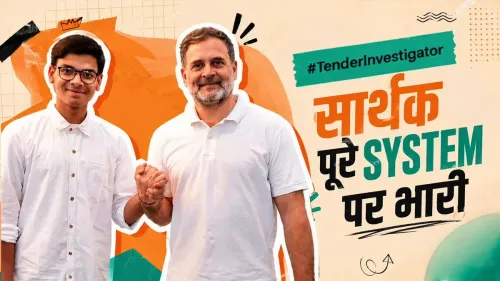
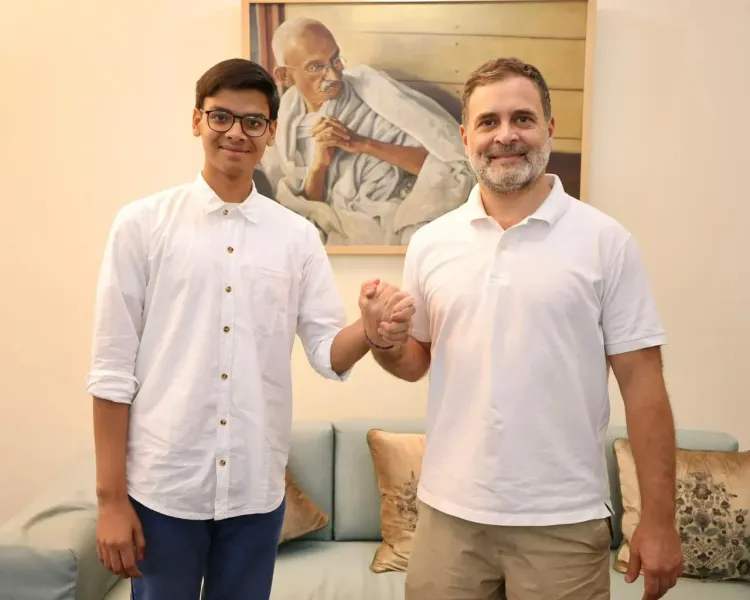
Congress leader Rahul Gandhi, the Leader of the Opposition in the Lok Sabha, posted a brief Hindi message on X on 2 June 2026 urging an individual named Sarthak to stand firm on his principles, attaching three images and the hashtag #TenderInvestigator, in a post read as political backing for scrutiny of public tenders.
Key Takeaways
Rahul Gandhi posted a short Hindi message on X on 2 June 2026 addressed to Sarthak.
The post translates to 'Sarthak, stand firm on your principles' and carries the hashtag #TenderInvestigator.
Three images were attached to the post, per the available metadata.
The message fits a wider pattern of the Leader of the Opposition spotlighting procurement and tender concerns on X.
No specific tender, ministry, or contracting entity is named in the post text.
Congress leader Rahul Gandhi, the Leader of the Opposition in the Lok Sabha and Member of Parliament from Rae Bareli, posted a short message of support on X on 2 June 2026 addressed to an individual named Sarthak, urging him to remain firm on his principles. The post, written in Hindi and tagged #TenderInvestigator, was accompanied by three images and circulated widely within hours of being published.
The text of the post reads: 'Sarthak, apne siddhanton par adig raho' ('Sarthak, stand firm on your principles'). The accompanying hashtag #TenderInvestigator frames the message within the broader vocabulary the Congress leader has used in recent months to flag concerns around public procurement and tender allocation processes.
Context
The brief endorsement-style post is consistent with a pattern in which Rahul Gandhi has used his X account to amplify individuals he describes as whistleblowers or independent investigators raising questions about government contracts. By naming the recipient and calling on him to hold his ground, the Congress leader is publicly extending political cover to a person engaged in scrutiny work.
The hashtag #TenderInvestigator functions as a label rather than a formal designation, signalling that the individual referenced is associated with examining tender-related matters. The three attached images, per the post metadata, accompany this framing.
Policy backdrop
Public procurement in India is governed by a layered framework that includes the General Financial Rules, the Central Vigilance Commission guidelines, and sector-specific tendering norms enforced by ministries and public sector undertakings. Concerns over transparency in tendering have been a recurring theme in Indian political debate, with opposition leaders frequently demanding stronger audit and disclosure mechanisms.
The Leader of the Opposition role, which Rahul Gandhi assumed after the 2024 general election, carries statutory weight in appointments to oversight bodies, including selection committees for institutions that touch on anti-corruption mandates. Public interventions of this kind are therefore read as both political messaging and a signal to accountability institutions.
Stakeholders and impact
Whistleblowers and citizen investigators occupy a contested space in Indian public life. The Whistle Blowers Protection Act, 2014, while on the statute book, has been criticised by civil society groups for limited operational rules. Public endorsements from senior political figures can raise the visibility of individuals working in this space, but also draw counter-scrutiny.
For public contractors and procurement officials, sustained social-media attention to specific tenders can prompt internal reviews, queries from vigilance officers, and, in some cases, parliamentary questions. The Congress party's communications apparatus has in recent cycles built campaigns around individual cases highlighted by its leadership on X.
The post does not name a specific tender, ministry, or contracting entity. It is, on its face, a personal message of solidarity, and the broader case to which it refers is not detailed in the text itself.
What's next
The immediate watch is whether Rahul Gandhi or other Congress MPs follow up the post with a more substantive intervention, such as a press briefing, a parliamentary question, or a formal letter to a vigilance authority. Any specific tender referenced in the attached images could become the subject of follow-on commentary from the party.
For the individual addressed in the post, the public endorsement from the Leader of the Opposition is likely to amplify both visibility and the operational pressures that come with it. The episode underscores how X has become a primary venue for opposition signalling on governance and procurement issues, with messages travelling faster than formal parliamentary instruments.
Point of View
The Leader of the Opposition is extending political cover to a person operating in the contested space of procurement scrutiny. It fits a broader arc in which Congress's communications strategy has leaned on individual cases and hashtags to keep governance and transparency on the daily news agenda. The political weight of such messages now often outruns the slower instruments of parliamentary oversight.
NationPress
16 Oct 2026
Frequently Asked Questions
What did Rahul Gandhi post about Sarthak?
Rahul Gandhi posted a brief Hindi message on X telling someone named Sarthak to stand firm on his principles, attaching the hashtag #TenderInvestigator and three images. The post was made on 2 June 2026.
What does #TenderInvestigator mean?
It is a hashtag used in the post to label the addressee as someone associated with scrutinising public tenders. It is not a formal title or official designation.
Did Rahul Gandhi name a specific tender or ministry?
No. The post does not identify any specific tender, ministry, contractor, or government department. It is framed as a personal message of support.
What role does Rahul Gandhi currently hold?
He is the Leader of the Opposition in the Lok Sabha and the Congress MP from Rae Bareli, a position he took on after the 2024 general election.
How does India regulate public tenders?
Public procurement in India is governed by the General Financial Rules, Central Vigilance Commission guidelines, and sector-specific tendering rules enforced by ministries and public sector undertakings.