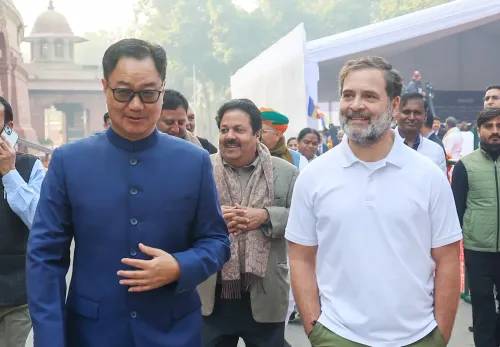
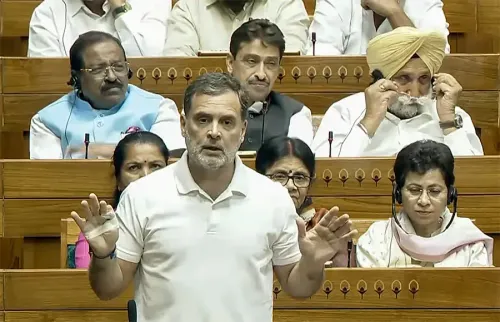
Rahul Gandhi Challenges Rijiju on Women's Quota Delay

Synopsis
Rahul Gandhi publicly challenged Parliamentary Affairs Minister Kiren Rijiju on 8 August 2026, questioning why the Women's Reservation Act — passed unanimously in September 2023 with Congress's full support — remains unimplemented and why the government is linking it to a delimitation exercise that could delay it by years.
Key Takeaways
Congress leader Rahul Gandhi directly addressed Kiren Rijiju , Union Minister of Parliamentary Affairs, on 8 August 2026 .
The Nari Shakti Vandan Adhiniyam , passed unanimously by both Houses in September 2023 , reserves one-third of seats in Parliament and state assemblies for women.
The Act's enforcement is legally tied to a post-census delimitation exercise, which critics argue could defer implementation by a decade or more.
Gandhi reminded Rijiju that Congress gave full support during the bill's passage and questioned why the law remains unimplemented three years later .
Earlier attempts at women's reservation, including the 108th Constitutional Amendment Bill passed by Rajya Sabha in 2010 , lapsed without becoming law.
The Opposition has consistently argued for decoupling women's reservation from the delimitation process to enable earlier rollout.
Three years after Parliament unanimously passed a landmark law reserving one-third of seats for women, Congress leader and Leader of the Opposition Rahul Gandhi is demanding a straight answer: why has it still not been enforced?
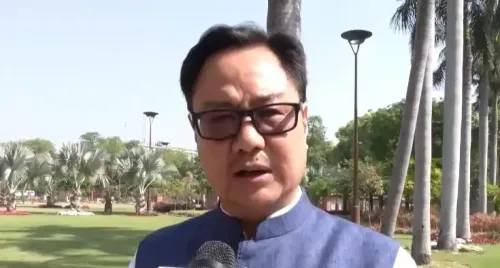
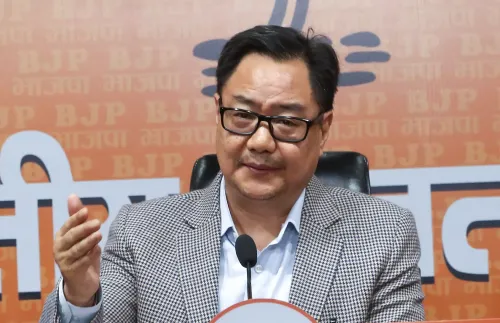
In a pointed post on Saturday, 8 August 2026, Gandhi addressed Union Minister of Parliamentary Affairs Kiren Rijiju directly, writing — 'Rijiju ji, sansadiya karya mantri hone ke naate aapse behtar yeh kaun jaanta hoga' ('Rijiju ji, who would know this better than you, as the Minister of Parliamentary Affairs') — and reminding him that the Women's Reservation Bill was passed unanimously in 2023 with Congress's full support. His sharper question: why, after three years, has it not been implemented, and why is the government now linking it 'unnecessarily' to delimitation?
The law that exists but does not yet operate
The Nari Shakti Vandan Adhiniyam, passed by both Lok Sabha and Rajya Sabha in September 2023, reserves one-third of seats in Parliament and state assemblies for women. The passage was historic — cross-party, unanimous, celebrated. But the Act itself contains a critical conditionality: it comes into force only after a delimitation exercise, which in turn depends on the completion of a fresh census. No census, no delimitation. No delimitation, no reservation. That procedural chain is precisely what Gandhi is challenging. The argument from the Opposition has long been that the two processes — women's reservation and delimitation — can and should be decoupled, allowing the quota to take effect without waiting for a census that has no fixed deadline.A decades-long struggle condensed into a clause
The road to the 2023 Act was itself a thirty-year detour. An earlier version — the 108th Constitutional Amendment Bill — cleared the Rajya Sabha in 2010 but lapsed without Lok Sabha approval, joining a line of failed attempts stretching back to the 1990s. When the Narendra Modi government revived and passed the bill in September 2023, it was widely hailed as a breakthrough. The delimitation clause, however, was flagged immediately by critics as a built-in delay mechanism. The Constitution (84th Amendment) Act, 2001 had already frozen the readjustment of Lok Sabha seat numbers until after the first census following 2026 — meaning delimitation is, at minimum, years away. Women aspirants and Opposition leaders have since argued that the reservation, as written, could effectively be deferred into the next decade.Gandhi's direct address to Rijiju
By naming Rijiju specifically — the minister constitutionally responsible for managing the government's legislative calendar — Gandhi is framing this not as an abstract policy debate but as an accountability question. The implication is clear: the minister who shepherds bills through Parliament cannot claim ignorance of a law his own government passed and celebrated. Gandhi's post asks why the government is now 'unnecessarily' tying the law's enforcement to delimitation rather than finding a path to earlier implementation. With no government clarification on decoupling the two processes in sight, the Nari Shakti Vandan Adhiniyam sits on the books — passed, praised, and pending.Point of View
He targets the official most directly responsible for legislative scheduling, making it harder to deflect with broad political rhetoric. The delimitation-linkage critique has been a consistent Opposition line since September 2023, and revisiting it in 2026 signals that Congress intends to keep the implementation gap as a live electoral and moral liability for the ruling dispensation. The post also reinforces Congress's self-positioning as the party that supported the law without reservation, while framing the delay as a government choice rather than a constitutional inevitability. If the census and delimitation timeline stretches further, this argument only gains traction.
NationPress
8 Aug 2026
Frequently Asked Questions
What is the Women's Reservation Bill and when was it passed?
The Women's Reservation Bill, officially called the Nari Shakti Vandan Adhiniyam, was passed unanimously by both Lok Sabha and Rajya Sabha in September 2023. It reserves one-third of seats in Parliament and state legislative assemblies for women.
Why has the Women's Reservation Act not been implemented yet?
The 2023 Act conditions its enforcement on the completion of a delimitation exercise, which itself depends on a fresh national census. Since no census has been conducted yet, the law remains on the books but is not yet operational.
What is delimitation and why is it linked to women's reservation?
Delimitation is the process of redrawing parliamentary and assembly constituency boundaries, typically done after a census. The Nari Shakti Vandan Adhiniyam explicitly requires a post-census delimitation before the women's quota seats can be identified and filled.
What did Rahul Gandhi say to Kiren Rijiju about the Women's Reservation Act?
On 8 August 2026, Rahul Gandhi posted on X reminding Rijiju that the bill was passed unanimously in 2023 with Congress's full support, and asked why it remains unimplemented three years later and why the government is 'unnecessarily' linking it to delimitation.
Has India tried to pass women's reservation in Parliament before 2023?
Yes. The 108th Constitutional Amendment Bill on women's reservation was passed by the Rajya Sabha in 2010 but lapsed without receiving Lok Sabha approval, continuing a pattern of failed attempts dating back to the 1990s.