Rahul Gandhi demands answers over alleged illegal Form 6 changes by ECI

Synopsis
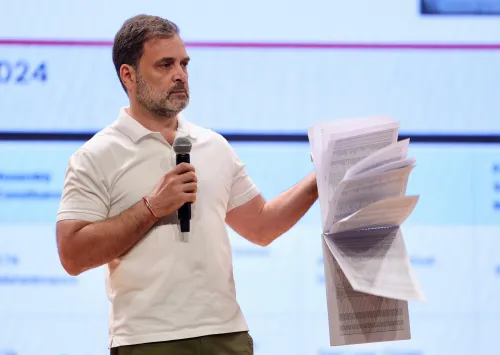
Congress leader Rahul Gandhi has pinned a post demanding to know who at the Election Commission of India ordered Tata Consultancy Services to make what he calls an illegal change to online Form 6, citing the ECI's own commissioners as having recorded the irregularity.
Key Takeaways
Rahul Gandhi alleges online Form 6 — the voter registration form — was altered 'illegally' by or through Tata Consultancy Services .
Gandhi states the ECI's 'own Commissioners' have recorded this change, implying an internal paper trail exists.
He asks three targeted questions: who at ECI gave the order, who at TCS authorised it, and whether TCS was pressured.
Gandhi pinned the post, signalling this is a sustained demand rather than a one-off allegation.
Form 6 governs new voter enrollments in India, an electorate of over 960 million registered voters, making any unauthorised change a high-stakes governance concern.
A pinned post from Congress leader Rahul Gandhi on Thursday, October 1, 2026 has sharpened one of Indian democracy's most charged fault lines — whether the Election Commission of India's own voter registration form was altered without authorisation, and who gave the order. Gandhi's three blunt questions are aimed squarely at the Election Commission of India (ECI) and technology giant Tata Consultancy Services (TCS), and they are not rhetorical.
The allegation: Form 6 changed 'illegally', commissioners on record
Gandhi's post states that the online Form 6 — the official document through which new voters apply to be enrolled on the electoral roll — 'was changed illegally.' Critically, he adds that the ECI's 'own Commissioners have recorded' this. Form 6 is administered digitally through the National Voters' Service Portal, and any modifications to its fields or logic carry direct implications for who can register to vote, how, and under what conditions.
The Leader of the Opposition is asking three specific questions: who at the ECI ordered TCS to make the change; who at TCS signed off on it; and whether TCS was pressured into doing it. Each question targets a distinct layer of accountability — political, institutional, and corporate.
Why TCS is in the frame
Tata Consultancy Services, India's largest IT services company, has a long-standing role in providing technology infrastructure for government platforms, including electoral systems. The allegation that TCS operationalised a change to a statutory form at the behest of an undisclosed authority — potentially under pressure — places the company at the centre of a governance dispute it has not publicly addressed.
Gandhi's framing is pointed: he is not accusing TCS of acting on its own initiative. He is asking whether the company was 'pressured' — which, if true, would shift the chain of culpability upward toward whoever issued the instruction.
What Form 6 governs — and why the stakes are high
Form 6 is the gateway document for first-time voter registration in India, a country with an electorate exceeding 960 million registered voters. Any unauthorised change to its structure — whether altering mandatory fields, removing verification steps, or modifying eligibility criteria — could affect the integrity of the roll. The ECI is constitutionally mandated to maintain a free and fair electoral roll; a finding that its own commissioners flagged an illegal alteration would be extraordinary.
Gandhi has not published the specific ECI records he references, but by pinning the post he is signalling that this is not a passing charge — it is a sustained demand for disclosure.
Whether the ECI or TCS responds, and on what timeline, will determine whether this becomes a parliamentary flashpoint or a question that accountability institutions are forced to formally address.
Point of View
He is attempting to shift the burden of proof from allegation to institutional admission. The three-question structure (ECI order, TCS sign-off, coercion) mirrors a parliamentary inquiry framing, suggesting this may be a precursor to a formal motion or privilege question. For the opposition, any evidence of tampering with voter registration infrastructure is a force-multiplier argument about the health of India's electoral institutions — one that could resonate far beyond party base politics. How the ECI and TCS choose to respond, or decline to, will itself become part of the story.
NationPress
1 Oct 2026
Frequently Asked Questions
What is Form 6 in Indian elections?
Form 6 is the official application form used by first-time voters to register their name on the electoral roll in India. It is administered through the National Voters' Service Portal and is central to the voter enrollment process.
What is Rahul Gandhi alleging about Form 6?
Rahul Gandhi alleges that the online Form 6 was changed illegally, and that the ECI's own Election Commissioners have recorded this. He is demanding to know who at the ECI ordered the change and whether Tata Consultancy Services was pressured into implementing it.
What is TCS's role in India's election infrastructure?
Tata Consultancy Services is a major technology partner for several Indian government platforms, including electoral systems. Gandhi's post implies TCS carried out the alleged Form 6 modification, raising questions about the company's accountability in election-related technology.
Has the Election Commission of India responded to the Form 6 allegation?
As of this report, no public response from the ECI or TCS has been recorded in response to Gandhi's October 1, 2026 post.
Why did Rahul Gandhi pin this post on his profile?
Pinning a post signals that the author considers it an ongoing or priority issue. Gandhi's decision to pin the Form 6 allegation suggests he intends to keep institutional pressure on the ECI and TCS until a formal explanation is provided.