Rahul Gandhi Demands Independent Probe into Ram Mandir Donation Irregularities
Synopsis
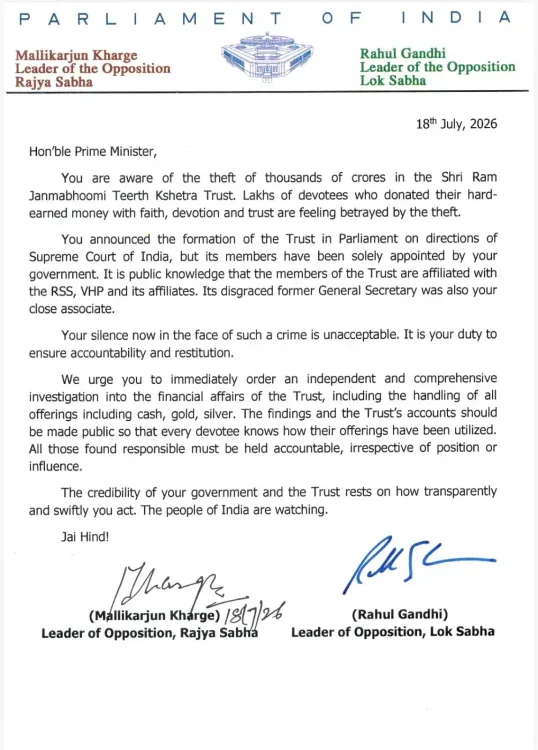
Congress leader Rahul Gandhi has demanded an immediate independent investigation into alleged donation irregularities at the Ayodhya Ram Mandir trust, directly addressing PM Modi and calling his silence 'unacceptable'. Gandhi noted all trust members were government-appointed.
Key Takeaways
Congress leader Rahul Gandhi posted on X on 19 July 2026 demanding an independent probe into alleged donation theft at the Ayodhya Ram Mandir .
Gandhi addressed Prime Minister Narendra Modi directly, calling the PM's silence on the matter 'unacceptable'.
He highlighted that every member of the Shri Ram Janmabhoomi Teerth Kshetra Trust was nominated by the Union government, placing accountability on the ruling establishment.
The trust was constituted by the central government in February 2020 following the Supreme Court's November 2019 verdict on the Ayodhya title dispute.
Gandhi demanded a full public accounting of the trust's finances alongside an independent inquiry.
The specific allegations of donation theft referenced in the post have not been independently confirmed.
Congress leader Rahul Gandhi, Leader of the Opposition in Lok Sabha, on Sunday, 19 July 2026, directly addressed Prime Minister Narendra Modi on social media platform X, demanding an immediate independent investigation into alleged financial irregularities at the Shri Ram Janmabhoomi Teerth Kshetra Trust in Ayodhya.
In a Hindi-language post, Gandhi wrote: 'श्री राम मंदिर में करोड़ों श्रद्धालुओं ने आस्था के साथ अपनी कमाई अर्पित की — वहां हुई चंदा चोरी अब किसी से छुपी नहीं है' ('Crores of devotees offered their hard-earned money with faith at the Shri Ram Mandir — the donation theft that took place there is no longer hidden from anyone'). He further stated that 'every member of the trust was chosen by your government' and called the Prime Minister's silence on the matter 'unacceptable', demanding a full public accounting.
Context
The Shri Ram Janmabhoomi Teerth Kshetra Trust was constituted by the Union government in February 2020, following the Supreme Court of India's landmark November 2019 verdict on the Ayodhya title dispute, which directed the formation of such a body to oversee construction of the Ram Mandir. The trust's members were nominated by the central government. Prime Minister Narendra Modi performed the consecration ceremony, or pran pratishtha, of the temple on 22 January 2024, marking a moment of enormous religious and political significance for the country.
Gandhi's post arrives against a backdrop of periodic opposition scrutiny of financial governance within institutions linked to the Ayodhya developments. His direct address to the Prime Minister, and the explicit reference to the government's role in selecting trust members, frames the accountability demand as one directed at the ruling establishment rather than the trust in isolation.
Policy Backdrop
Because the Shri Ram Janmabhoomi Teerth Kshetra Trust was notified and its members appointed by the Union government, questions of oversight and transparency in its functioning carry direct political weight. Opposition parties have previously argued that institutions created through judicial resolutions of contested religious sites must be subject to rigorous public accountability, given the scale of voluntary donations they receive from millions of devotees across the country.
Gandhi's demand for an 'immediate independent inquiry' and a 'full public accounting' — 'तत्काल स्वतंत्र जांच कराइए, पूरा हिसाब सार्वजनिक' — echoes a broader Congress position that institutions handling public or devotee funds must be subject to independent audit and disclosure. The specific nature of the allegations referenced in his post has not been independently confirmed.
Stakeholders and Impact
The primary stakeholders in this dispute are the crores of Hindu devotees who have contributed donations to the Ram Mandir, the Shri Ram Janmabhoomi Teerth Kshetra Trust itself, and the Union government that constituted it. Any credible allegation of financial mismanagement at a site of this religious and national importance would carry significant public resonance, given the depth of sentiment surrounding the temple's construction.
For the ruling Bharatiya Janata Party, the Ram Mandir is a flagship political and civilisational achievement. Opposition demands for a probe, framed around the trust's government-nominated composition, place the BJP in the position of having to either defend the trust's record or respond to calls for transparency. The Congress, meanwhile, positions itself as the voice of devotees whose contributions deserve accountability.
What's Next
Attention will now turn to whether the Shri Ram Janmabhoomi Teerth Kshetra Trust or the Union government issues any formal response to Gandhi's demands. The issue is also likely to be raised during the next session of Parliament, where Gandhi, as Leader of the Opposition, has a platform to press the government directly.
If no independent inquiry is announced, Congress is expected to sustain pressure through parliamentary proceedings and public messaging. The episode underscores a continuing tension between the political symbolism attached to the Ram Mandir and demands for institutional transparency in how devotee donations are managed and accounted for.
Point of View
He attempts to make the BJP inseparable from any governance failure at the temple. This follows a broader Congress pattern of contesting the BJP on its own symbolic terrain rather than ceding it. The demand for an independent inquiry — rather than a parliamentary committee or CBI probe — signals an attempt to appeal to the religious sentiment of devotees, framing the opposition as protectors of their faith and their donations. How the government responds, or chooses not to, will shape the political salience of this issue heading into the next Parliament session.
NationPress
20 Jul 2026
Frequently Asked Questions
What has Rahul Gandhi said about the Ram Mandir trust?
Rahul Gandhi has demanded an immediate independent investigation into alleged donation irregularities at the Shri Ram Janmabhoomi Teerth Kshetra Trust, calling Prime Minister Modi's silence on the matter 'unacceptable' and asking for a full public accounting of temple funds.
Who appointed the members of the Ram Mandir trust?
The Shri Ram Janmabhoomi Teerth Kshetra Trust was constituted by the Union government in February 2020, with its members nominated by the central government following the Supreme Court's 2019 Ayodhya verdict.
What is the Ram Mandir trust controversy about?
Rahul Gandhi has alleged that donation theft has occurred at the Ayodhya Ram Mandir, where crores of devotees have contributed their earnings. The specific nature of the alleged irregularities has not been independently confirmed.
When was the Ayodhya Ram Mandir inaugurated?
Prime Minister Narendra Modi performed the pran pratishtha, or consecration ceremony, of the Ram Mandir in Ayodhya on 22 January 2024.
What action is Congress demanding over Ram Mandir funds?
Congress leader Rahul Gandhi is demanding an immediate independent inquiry into the temple trust's finances and a full public disclosure of accounts, holding the Union government accountable as the body that nominated all trust members.