Rahul Gandhi flags excess ethanol in petrol after Karnataka lab tests
Synopsis
Congress leader Rahul Gandhi cited Karnataka government lab tests showing petrol samples from IOCL and HPCL carry ethanol well above the mandated 20 per cent, calling it outright theft from consumers and demanding accountability from the Modi government's E20 programme.
Key Takeaways
11 of 14 petrol samples collected by the Karnataka government from 7 districts reportedly exceeded the 20 per cent ethanol blending limit.
IOCL recorded the highest reading at 31.2 per cent ethanol; HPCL was at 30.5 per cent , according to Gandhi's post.
Ethanol contains roughly one-third less energy per litre than petrol, meaning over-blending reduces effective mileage for consumers who pay the full petrol price.
India's National Policy on Biofuels (2018) and a 2021 government target set the 20 per cent blending ceiling as part of a wider energy-security drive.
The Ministry of Petroleum and Natural Gas had not publicly responded to the Karnataka findings at the time of publication.
Gandhi framed the alleged over-blending as consumer fraud, using the Hindi wordplay 'E20 बना 420' to invoke the colloquial term for cheating.
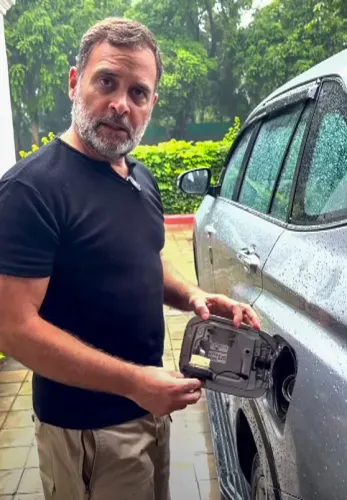
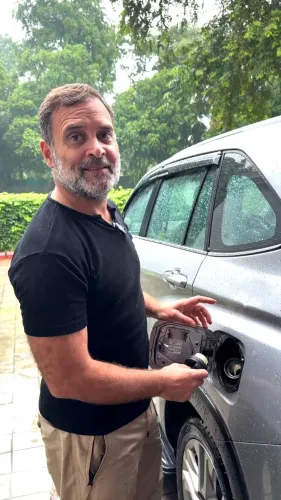
A fuel-quality row is brewing over India's flagship E20 ethanol-blending programme, after Congress leader Rahul Gandhi on Saturday, 7 November 2026 shared findings from Karnataka government laboratory tests that show petrol samples contain significantly more ethanol than the mandated 20 per cent.
Gandhi's post, written in Hindi, opens with a sharp play on words: 'E20 बना 420' — roughly, 'E20 has become a 420,' invoking Section 420 of the Indian Penal Code, a colloquial shorthand for cheating. He frames the findings as direct theft from ordinary motorists: 'petrol chori from the public's vehicles.'
What the Karnataka samples reportedly found
The Karnataka government collected petrol samples from 7 districts and sent them to an accredited laboratory. According to the figures shared by Gandhi, 11 of 14 samples showed ethanol content exceeding 20 per cent — the ceiling set under the national programme. The two most striking figures cited: Indian Oil Corporation Limited (IOCL) at 31.2 per cent ethanol and Hindustan Petroleum Corporation Limited (HPCL) at 30.5 per cent.
NationPress has not independently verified the laboratory results or the district-level breakdown. The numbers come from Gandhi's post and the linked image; a formal government report has not been publicly confirmed at the time of writing.
Why over-blending matters for car and bike owners
Ethanol blending reduces crude-oil import dependence and supports sugarcane farmers — twin goals that drove India's National Policy on Biofuels (2018) and the subsequent 2021 target of achieving 20 per cent blending by 2025. But the chemistry cuts both ways. Ethanol carries roughly one-third less energy per litre than petrol, so higher-than-declared blends reduce effective mileage. Consumers pay for a litre of petrol and receive a mix that delivers measurably less power — which is precisely Gandhi's 'chori' (theft) argument.
Beyond mileage, ethanol at concentrations above what a vehicle's fuel system is calibrated for can accelerate wear on rubber seals, fuel pumps and injectors — a concern that has shadowed the E20 rollout since its national expansion. Vehicle compatibility standards have been a recurring flashpoint between automakers, oil marketers and the Ministry of Petroleum.
The public-sector oil companies at the centre of the allegation
IOCL and HPCL are the two dominant public-sector oil marketing companies that retail petrol across India. Under the blending mandate, they are required to procure ethanol from distilleries and blend it at depots before distribution. If blending consistently overshoots the declared percentage, the question is whether it reflects measurement error at the depot level, procurement pressure to absorb surplus ethanol stocks, or inadequate oversight by quality-control authorities including the Bureau of Indian Standards (BIS).
No government response yet — but the pressure is real
The Ministry of Petroleum and Natural Gas had not issued a public response to the Karnataka findings at the time of publication. The state government's decision to run accredited-lab tests — rather than rely on oil-company self-reporting — adds institutional weight to the complaint and makes a dismissal harder. If the results are confirmed, they could trigger mandatory third-party quality audits at blending depots across the country.
Gandhi, as Leader of the Opposition in Lok Sabha, has consistently used governance data — often state-level — to press the central government on consumer-welfare issues. This post follows that pattern: a specific number, a named agency, a lab test, and a sharp political frame. The Modi government's E20 programme was a headline achievement of its energy-transition agenda. The Karnataka data, if validated, strikes at the credibility of that claim at the last-mile — the fuel nozzle.
Point of View
It shifts the debate from policy ambition to implementation accountability and consumer protection. Gandhi's tactic of anchoring a political attack in state-government data rather than partisan assertion is structurally harder to deflect, particularly when the agencies named — IOCL and HPCL — are central government undertakings. A non-response from the Ministry of Petroleum risks letting the narrative solidify; a rebuttal that simply defends the programme without addressing the specific sample data will likely intensify scrutiny.
NationPress
7 Nov 2026
Frequently Asked Questions
What is the E20 ethanol blending programme in India?
The E20 programme is a national initiative to blend up to 20 per cent ethanol in petrol to reduce crude-oil imports and support farmers. The government set a target to achieve this blending level by 2025 under the National Policy on Biofuels (2018).
Why is excess ethanol in petrol a problem for vehicle owners?
Ethanol delivers roughly one-third less energy per litre than petrol, so a higher-than-declared blend reduces effective mileage. Consumers pay for pure petrol pricing but receive a less energy-dense fuel, amounting to a financial loss per fill-up.
What did the Karnataka petrol test results show?
According to Rahul Gandhi's post citing the Karnataka government's accredited lab tests, 11 of 14 samples from 7 districts contained more than 20 per cent ethanol. IOCL recorded 31.2 per cent and HPCL recorded 30.5 per cent — well above the mandated ceiling.
Has the central government responded to the Karnataka ethanol findings?
As of the publication of this article, the Ministry of Petroleum and Natural Gas had not issued a public response to the Karnataka test findings.
What can petrol consumers do if they suspect fuel quality issues?
Consumers can file a complaint with the Bureau of Indian Standards (BIS) or approach the respective oil marketing company's customer grievance portal. State food and civil supplies departments also have authority to collect and test fuel samples from retail outlets.