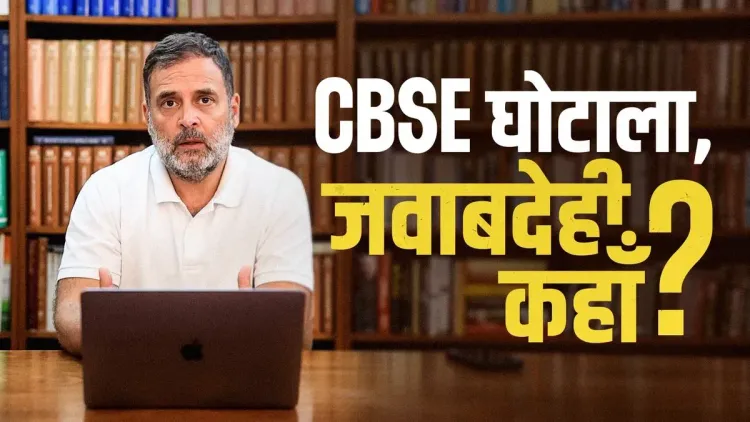
Rahul Gandhi flags CBSE result 'manipulation', targets Modi govt
Synopsis
Congress leader Rahul Gandhi on 27 May 2026 alleged 'terrible manipulation' in CBSE examination results, accusing the Modi government of silence and naming vendor COEMPT — allegedly formerly Globarena — as having a prior record of similar irregularities in Telangana in 2019, leaving lakhs of students and parents in distress.
Key Takeaways
Rahul Gandhi alleged 'terrible manipulation' in CBSE examination results , saying lakhs of students and parents are in shock.
He directly criticised Prime Minister Modi for offering 'no answer, no accountability, no shame.' Gandhi named COEMPT as the company awarded the result-processing contract, alleging it previously operated as Globarena .
He alleged Globarena carried out similar irregularities in Telangana in 2019 .
CBSE functions under the Ministry of Education and has increasingly outsourced technical processing to private vendors.
The controversy is expected to be raised in the upcoming monsoon session of Parliament .
Congress leader Rahul Gandhi, Leader of the Opposition in Lok Sabha, on Wednesday, 27 May 2026, accused the CBSE of massive result manipulation, alleging that lakhs of students and their parents have been left in shock, and squarely blamed the Modi government for silence and lack of accountability.
Context
In a post in Hindi on X, Gandhi wrote: 'CBSE परीक्षा परिणाम में भयंकर हेर-फेर हो गई' ('There has been terrible manipulation in the CBSE examination results'), adding that 'lakhs of children and their parents are in shock.' He then directly targeted the Prime Minister, saying: 'And Modi ji? As always — no answer, no accountability, no shame.'
Gandhi further alleged that the company COEMPT, which was awarded the responsibility for result processing, had previously operated under the name Globarena and had carried out similar alleged irregularities in Telangana in 2019. He shared what appeared to be supporting material via a link attached to the post.
Policy Backdrop
The Central Board of Secondary Education (CBSE) is India's premier national school examination body, functioning under the Ministry of Education. In recent years, Indian school boards have increasingly outsourced result compilation and technical processing to private technology vendors as part of broader digitisation of examinations.
This trend has drawn recurring scrutiny from opposition parties and parent groups, who argue that the outsourcing of sensitive academic data to private firms raises serious questions of transparency and accountability. Gandhi's allegation that COEMPT was formerly known as Globarena and was linked to irregularities in Telangana in 2019 fits a pattern of concerns raised about the track record of such vendors — though these specific claims have not been independently confirmed.
Stakeholders and Impact
The primary stakeholders are the lakhs of Class 10 and Class 12 CBSE students across India whose results may be affected, along with their families. Errors or alleged manipulation in board results have cascading consequences — affecting university admissions, scholarship eligibility, and student mental health.
For the Modi government and the Ministry of Education, the allegation adds political pressure at a sensitive time. Opposition parties have long argued that privatisation of public examination infrastructure introduces risks that disproportionately harm students from less privileged backgrounds who rely entirely on board results for their future.
What's Next
All eyes will be on whether CBSE or the Ministry of Education issues a formal clarification or orders an inquiry into the result processing controversy. The matter is also likely to be raised during the upcoming monsoon session of Parliament, where opposition members are expected to demand answers on the vendor selection process and the alleged prior record of COEMPT.
If the allegations gain traction, they could trigger demands for a parliamentary committee review of CBSE's outsourcing practices — a debate that would have lasting implications for how India's central examination boards handle sensitive student data and result processing going forward.
Point of View
And it introduces a named private vendor with an alleged prior record — a tactic designed to sustain the story beyond a single news cycle. By linking COEMPT to the Globarena name and the 2019 Telangana episode, the Congress is attempting to build a narrative of systemic negligence in the outsourcing of sensitive public examination infrastructure. The accusation of prime ministerial silence is a recurring opposition motif, but anchoring it to a specific vendor's alleged history gives it sharper political bite. If CBSE or the Ministry of Education does not respond swiftly, the controversy could dominate the education debate in the monsoon session of Parliament.
NationPress
10 Oct 2026
Frequently Asked Questions
What did Rahul Gandhi say about CBSE results in May 2026?
Rahul Gandhi alleged on 27 May 2026 that there had been 'terrible manipulation' in CBSE examination results, leaving lakhs of students and parents in shock, and accused the Modi government of offering no answer or accountability.
What is COEMPT and why is it in the news?
COEMPT is the company Gandhi alleges was awarded the CBSE result-processing contract. He claimed it previously operated under the name Globarena and carried out similar alleged irregularities in Telangana in 2019, though these specific claims have not been independently verified.
What was the Globarena Telangana controversy in 2019?
Gandhi alleged that the firm now known as COEMPT, previously called Globarena, was involved in similar examination-related irregularities in Telangana in 2019. Independent verification of the specific details of this claim is not available.
Has CBSE or the Ministry of Education responded to the allegations?
As of the time of Gandhi's post on 27 May 2026, no formal response from CBSE or the Ministry of Education had been reported. A clarification or inquiry is widely expected.
Will the CBSE result controversy be raised in Parliament?
The issue is expected to be raised during the upcoming monsoon session of Parliament, where opposition members are likely to demand answers on the vendor selection process and the alleged track record of COEMPT.