Rahul Gandhi Demands Answers From CBSE, Education Minister
Synopsis
Congress leader Rahul Gandhi publicly called out the Union Education Minister and CBSE on May 27, 2026, demanding answers to four questions he says have gone unanswered, warning that the futures of 18.5 lakh students are at stake.
Key Takeaways
Congress leader Rahul Gandhi posted on May 27, 2026 demanding answers from the Union Education Minister and CBSE .
Gandhi stated that 18.5 lakh students have had their futures 'put in jeopardy'.
He characterised the government's response so far as a 'denial' rather than a substantive answer.
Gandhi said he had already asked four specific questions, none of which have been answered to his satisfaction.
CBSE conducts board examinations for over 20 lakh students annually, making the stakes of any unresolved issue extremely high.
The matter could be raised in Lok Sabha during the next parliamentary session, where Gandhi holds formal standing as Leader of the Opposition.
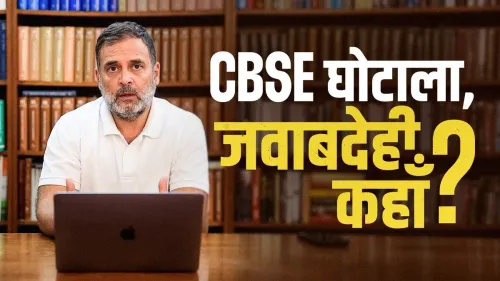
Congress leader Rahul Gandhi, Leader of the Opposition in Lok Sabha, on Wednesday, May 27, 2026, publicly challenged the Union Education Minister and CBSE to answer what he described as four unanswered questions, saying the futures of 18.5 lakh students had been put in jeopardy and that they deserved the truth.
Context
In a pointed post on X, Gandhi wrote: 'A denial is not an answer. Why are the Education Minister and CBSE unable to answer the four simple questions I have asked? The future of 18.5 lakh students have been put in jeopardy. They deserve the truth.' The post did not specify the four questions by name, but framed the government's response so far as evasion rather than clarification.
Gandhi has consistently used parliamentary and public platforms to raise accountability questions on education policy, particularly around examination processes and their impact on young students. The intervention follows what appears to be a prior round of questions he had already put to the Ministry, which he says received only a denial in response.
Policy Backdrop
The Central Board of Secondary Education conducts Class 10 and Class 12 examinations for over 20 lakh students annually, making its processes among the most consequential in Indian public administration. Any disruption — whether to examination schedules, result declarations, or assessment norms — directly affects the academic trajectories of millions of students and their families.
The National Education Policy 2020 introduced wide-ranging structural changes to board examinations, including new assessment patterns and multidisciplinary frameworks. These reforms have generated ongoing political debate about implementation timelines, transparency, and the readiness of students and institutions to absorb change.
Stakeholders and Impact
At the centre of Gandhi's concern are the 18.5 lakh students whose futures, he argues, are directly at stake. For students appearing in or awaiting results from board examinations, uncertainty around official processes can affect college admissions, scholarship eligibility, and career planning.
Opposition leaders have routinely pressed the Education Ministry on transparency around examination cycles, result declarations, and policy roll-outs. Gandhi's framing — that a denial is not an answer — signals that the Congress intends to sustain pressure on the Ministry until specific, substantive responses are provided. Parents, school administrators, and student advocacy groups are among those watching the Ministry's next move closely.
What's Next
The immediate focus shifts to the Union Education Ministry and CBSE, both of which now face public and political pressure to respond directly to Gandhi's questions. Any official clarification or parliamentary statement is likely to be scrutinised against the specific concerns Gandhi has raised.
With a parliamentary session on the horizon, the issue could be taken up on the floor of Lok Sabha, where Gandhi, as Leader of the Opposition, holds the institutional standing to demand a formal ministerial reply. The episode underscores a recurring pattern in Indian politics: education policy, particularly when it touches board examinations at scale, rapidly becomes a flashpoint between the government and the opposition.
Point of View
He shifts the burden of proof squarely onto the Ministry and CBSE, and positions the Congress as the defender of student interests. The invocation of 18.5 lakh students is politically significant — it transforms what could be a procedural dispute into a mass-stakes accountability moment. This fits a broader opposition pattern of using education as a wedge issue, particularly around board exam cycles when parental anxiety is highest. If the Ministry does not respond with specifics, the silence itself becomes the story heading into the next parliamentary session.
NationPress
15 Oct 2026
Frequently Asked Questions
What did Rahul Gandhi say about CBSE and the Education Minister?
Rahul Gandhi posted on May 27, 2026, accusing the Union Education Minister and CBSE of failing to answer four questions he had raised, saying the futures of 18.5 lakh students had been put in jeopardy.
How many students are affected according to Rahul Gandhi?
According to Gandhi's post, the futures of 18.5 lakh students have been put at risk, though the specific mechanism was not detailed in the post.
What are the four questions Rahul Gandhi asked CBSE?
Gandhi referred to four questions he had previously raised but did not enumerate them in this particular post; the specific questions have not been publicly detailed in available records.
What is CBSE and why does it matter?
The Central Board of Secondary Education is India's national board conducting Class 10 and Class 12 examinations for over 20 lakh students each year, making its processes central to millions of students' academic futures.
Can Rahul Gandhi raise this issue in Parliament?
Yes. As Leader of the Opposition in Lok Sabha, Gandhi has the institutional standing to demand a formal ministerial reply during a parliamentary session, and the issue is expected to be taken up if the Ministry does not respond publicly.