Rahul Gandhi flags CBSE marking row, targets Modi govt
Synopsis
Congress leader Rahul Gandhi targeted the Modi government on May 25, 2026, over alleged CBSE board examination irregularities, saying 18.5 lakh students' complaints about OSM errors and wrong marking had gone unheard for over a week while the Education Minister remained inactive.
Key Takeaways
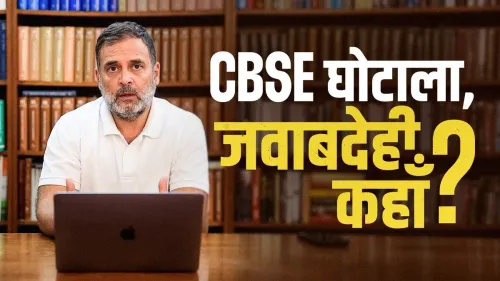
Rahul Gandhi accused the 'Modi-Pradhan duo' of turning CBSE into a symbol of fraud in a post on May 25, 2026 .
18.5 lakh (1.85 million) students appeared in the CBSE board examinations at the centre of the controversy.
Complaints about On-Screen Marking (OSM) , wrong marking, and evaluation discrepancies have reportedly remained unaddressed for over a week.
Dharmendra Pradhan , Union Education Minister, is the implied target of Gandhi's criticism over alleged ministerial inaction.
CBSE introduced OSM after 2017 to digitise evaluation; the system has faced recurring complaints across multiple examination cycles.
The issue is expected to feature in parliamentary questions during the upcoming Monsoon Session .
Congress leader Rahul Gandhi on Monday, May 25, 2026, launched a sharp attack on the Modi government over alleged irregularities in the CBSE board examinations, accusing the administration of turning yet another institution into a symbol of malpractice. Gandhi's post on X, directed at what he called the 'Modi-Pradhan duo,' came amid reported complaints from students and parents about On-Screen Marking (OSM) errors, wrong marking, and evaluation discrepancies in the board results.
Context
In his post, Gandhi wrote in Hindi: 'Modi-Pradhan ki jodi ne ek aur sanstha ko dhandli ka pratik bana diya' — translated as, 'The Modi-Pradhan duo has turned yet another institution into a symbol of fraud.' He noted that serious questions were being raised about the CBSE board examinations for the first time in decades, with 18.5 lakh (1.85 million) students having appeared for the exam. Gandhi alleged that complaints about OSM, wrong marking, and evaluation irregularities had gone unheard for over a week, and that the Education Minister remained unmoved from his chair — implying inaction.
The reference to 'Pradhan' is widely understood to point to Dharmendra Pradhan, the Union Education Minister who oversees school and higher education policy under the NDA government. Gandhi's framing positions the alleged examination lapses as part of a pattern of institutional erosion under the current administration.
Policy Backdrop
CBSE introduced On-Screen Marking (OSM) in phases after 2017 to digitise the evaluation of answer scripts, aiming to reduce human error and improve transparency. However, the shift to digital evaluation has also introduced new categories of complaints, including software errors, mismatched scripts, and incorrect tabulation of marks.
The board has faced examination integrity crises before — most notably in 2018, when paper leak incidents in Class 10 Mathematics and Class 12 Economics forced nationwide re-examinations and triggered parliamentary scrutiny. The National Education Policy 2020 subsequently called for a fundamental rethink of board examination patterns and assessment methods, though implementation has been incremental.
Stakeholders and Impact
The students most directly affected are the 18.5 lakh candidates who appeared in the examination cycle in question. For many, board results are the gateway to college admissions, competitive entrance examinations, and scholarship eligibility — making marking accuracy a high-stakes concern. Parents and student groups have reportedly been raising complaints for over a week without receiving satisfactory responses from the board or the ministry, according to Gandhi's post.
Opposition parties, including the Indian National Congress, have periodically used lapses in central educational institutions to build a broader narrative about governance failure. Gandhi's intervention raises the political profile of what might otherwise be treated as an administrative grievance, potentially forcing a parliamentary response when the Monsoon Session convenes.
What's Next
The Ministry of Education and CBSE are yet to issue a formal public response to the specific complaints raised. Pressure is likely to mount for the board to release a detailed statement on the OSM process, the volume of complaints received, and the redressal mechanism available to affected students.
With the Monsoon Session of Parliament approaching, questions on CBSE evaluation reforms and result declaration timelines are expected to feature prominently. If the ministry does not act, the issue could become a sustained Opposition flashpoint — drawing in student unions, state governments, and education policy advocates across the political spectrum.
Point of View
Framing CBSE's alleged evaluation failures as evidence of systemic institutional decay under the NDA government. By naming Education Minister Dharmendra Pradhan directly, the Congress leader personalises accountability in a way that is difficult for the ministry to deflect with bureaucratic responses. The post follows a well-established Opposition playbook of linking examination or institutional controversies to the broader 'institutions under siege' narrative. With 18.5 lakh students directly affected, the political cost of continued official silence is unusually high.
NationPress
12 Oct 2026
Frequently Asked Questions
What is Rahul Gandhi's complaint about CBSE board exams?
Rahul Gandhi alleged that complaints from students about On-Screen Marking errors, wrong marking, and evaluation irregularities in CBSE board examinations had gone unaddressed for over a week, while the Education Minister took no visible action.
What is CBSE On-Screen Marking (OSM)?
On-Screen Marking is a digital evaluation system introduced by CBSE in phases after 2017, where examiners assess scanned answer scripts on a computer screen rather than physical paper, intended to reduce human error and improve consistency.
How many students appeared in the CBSE exam in question?
According to Rahul Gandhi's post, 18.5 lakh (1.85 million) students appeared in the CBSE board examinations at the centre of the current controversy.
Who is Dharmendra Pradhan and what is his role in this controversy?
Dharmendra Pradhan is the Union Education Minister responsible for school and higher education policy. Gandhi's reference to the 'Modi-Pradhan duo' targets Pradhan for alleged inaction in addressing student complaints about CBSE evaluation.
Has CBSE faced exam controversies before?
Yes. In 2018, CBSE was at the centre of a major paper leak crisis in Class 10 Mathematics and Class 12 Economics, which led to nationwide re-examinations and parliamentary scrutiny of the board's security protocols.