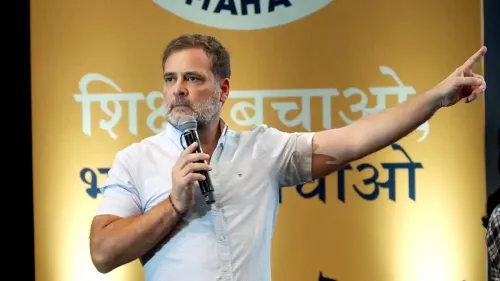
Rahul Gandhi calls India's education system a 'corrupt extortion racket'
Synopsis
Congress leader Rahul Gandhi on 13 July 2026 declared India's education system a 'dishonest extortion racket,' amplifying students' own words — corrupt, unjust, biased, dishonest — in a pointed attack on the institutional framework meant to secure children's futures.
Key Takeaways
Rahul Gandhi posted on 13 July 2026 calling India's education system 'corrupt, unjust, biased, and dishonest' — words he attributed to the country's students.
Gandhi described the system as 'a dishonest extortion racket' ( बेईमान वसूली तंत्र ), shifting the critique from individual exams to the entire institutional structure.
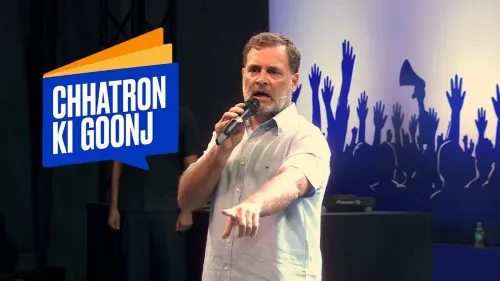
The post included a video , indicating a more detailed elaboration of his position beyond the text.
The critique aligns with a broader Congress opposition narrative linking education commercialisation and centralised testing failures to youth unemployment and social inequality.
India's education system is governed by the National Education Policy 2020 and the Right to Education Act 2009 , both of which have faced scrutiny over implementation and equitable access.
The post signals a potential sustained political campaign on education ahead of possible parliamentary debate on exam reforms and the education budget.
Congress leader Rahul Gandhi on Monday, 13 July 2026, launched a sharp attack on India's education system, calling it 'corrupt, unjust, biased, and dishonest' — words he said are being used by the country's students themselves. Gandhi, the Leader of the Opposition in Lok Sabha and MP from Rae Bareli, posted on X that the system meant to build children's futures has instead become, in his words, 'a dishonest extortion mechanism.'
Context
Gandhi's post, written in Hindi, opens by attributing four words to India's students: 'भ्रष्ट, अन्यायी, पक्षपाती, बेईमान' — 'corrupt, unjust, biased, dishonest.' He is explicit that these are not his own characterisations but a reflection of what students across the country are saying about the education system they navigate daily. The post includes a video, suggesting a more detailed elaboration of his critique.
Gandhi then states his own conclusion: that India's education system has now become 'एक बेईमान वसूली तंत्र' — 'a dishonest extortion racket.' The framing is pointed, targeting the institutional structure rather than any single examination or policy in isolation.
Policy Backdrop
India's education framework has undergone significant structural change in recent years. The National Education Policy (NEP) 2020 replaced a framework dating to 1986, introducing a 5+3+3+4 curricular design, multiple entry-exit options in higher education, and an emphasis on vocational training and digital infrastructure. Proponents argue it modernises a system long criticised for rote learning and rigid streams.
The Right to Education Act, 2009 had earlier mandated free and compulsory education for children aged 6 to 14, establishing a baseline guarantee. Critics, however, argue that implementation gaps, rising private-school fees, and the dominance of high-stakes centralised testing have eroded equitable access — particularly for students from non-urban and lower-income households.
Opposition leaders, including those from the Indian National Congress, have consistently framed education debates around commercialisation, the outsized influence of the coaching industry, and the unequal burden placed on families outside metropolitan centres. Gandhi's post fits squarely within this sustained political narrative.
Stakeholders and Impact
Students and parents are the most directly affected constituencies. Rising costs associated with private schooling, competitive examination coaching, and higher education fees have made education a significant household expenditure, particularly for middle- and lower-income families. Concerns about fairness in centralised testing mechanisms have added to a broader sense of institutional distrust among young people.
The critique also connects to the wider issue of youth unemployment and social mobility. When the education system is perceived as failing to deliver on its foundational promise — preparing children for productive futures — the downstream effects on employment, skill development, and social equity become politically salient. Gandhi's framing of the system as an 'extortion racket' is designed to sharpen that connection for a youth audience.
What's Next
Attention will turn to whether the Education Ministry responds to the Opposition's framing, particularly if parliamentary sessions provide a forum for debate on examination reforms or the education budget. Any regulatory bills touching on fee structures, centralised testing, or private-institution oversight are likely to become flashpoints.
Gandhi's post, accompanied by a video, suggests this may be the opening of a more sustained campaign on education. Whether the Indian National Congress formalises this into a policy position paper or a parliamentary motion will determine how much legislative traction the critique gains beyond social media.
Point of View
He pre-empts the charge of partisan hyperbole and grounds the critique in lived experience. The 'extortion racket' framing is the sharpest language the Congress leader has used on education, signalling an intent to move this issue from background grievance to front-line political contest. This fits a broader opposition strategy of linking institutional dysfunction — in education, employment, and health — into a unified narrative of governance failure targeting young voters. Whether the government engages substantively or dismisses the attack as rhetoric will shape how the debate develops in Parliament.
NationPress
12 Oct 2026
Frequently Asked Questions
What did Rahul Gandhi say about India's education system on 13 July 2026?
Rahul Gandhi called India's education system a 'dishonest extortion racket,' saying students across the country describe it as corrupt, unjust, biased, and dishonest. He posted this on X on 13 July 2026, along with a video elaborating his position.
Why is Rahul Gandhi criticising India's education system?
Gandhi's criticism centres on what he and the Congress opposition describe as the commercialisation of education, rising costs, and centralised testing failures that disproportionately affect students from non-urban and lower-income families. He argues the system has abandoned its core purpose of preparing children for the future.
What is the National Education Policy 2020 and why is it controversial?
The National Education Policy 2020 is India's overarching education framework, replacing a 1986 policy. It introduced a 5+3+3+4 curricular structure and multiple entry-exit options in higher education. Critics, including opposition leaders, argue it has not addressed commercialisation or equitable access, particularly for students outside major cities.
What does 'bhrashtachar in education' mean for Indian students?
In the current political discourse, corruption in education refers to perceived unfairness in centralised examinations, the high cost of coaching and private schooling, and institutional bias that disadvantages students from poorer or rural backgrounds. Gandhi's post channels these concerns into a direct political indictment of the system.
Will this lead to a parliamentary debate on education in India?
Gandhi's post, accompanied by a video, suggests the Congress party may be building toward a formal parliamentary push on education reform. Any upcoming session debate on the education budget or examination regulation bills is likely to become a flashpoint for this critique.