Rahul Gandhi flags CBSE tender manipulation claim by teen blogger

Synopsis
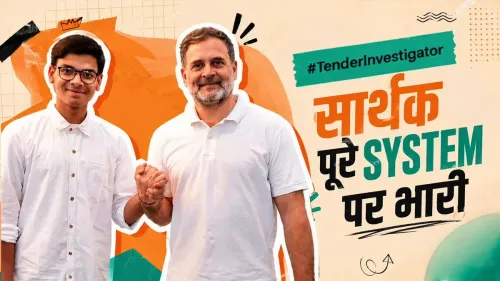
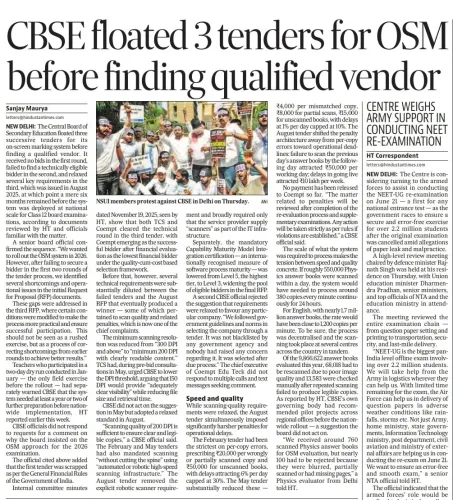
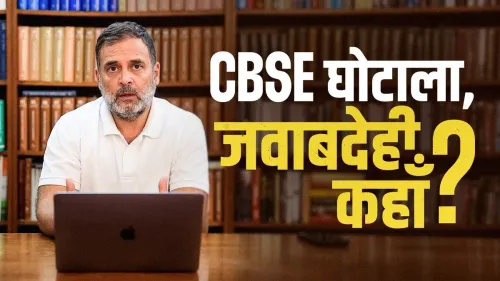
Congress leader Rahul Gandhi has amplified claims by 17-year-old blogger Sarthak Sidhant that CBSE manipulated its own Request for Proposal process to favour COEMPT over TCS, citing the board's own documents as evidence of the alleged irregularity.
Key Takeaways
Rahul Gandhi on 29 May 2026 shared allegations that CBSE manipulated its procurement process.
A 17-year-old blogger, Sarthak Sidhant , is credited with the expose, using CBSE's own documents.
The allegation centres on changes to an RFP (Request for Proposal) that allegedly benefited COEMPT at the cost of TCS .
The background of COEMPT and specific RFP details remain unverified by independent sources.
The development may prompt parliamentary questions, RTI filings, or a formal response from CBSE or the Ministry of Education .
Congress leader Rahul Gandhi on Friday, 29 May 2026 shared allegations by a 17-year-old blogger, Sarthak Sidhant, who claims to have used CBSE's own documents to expose how the board allegedly manipulated its procurement process to favour a company called COEMPT, at the expense of Tata Consultancy Services (TCS).
Context
Gandhi, posting on X, stated that Sidhant's blog 'reveal[s] how CBSE changed the RFP to unduly benefit COEMPT, at the cost of TCS.' He added that the blogger 'has revealed the hollowness of' the process — the post appearing to be cut off mid-sentence. The claim centres on alleged changes to a Request for Proposal (RFP), a formal procurement document through which government bodies invite bids from vendors for contracts.
The Central Board of Secondary Education is India's apex school board, overseeing curriculum and examinations for thousands of affiliated schools. Procurement decisions by CBSE, particularly for large-scale technology or examination services, carry significant financial and administrative weight.
Policy Backdrop
Government technology tenders — especially those involving examination boards and education infrastructure — have periodically attracted disputes between competing IT vendors in India. Opposition leaders have increasingly used social media to flag alleged irregularities in public procurement, often preceding formal parliamentary questions or Right to Information (RTI) filings.
TCS, one of India's largest IT services firms, has participated in multiple government technology contracts over the years. The identity and background of COEMPT — the company alleged to have benefited from the RFP changes — could not be independently verified at the time of publication.
Stakeholders and Impact
If the allegations are substantiated, the implications would extend beyond a single contract. A manipulated RFP process at a national education board would raise questions about procurement integrity in India's public education technology sector, affecting competing IT service firms and the credibility of CBSE's administrative processes.
For students and schools affiliated with CBSE — numbering in the tens of thousands across India — the integrity of the board's vendor-selection processes directly affects the quality and reliability of examination and administrative services they receive. Civil society groups and parliamentary committees focused on education accountability are likely stakeholders in any follow-up.
What's Next
Gandhi's post is likely to invite a formal response from CBSE or the Ministry of Education. Parliamentary questions or an RTI application seeking details of the specific RFP and its revisions would be a natural next step for the opposition. Whether Sidhant's blog documentation will be placed before any regulatory or oversight body remains to be seen.
The episode underscores a growing pattern of citizen-led procurement scrutiny in India, where publicly available government documents are increasingly used to challenge official processes — and where social media amplification by prominent political figures can rapidly elevate such claims into the national conversation.
Point of View
Lending them greater credibility. The CBSE-COEMPT-TCS triangle, if substantiated, would represent a significant governance failure at one of India's most consequential public institutions. This episode fits a broader pattern of opposition leaders using social media to set the agenda ahead of parliamentary sessions, forcing government ministries onto the defensive. The unverified status of key details, however, means the story's trajectory depends heavily on whether formal oversight mechanisms — RTI, parliamentary committees, or a CBSE audit — are invoked.
NationPress
12 Oct 2026
Frequently Asked Questions
What did Rahul Gandhi say about CBSE and COEMPT?
Rahul Gandhi shared claims by blogger Sarthak Sidhant that CBSE altered its Request for Proposal to unduly benefit a company called COEMPT, at the expense of TCS, using CBSE's own documents as evidence.
Who is Sarthak Sidhant?
Sarthak Sidhant is identified in Rahul Gandhi's post as a 17-year-old who published a blog alleging CBSE manipulated its vendor selection process, though his background has not been independently verified.
What is an RFP and why does it matter in this case?
An RFP, or Request for Proposal, is a formal document through which government bodies invite bids from vendors. Allegations that CBSE changed the RFP mid-process to favour one bidder would, if true, indicate a serious breach of procurement integrity.
What is COEMPT and what is its connection to CBSE?
COEMPT is named in the allegations as the company that allegedly benefited from changes to CBSE's RFP. Its full background and the nature of its contract with CBSE could not be independently verified at the time of publication.
What could happen next in the CBSE tender controversy?
The allegations are likely to prompt parliamentary questions, RTI applications seeking details of the RFP, and possibly a formal clarification from CBSE or the Ministry of Education.