Nvidia Touts Unified Inference Stack for Compounding AI Gains
Synopsis
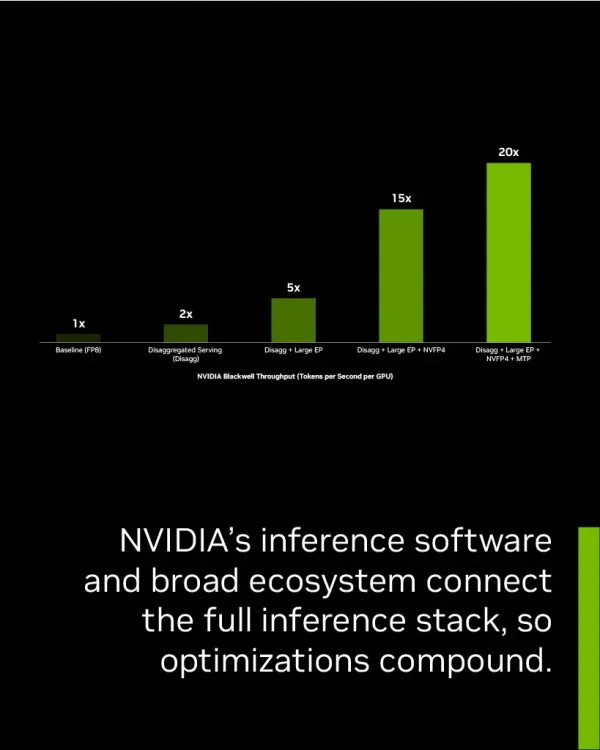
Nvidia's corporate account on 13 July 2026 detailed how four inference technologies — disaggregated serving, NVLink-scale expert parallelism, NVFP4 precision, and multi-token prediction — compound when run as a unified system, reinforcing the company's full-stack AI infrastructure strategy against custom ASIC rivals.
Key Takeaways
Nvidia posted on 13 July 2026 that its full inference stack produces compounding gains when all components work together.
Four specific techniques were cited: disaggregated serving , large expert parallelism over NVLink , NVFP4 precision, and multi-token prediction .
Each technique delivers 'meaningful gains on their own,' but the combined system-level effect is greater than the sum of parts.
NVLink interconnect is central to enabling large expert parallelism across GPU clusters at hyperscale.
The strategy directly counters custom AI accelerators built by major cloud providers by emphasising system-level, compounding advantages.
Technical benchmarks and papers linked in the post are expected to provide further evidence for the compounding-gains claim.
Chip giant Nvidia on Monday, 13 July 2026 outlined how combining its full inference stack into a single coordinated system produces performance gains that exceed what any individual optimisation can deliver alone, sharing details via its official corporate account on X.
Context
In the post, Nvidia highlighted four specific technologies — disaggregated serving, large expert parallelism over NVLink interconnect, NVFP4 precision, and multi-token prediction — each described as delivering 'meaningful gains on their own.' The core claim is that when these techniques operate as a unified system, their benefits compound rather than simply add. The company linked to additional technical material to support the assertion.
The framing reflects a deliberate full-stack philosophy: rather than selling discrete hardware or software improvements, Nvidia is positioning its ecosystem as a system where every layer reinforces the others. This is consistent with the company's trajectory since the launch of its Hopper architecture and Transformer Engine in 2022, which introduced mixed-precision support for transformer-based AI models.
Policy Backdrop
Nvidia introduced its Blackwell GPU generation in 2024 with a stated emphasis on inference throughput and hardware-software co-design. The current messaging around disaggregated serving and NVLink-scale expert parallelism extends that strategy into deployment-time efficiency, not just training speed. NVLink, the company's high-bandwidth interconnect, was originally designed to connect multiple GPUs within servers; it has since become central to scaling AI compute clusters at hyperscale.
NVFP4 precision refers to a reduced-precision numerical format aimed at accelerating inference while limiting accuracy loss — a technique that has become strategically important as model sizes grow and inference costs become a primary concern for operators. Multi-token prediction, meanwhile, allows models to generate more than one output token per forward pass, directly improving throughput.
Stakeholders and Impact
The primary audience for these optimisations is AI developers and hyperscale cloud operators — the companies running large language models and other foundation models at scale. For these operators, inference efficiency translates directly into cost per query, which in turn affects the economics of deploying AI products to end users.
The announcement also carries competitive significance. Nvidia faces growing pressure from custom AI accelerators developed internally by major cloud providers. By demonstrating that its full stack — interconnects, numerical formats, serving infrastructure, and decoding strategies — produces compounding gains, the company is making a case that vertically integrated, purpose-built alternatives cannot easily replicate its system-level advantages.
What's Next
Attention will turn to any technical benchmarks or research papers Nvidia releases alongside the linked content, which would allow independent verification of the compounding-gains claim. Analysts and AI infrastructure teams will be watching whether these techniques translate into measurable reductions in cost-per-token at production scale. The rollout of next-generation platforms that natively integrate all four techniques will be the clearest test of whether the full-stack thesis holds under real-world workloads.
Point of View
NVFP4, disaggregated serving, and multi-token prediction as mutually reinforcing, Nvidia is arguing that system-level lock-in produces value no single-layer rival can match. This narrative is increasingly important as inference costs, not training costs, become the dominant economic variable in AI deployment. If independent benchmarks validate the compounding claim, it strengthens Nvidia's hand in enterprise and hyperscale procurement cycles through 2026 and beyond.
NationPress
14 Jul 2026
Frequently Asked Questions
What is Nvidia's full inference stack?
Nvidia's full inference stack refers to the integrated combination of hardware and software components — including NVLink interconnects, NVFP4 numerical precision, disaggregated serving architecture, and multi-token prediction — that work together to accelerate AI model inference beyond what any single component achieves alone.
What is NVFP4 precision in Nvidia GPUs?
NVFP4 is a reduced-precision numerical format used during AI inference that lowers computational cost and memory bandwidth requirements while aiming to preserve model accuracy, making large-model deployment more economical at scale.
How does NVLink help with AI inference?
NVLink is Nvidia's high-bandwidth chip-to-chip interconnect that enables fast data transfer between multiple GPUs, which is critical for techniques like large expert parallelism where different parts of a model run simultaneously across many accelerators.
What is disaggregated serving in AI?
Disaggregated serving separates the prefill and decode phases of AI inference across different hardware resources, improving overall throughput and resource utilisation for large language model deployments.
Why is Nvidia focused on inference efficiency in 2026?
As AI model sizes grow, the cost of running inference — generating responses for users — has become the primary operational expense for cloud operators and AI companies, making inference efficiency a key competitive and commercial battleground for chip and infrastructure providers.