Rahul Gandhi Flags Alleged CBSE OSM Tender Irregularities
Synopsis
Congress leader Rahul Gandhi has alleged that CBSE progressively lowered technical standards across three OSM tender rounds — scrapping robotic scanner and CMMI requirements and cutting scanning resolution — until a single firm, COEMPT, could qualify, raising procurement governance concerns for India's board exam system.
Key Takeaways
CBSE floated the On-Screen Marking (OSM) tender at least three times , according to Rahul Gandhi's post.
The first round drew zero bids ; the second produced no qualified bidder .
Gandhi alleges technical standards were lowered — including cuts to scanning resolution , removal of the robotic scanner requirement , and relaxation of CMMI certification norms — before the third round.
A firm identified as COEMPT is alleged to have qualified only after these relaxations.
CBSE's OSM system affects millions of Class 10 and Class 12 students whose answer scripts are evaluated digitally.
The matter may be raised in the Parliament Monsoon Session and could attract CAG scrutiny.
Congress leader and Leader of the Opposition in Lok Sabha Rahul Gandhi on Friday, May 29, 2026, raised serious questions about the procurement process followed by the Central Board of Secondary Education (CBSE) for its On-Screen Marking (OSM) system, alleging that technical eligibility standards were progressively lowered across three tender rounds until a single firm could qualify.
Context
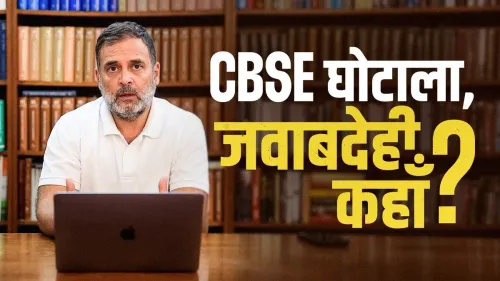
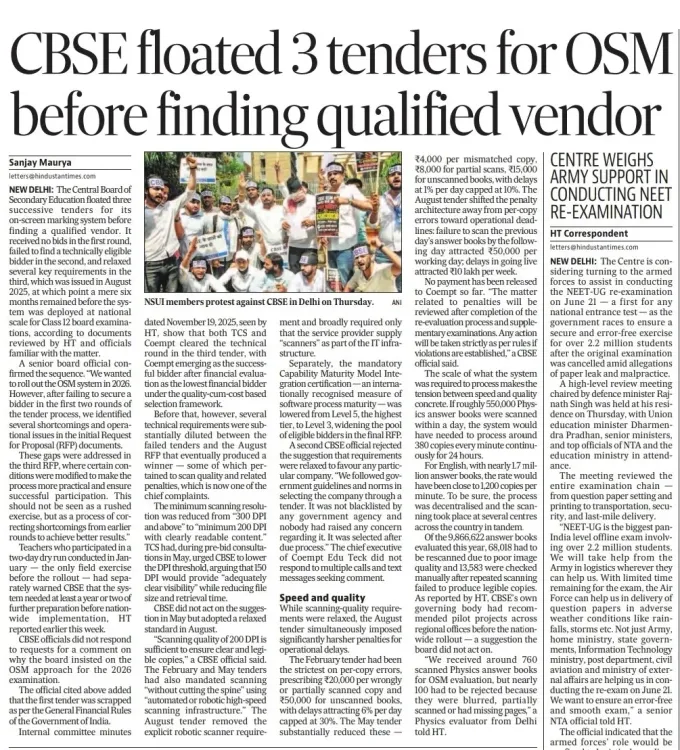
In a post on X, Gandhi urged followers to read the account of the CBSE OSM tender process 'carefully.' He alleged that CBSE floated the tender three times: the first round drew zero bids, the second produced no qualified bidder, and by the third round, the technical bar had been reduced until a firm identified as COEMPT could clear it. Gandhi specifically cited a cut in scanning resolution, the dropping of a robotic scanner requirement, and a relaxation of CMMI (Capability Maturity Model Integration) certification standards as examples of the alleged dilution.
The post was accompanied by an image, the contents of which appear to document the tender sequence. Gandhi did not name a ministry official or provide tender reference numbers in the public post itself.
Policy Backdrop
CBSE began piloting On-Screen Marking for select Class 10 and Class 12 subjects from 2013 onward, as part of a broader shift toward digitised, paperless evaluation of high-stakes board examinations. The system involves scanning physical answer scripts and having evaluators mark them on-screen, reducing manual handling and aiming to improve consistency and transparency.
Public procurement for scanning and evaluation technology has drawn scrutiny in the past across multiple government digitisation initiatives. Allegations that eligibility criteria are adjusted mid-process — through successive re-tenders — have surfaced in other document-management and e-governance contracts in the education sector as well. Technical benchmarks such as scanning resolution and CMMI certification levels are standard quality markers in such procurements, and their relaxation in successive rounds can attract questions about competitive fairness.
Stakeholders and Impact
The OSM system directly affects millions of Class 10 and Class 12 students whose answer sheets are evaluated through the platform, as well as the tens of thousands of evaluators who use it. The integrity and technical robustness of the scanning and marking infrastructure has a direct bearing on result accuracy and the credibility of one of India's most consequential public examinations.
Vendors in the education-technology and document-management space also have a stake: procurement norms that shift between tender rounds raise questions about a level playing field. The Ministry of Education, which oversees CBSE, will face pressure to clarify the rationale for any changes in technical specifications across the tender rounds Gandhi has described.
What's Next
The allegations are likely to prompt demands for official disclosure of the tender documents and a formal response from CBSE or the Ministry of Education. With the Parliament Monsoon Session approaching, opposition members may raise the matter through questions or adjournment motions on the floor of the House. Observations by the Comptroller and Auditor General (CAG) on examination-digitisation expenditure, if any, could add further weight to the scrutiny. Gandhi's post, framed as a call to read a documented account rather than a direct allegation, signals a sustained opposition focus on procurement governance in the education sector.
Point of View
Two areas where the opposition has consistently sought to highlight process lapses under the current government. If the tender documents corroborate the sequence Gandhi describes, the Ministry of Education will face a difficult choice between defending the procurement process and ordering a review. The episode also reflects a broader pattern in which high-stakes government digitisation contracts attract questions about whether technical criteria are calibrated to outcomes rather than open competition.
NationPress
14 Oct 2026
Frequently Asked Questions
What is CBSE OSM and why does it matter?
CBSE's On-Screen Marking (OSM) system digitises the evaluation of Class 10 and Class 12 board exam answer scripts by scanning them and allowing examiners to mark on-screen. It directly affects the accuracy and credibility of results for millions of students across India.
What did Rahul Gandhi allege about the CBSE OSM tender?
Rahul Gandhi alleged that CBSE floated the OSM tender three times, and that technical standards — including scanning resolution, robotic scanner requirements, and CMMI certification levels — were progressively lowered until a firm called COEMPT could qualify.
What is CMMI certification and why is it relevant to this tender?
CMMI (Capability Maturity Model Integration) is an internationally recognised benchmark for process maturity in software and technology organisations. Its inclusion or removal as an eligibility criterion in a government technology tender is a significant indicator of the technical bar being set for bidders.
What action could follow Rahul Gandhi's allegations against CBSE?
The allegations could lead to parliamentary questions during the Monsoon Session, demands for public disclosure of tender documents, a formal response from CBSE or the Ministry of Education, and potentially a CAG audit of the OSM procurement.
Has CBSE responded to the OSM tender allegations?
As of the time of this report, no official response from CBSE or the Ministry of Education to Gandhi's specific allegations has been made public.